
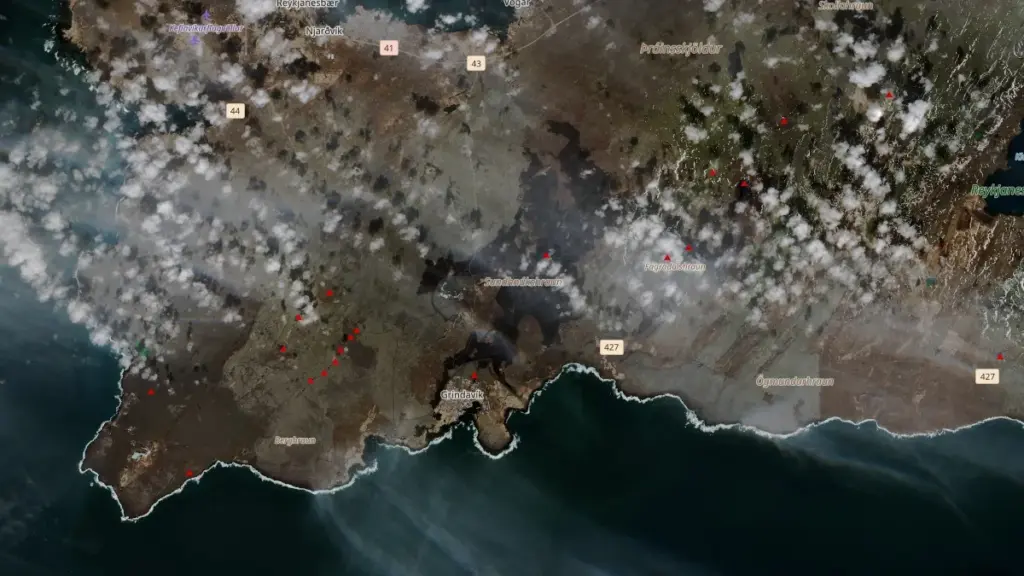
IMO said magma accumulation beneath Svartsengi remains slow but steady, with continued deformation in the volcanic system on the Reykjanes Peninsula. Model calculations show that more than 25 million m³ of magma has accumulated beneath the area since the July 2025 eruption. This is the largest volume measured since the eruptions began on the Sundhnúkur crater row.
Rising pressure in the system keeps dike propagation from Svartsengi toward the Sundhnúkur crater row as the most likely scenario. Based on previous events in the area, warning times before a new dike intrusion or eruption should be expected to remain short, ranging from 20 minutes to just over 4 hours.
Seismic activity near the dike region remains low, although there was a slight increase over the past two weeks, with most earthquakes below M1.
A recent InSAR image covering March 16 to April 18, 2026, shows clear uplift in the Svartsengi region but no deformation elsewhere on the Reykjanes Peninsula during that period.
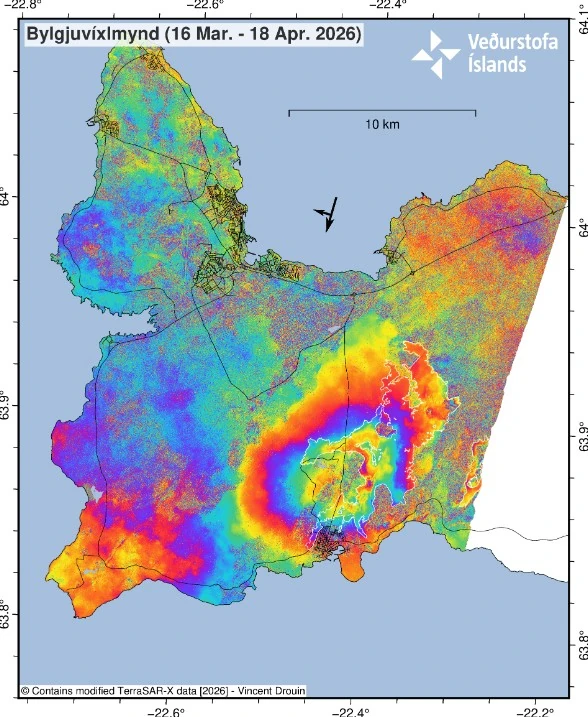 InSAR image covering the period March 16 – April 18, 2026, showing uplift at Svartsengi. The white contours identify the emplaced lava fields from previous eruptions in the Sundhnúks crater row. Credit: IMO
Model calculations, based in part on measurements of ground uplift, show that the rate of magma accumulation beneath Svartsengi has never been slower.
“The fact that magma accumulation has never been slower, while the amount of magma beneath Svartsengi has never been greater between eruptions, increases the uncertainty about developments in the area,” IMO said.
Slow magma accumulation is not a clear indication that an eruption will not occur. The most immediate example of this is the Krafla Fires eruption sequence from 1975 to 1984.
During the period from November 1981 to August 1984, the rate of magma inflow beneath Krafla decreased significantly. Despite the slow rate of magma accumulation for nearly three years, an eruption eventually occurred in August 1984, which was also the largest eruption of the Krafla Fires. Following the last eruption, continued ground uplift was measured until 1989, without culminating in an eruption.
Although there are fundamental differences between Krafla and the volcanic systems on the Reykjanes Peninsula, the comparison suggests that magma accumulation beneath Svartsengi could continue for several years and that the possibility of a new eruption remains.
“As long as magma accumulation continues, a magma intrusion and eruption on the Sundhnúkur crater row remains the most likely scenario,” IMO said on March 31. “Because the amount of magma beneath Svartsengi is now greater than before, it is possible that the next eruption could be larger than previous ones, if the magma reaches the surface in part or in full.”
No data indicate that the eruption sequence on the Sundhnúkur crater row is coming to an end, and the Reykjanes-Svartsengi volcanic system remains at Volcano Alert Level 2, “Heightened Unrest” (orange), as issued by the Icelandic Meteorological Office.
The hazard assessment remains unchanged and valid until June 30, 2026.
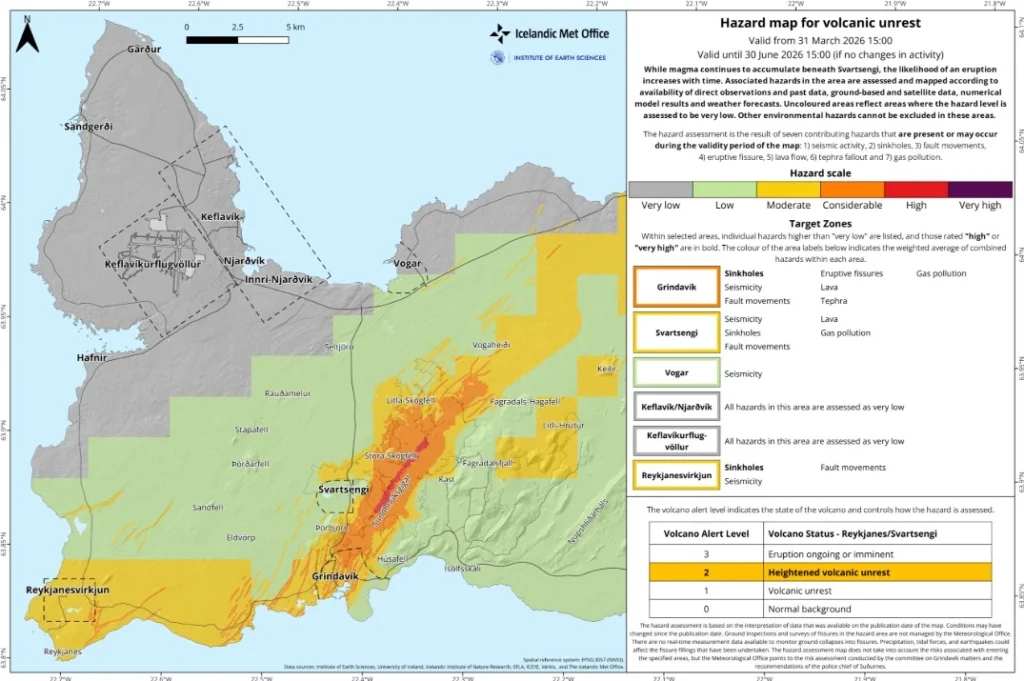 Image credit: IMO
The Svartsengi unrest is part of the Sundhnúkur crater row eruption sequence, which began in late 2023. IMO’s earlier updates reported continued recharge beneath Svartsengi after the July 2025 eruption, with the accumulated volume rising through early 2026 before exceeding 25 million m³ at the end of April.
References:
1 Ground uplift and magma accumulation continue beneath Svartsengi – IMO – April 28, 2026