
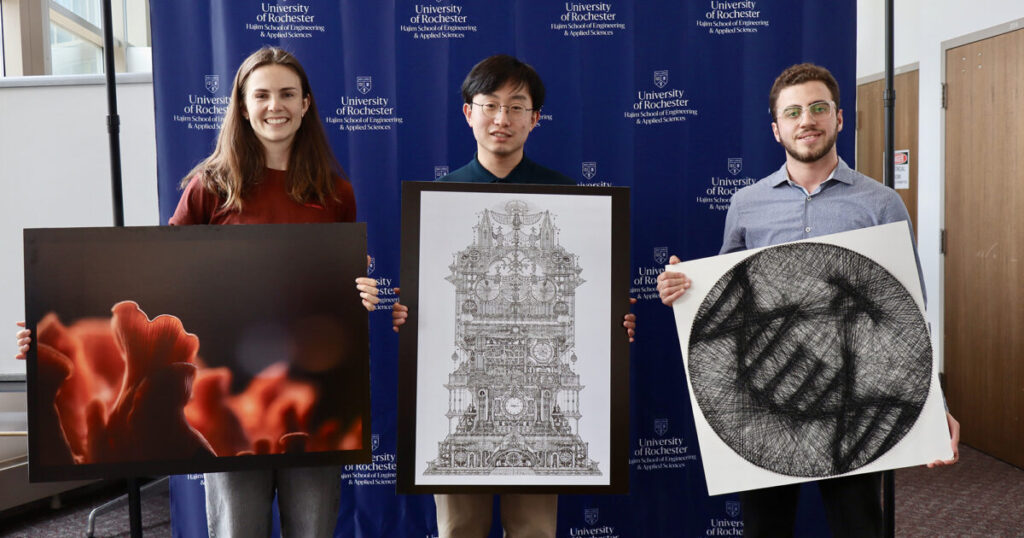
More than 50 students, faculty, and staff submitted artwork in the 2026 Ed and Barbara Hajim Art of Science Competition, the University of Rochester’s annual contest to explore and illuminate the aesthetic beauty that results when science, art, and technology intersect. Three winning entries will be permanently displayed in the Carlson Library.
Held each spring, the competition is sponsored by the Hajim School of Engineering & Applied Sciences in collaboration with River Campus Libraries and supported through an endowed fund established by Trustee Emeritus Ed Hajim ’58 and his wife Barbara. Prizes are awarded for the top student submissions and for the People’s Choice Award, with more than 500 members of the URochester community casting votes.
First Place and People’s Choice Award
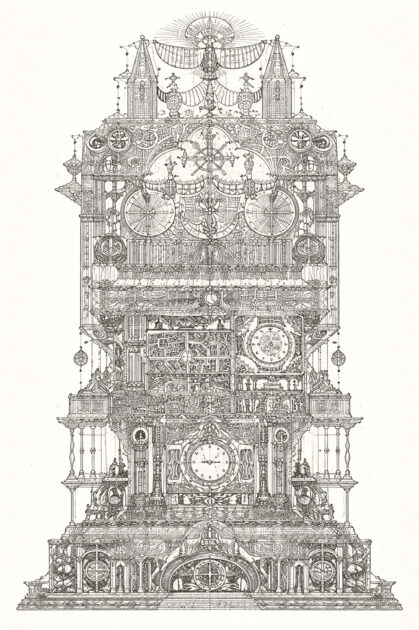 The Architecture of Knowledge by Matthew Ahn ’28
For the second consecutive year, the judges and the URochester community voters selected the same top entry. Political science student Matthew Ahn ’28 took home both first place and the People’s Choice Award—totaling $1,250—for his hand-drawn ink illustration titled The Architecture of Knowledge. Ahn says his ornate artwork featuring clocks, mechanical systems, geometric networks, and symbolic forms is intended to represent the structural layers of scientific discovery.
“The lower sections evoke instruments used to measure time and motion, while the upper sections introduce increasingly complex geometric and interconnected systems,” he says. “Each layer reflects how scientific knowledge builds progressively upon previous discoveries. The symmetry and intricate patterns invite viewers to explore the drawing at multiple scales, revealing new details much like scientific observation itself.”
Second Place
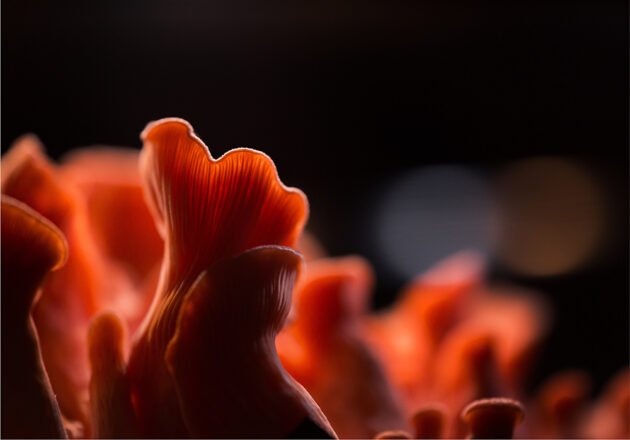 Luminous Gills by PhD student Meg Farinsky
Physics PhD student Meg Farinsky was the runner-up with Luminous Gills, her macro photograph of the gills on the underside of a pink oyster mushroom illuminated by grow lights. She photographed the home-grown culinary mushrooms using a 100 mm Rokinon macro lens on a Canon 5D Mark III camera.
“Mushrooms—pink oysters in particular—are attracting a lot of scientific interest right now,” says Farinsky. “They’re being studied for applications in bioremediation and plastic degradation, sustainable food, and material production, and electrical signaling in fungal networks that resembles neural activity. Beyond their scientific relevance, their glowing gills and sculptural forms make them naturally compelling visual subjects.”
Third Place
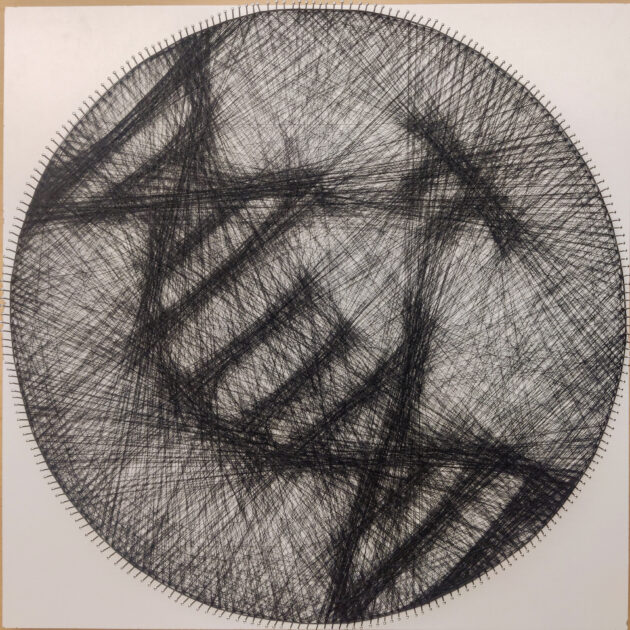 Strings of Life by Majd Tabsi ’29
Majd Tabsi ’29, a biomedical engineering major, earned a place on the podium with Strings of Life—a creative representation of DNA and gene editing using about a mile of string. Tabsi sketched a design and input it into software called MyZigzagArt, which uses an algorithm to generate a sequence of string passes to create a representation of the sketch. He made a circle of 250 nails on a 2 x 2 foot piece of wood and, over the course of 30 hours, made 2,500 string passes from one nail to another to produce the final artwork.
“Humanity has always wondered about how life is created and how traits are passed,” says Tabsi. “Mendel’s discovery of the laws of heredity started the ever-growing field of genetics. We later learned about the smallest strings that hold the keys to our evolution and the continuity of life—DNA, or what my work calls ‘Strings of Life.’ We sought to map them, understand their construction, and even started trying to edit them using tools like CRISPR-Cas9, which is what the separated gene in my work refers to. Tools like these raise a variety of questions around the ethicality and the limitations of usage. But they also show what humanity is capable of. And the question remains: What will we do next?”