
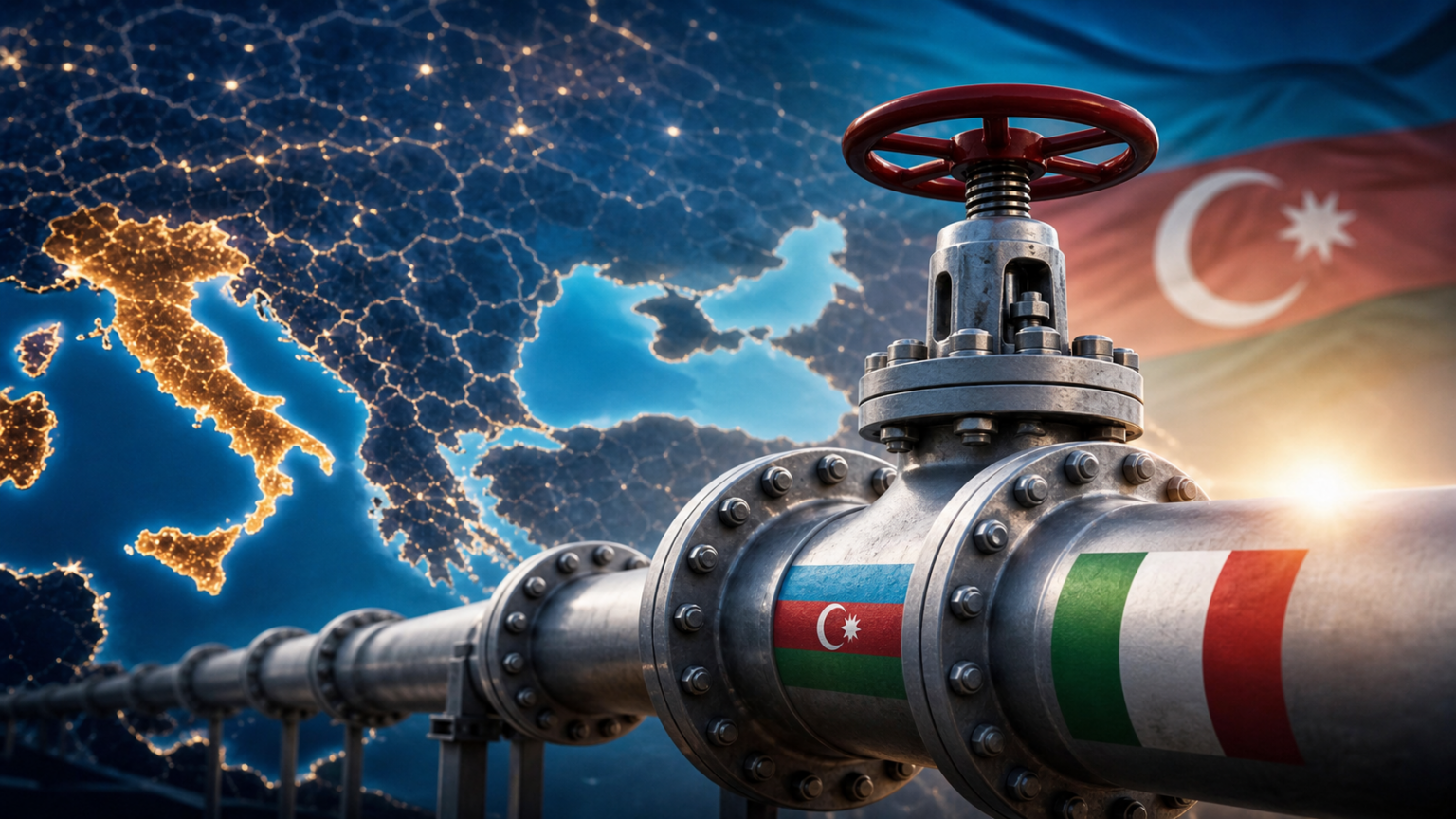

In the early hours of Monday, 5 May, Italy’s Prime Minister
Giorgia Meloni will board a flight from Yerevan, where she will
participate in the European Political Community summit the day
before, to Baku (or maybe Gabala) for a one-day bilateral meeting
with Azerbaijan’s President Ilham Aliyev. This timing was
deliberate. The EPC summit in Yerevan on 4 May is a multilateral
forum of Europe. But the visit to Baku on 5 May is where Italy
conducts its actual energy interests. In an interview with La
Repubblica this week, Elchin Amirbayov, Azerbaijan President’s
Representative for Foreign Policy, noted: “This visit confirms that
we consider there is considerable potential for enhancing
cooperation in various fields, starting with energy, which Italy
represents for us as a main partner.” That visit, he could have
added, is being made because the pipeline between them is full, and
Europe does not want it to be.
In 2025, the Trans Adriatic Pipeline delivered 9.5 billion cubic
metres of natural gas from Azerbaijan to Italy – accounting for
roughly 16 percent of Italy’s total annual gas consumption
requirements, the grid operator of Italy. In less than five years,
it has become one of the fastest-ramping new energy infrastructures
in Europe, having already supplied more than 47.5 billion cubic
metres of natural gas since starting commercial operations in
November 2020. Following the completion of its first expansion
phase, initiated due to the market test in 2021, TAP has been
operating at an increased capacity of 11.2 bcm per year through the
installation of a compressor station with a power capacity of 15
megawatts at the Kipoi facility located close to the Turkish-Greek
border. Of this extra 1.2 bcm, one billion cubic metres will go to
Italy, and the remaining 200 million cubic metres will be delivered
to Albania. For the first time, natural gas is being transported
northward to Austria and Germany through the new Caspian
Corridor.
Capacity challenge
TAP’s expansion objective was built to accommodate volumes of up
to 20 billion cubic meters per year, double its design throughput.
The European Union and Azerbaijan committed to expanding the
Southern Gas Corridor in a Memorandum of Understanding reached in
July 2022, aiming for an increase in supplies to the EU to at least
20 bcm per year, with 2027 being the proposed deadline. This goal
has proven elusive thus far; the first step towards the expansion
to 11.2 bcm involved a market test back in 2021, and the increased
capacity became available in January 2026. Another expansion phase
– one that might materialize as early as late 2027, which hinges on
yet another market test resulting in sufficient demand guarantees
from shippers.
Expanding TAP from 11.2 bcm to 20 bcm requires the construction
of two entirely new compressor stations, one in Greece and one in
Albania, plus additional compressor units at existing stations. The
pipeline’s route through northern Greece and mountainous Albania
means these are not trivial civil engineering projects. The cost of
full expansion to 20 bcm is estimated by TAP AG at several hundred
million euros, though a precise figure has not been disclosed
publicly. Beyond the pipeline itself, full expansion also requires
upstream investment to increase production at Shah Deniz and
potentially other Azerbaijani fields, investment that SOCAR and bp
must commit to before additional volumes can be guaranteed to
European shippers. Amirbayov said this week with notable frankness:
“Any further increase in exported gas volumes will require
additional upstream investments in development and pipeline
capacity.” That is not a technical caveat. It is a negotiating
position ahead of Tuesday’s meeting.
So, currently, both Phase – 0 and Phase – 1 expansions are
operational. Further Phase 2, i.e., the second expansion, is under
consideration; further increase can be up to 20 bcm. It will
involve the construction of new compressor stations in Greece and
Albania, as well as additional compressor stations in existing
compressor stations. The implementation will depend on the results
of the market test in 2023; the earliest possible realization will
take place in late 2027.
Full capacity – ceiling 20 bcm/year, which represents double the
original capacity. It includes full expansion of compressor station
facilities and upstream operations at Shah Deniz/new fields.
Enter Meloni
All that said, here comes Italian PM Meloni’s trip, which
amplifies Rome’s leverage. Italy, in the last two years, has
managed to quietly convert itself from being a gas consumer to
being a gas transit country. Beginning from January 2026,
Azerbaijani gas has started to flow north through Italy to Austria
and Germany – an economic relationship that seemed unlikely to even
occur by 2021, when Germany still relied on gas transported through
Russia and did not really have a need to turn south for gas from
the Caspian. The war in Iran has made it possible for every
European government at once.
For Rome, however, this development has very clear political
implications as well. In other words, not only does Italy now
import Caspian gas from Azerbaijan, but, at the same time, it is
the gateway to this gas supply for the entire continent of Europe.
Perhaps, every strategic lever in the Caucasus is also a new
exposure. With increased significance for Italy in continental
energy infrastructure comes increased vulnerability to threats to
the energy corridor from the TAP, as well as from the possibility
of geopolitical tensions, technical disruptions, and even possible
legal challenges. To be sure, there has been a legal challenge
filed against TAP AG in Lecce, Italy, on the grounds of an
environmental violation by TAP AG during the process of pipeline
construction, a case still pending since 2020.
There is also the broader picture, one beyond the gas contracts
– renewable energy. For instance, Ansaldo Energia is tied to the
modernisation of Azerbaijan’s Mingachevir power plant, the
country’s largest electricity generation facility. Back in 2024,
during Baku Energy Week, I had the chance of encountring with CEO
of the company, Fabrizio Fabbri. He disclosed the company’s
ambitious plans for the installation of a highly efficient power
plant in Mingachevir, Azerbaijan. Highlighting the environmental
impact, Fabbri emphasized, “Compared with the current power plant,
we’re going to increase the efficiency from 38 to 56%, saving the
emission of 2 million tons of CO2 per year and 800 million cubic
meters of gas for the country.”
A year later, in June 2025, the inauguration ceremony took
place. Ansaldo Energia supplied four advanced AE94.3A gas turbines
and four generators for this landmark installation. The AE94.3A gas
turbine stands out for its outstanding operational flexibility,
proven reliability, and cost-effectiveness. The plant enables a
significant reduction of CO2 emissions and an important saving of
natural gas consumption. This facility, which has an energy
capacity of 2,000 megawatts, will reduce emissions into the air by
50 percent compared to the past. The capacity of the power plant is
1,880 megawatts.
In terms of improving ties between Italy and Azerbaijan, during
the January 2026 meeting of the intergovernmental commission,
chaired by Deputy Minister Edmondo Cirielli, the Joint Action Plan
for 2026-27 was devised, comprising 65 activities in 18 sectors,
including energy, infrastructure, space technology, agribusiness,
tourism, customs, and humanitarian demining. The involvement of
humanitarian demining in this list deserves attention because Italy
has considerable experience in clearing mines after wars, which
will be relevant to the Azerbaijani programme for the
reconstruction of Karabakh, where explosive munitions hinder the
Great Return programme.
For the visit to advance the energy relationship substantively,
it must achieve three specific things. Firstly, a political
indication as to whether Azerbaijan will be able to make the
downstream investment commitment for Shah Deniz and possibly the
Absheron field, which can ensure the supply volumes required to
make the compressor station investment in Greece and Albania
worthwhile. Without such a political commitment for upstream
investments, there is no need for an expanded pipeline network,
which means that TAP has nothing to transport through its pipeline.
Secondly, a timeline for the talks for the EU-Azerbaijan bilateral
agreement which would put the energy cooperation into a greater
legal context, establishing the regulatory dialogue necessary to
expand TAP’s activities.
It is rare for the geopolitics to align so perfectly for all
three to progress. The Iran War has increased the value of Caspian
supplies to levels never before seen since the Russian invasion of
Ukraine in 2022. The Hormuz embargo has forced Europeans to
consider diversifying their sources of supply in ways that would
have taken months of reports and planning to achieve. Azerbaijan’s
position as a neutral nation, maintaining links with Israel, Iran,
Russia, and the EU, while remaining uninvolved in the associated
conflicts, has actually been a source of stability amid
instability.
*the image is generated by artificial intelligence