
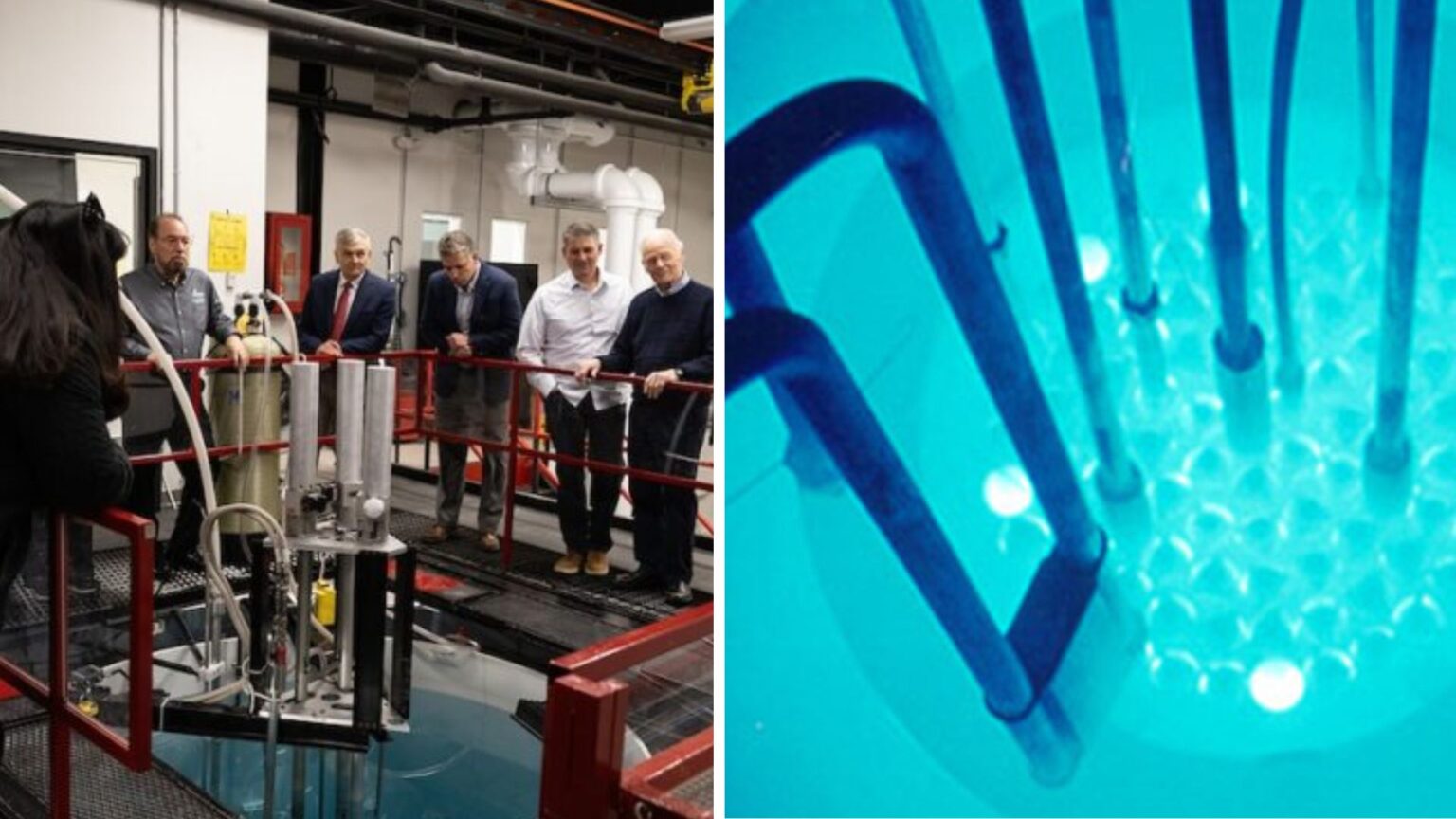
In a proof-of-concept demonstration, researchers at Utah University and Elemental Nuclear Energy Corporation plan to use a research nuclear fission reactor to generate electricity.
The 2-3 kW output from the reactor will be used to power a high-performance GPU node to that will execute a live artificial intelligence (AI) workload.
The recent surge in AI applications has increased demand for data centers in the future. With high-performance GPUs also consuming significant energy, electricity demand is expected to double by the end of this decade.
While Big Tech companies were previously looking to achieve net-zero goals in the coming decade, the intense competition in AI is also forcing them to consider faster-to-deploy options like gas turbines to meet energy demands. In such a scenario, small and microscale nuclear reactors could help meet energy demands without accompanying carbon emissions.
TRIGA reactor in Utah
The College of Engineering at Utah University is also home to a TRIGA fission nuclear reactor. Designed and developed by General Atomics, this reactor is built for research and allows students to conduct scientific investigations.
Although there are many startups looking to build microreactors that can either be portable or operated in remote locations, research reactors are not in the same category. These are essentially neutron factories that are smaller than microreactors, too, and have never been used to generate electricity.
“This will be, to our knowledge, the first time any university reactor has produced electricity, not just our own,” said reactor manager Ted Goodell. “It’s a milestone for our students, but it also shows that small, safe reactors could live at data centers, rather than in labs.”
How will it be done?
To turn the research reactor into an electricity-producing one, Utah University is teaming up with Elemental Nuclear Energy Corp., which deploys a cold-helium-based power generator to trap heat generated by microreactors.
While heat from a TRIGA reactor is usually vented, thanks to Elemental’s technology, university researchers will be able to partially tap into it and use the Reverse Brayton cycle to compress the helium working fluid and heat it with reactor pool water. It is then expanded through a turbine generator and then cooled via a cryogenic heat exchanger.
The team expects a thermal input of 50 kW from the reactor water, while the turbine can generate 13 kW output. Net electricity generation from this setup is not expected to exceed three kW. While this is modest compared to the megawatt demand of AI data centers, the experiment is only intended to demonstrate that even small nuclear reactors can produce usable electricity.
“This is one of the most extraordinary scientific networks in the world,” said Mike Luther, Chairman at Elemental Nuclear, in a press release. “It combines operating nuclear infrastructure with a deep bench of talent and institutional knowledge. We believe it represents a powerful platform for accelerating next-generation nuclear technologies.”
“Our objective is to deliver a commercially viable nuclear microreactor by 2030–2031,” added Luther. “Experiments like this enable us to move quickly, validate real-world systems, and build toward scalable solutions.”