
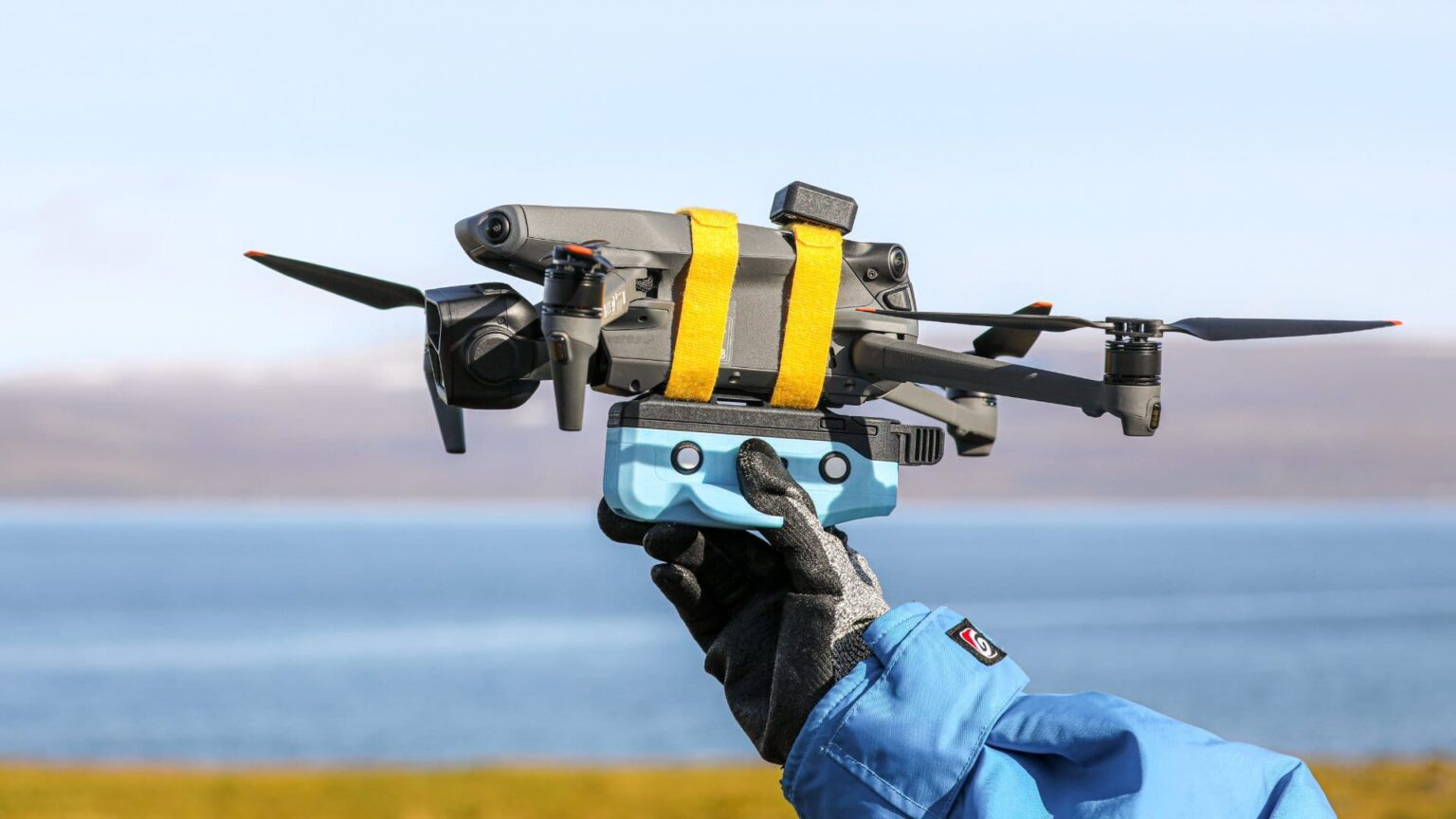
A few months ago, a lightweight sensor system lifted off above a pod of humpback whales off the Icelandic coast, attached to a drone and designed around one straightforward premise: make marine mammal measurement faster, safer, and accessible without the logistical burden that typically slows field science down.
That system was WHASER, developed by UK-based R&D agency Tandem Ventures in partnership with Bambu Lab, whose 3D printing technology enabled the team to design, print, test, and integrate changes in days rather than weeks, moving components directly from development into deployment without treating the two as separate manufacturing stages.
Over several months, WHASER collected biometric data on more than 115 humpback whales. Results confirmed the concept’s viability, and demand followed shortly after, with researchers from six continents reaching out to inquire about the system.
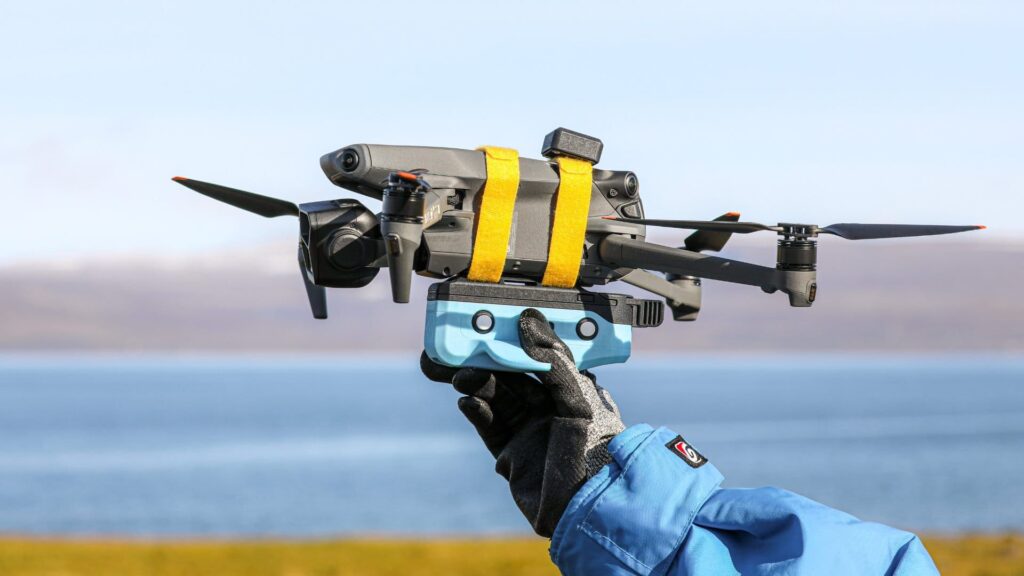 WHASER, Drone Device. Photo via Bambu Lab.
The Redesign That Actually Mattered
Research hardware often stops at validation. A device works, a paper gets published, and the project wraps up. WHASER’s story took a different turn when teams from the US, South America, Europe, Africa, and Australia began reaching out. marine biologists, conservation researchers, teams working in remote coastal environments with little tolerance for unreliable equipment.
That kind of demand doesn’t care about convenient stopping points. The question was no longer whether the device worked in Iceland. It was whether it worked in Hawaii’s humidity, Chile’s winds, and African coastal conditions that share nothing with the North Atlantic.
The team rebuilt around what field deployment actually revealed. Battery capacity grew to handle fieldwork timelines that don’t pause for recharging. Weight came down to 170 grams, every gram a deliberate decision in remote environments where kit load is a real constraint.
Internal geometry was tightened so components stayed put in transit. Weather sealing around the LiDAR unit improved. Circuitry was updated for efficiency. The interface was simplified to an always-on display with no wake button, because the right tool reduces friction rather than introducing it.
The team also developed a custom hard case with 3D printed internal structures shaped around the device itself, allowing researchers to arrive at a site and begin work immediately. In marine fieldwork, where access windows open and close with the tide, setup time is not a minor detail.
Today, each WHASER unit ships with a trackable serial number, monitored and supported across a global deployment network, an accountability structure that distinguishes a sustained product from a one-time project.
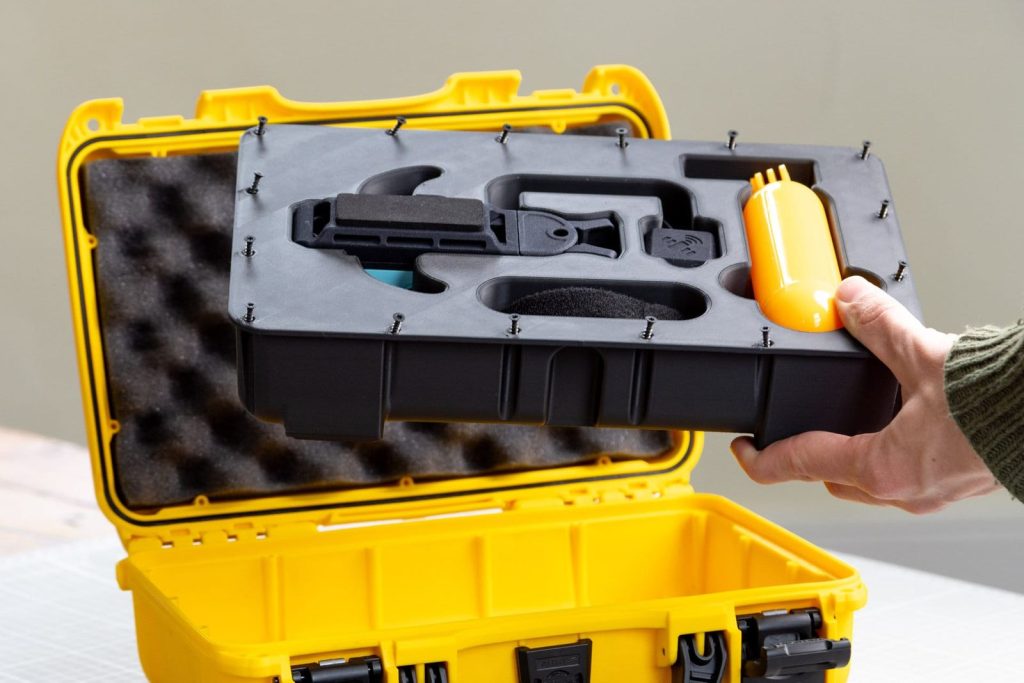 WHASER, Drone Device. Photo via Bambu Lab.
3D Printing as Field Infrastructure for Marine Research
Marine conservation field research has long been constrained by costly, slow-to-iterate hardware that struggles to survive real ocean conditions. 3D printing is changing that, giving research teams the ability to design, test, and refine tools at a pace that matches the urgency of the work.
The application of additive manufacturing in marine contexts has expanded well beyond prototyping. Zaha Hadid Architects and D-Shape developed Nereid, a digitally fabricated marine habitat for a conservation zone in Hong Kong, using large-scale 3D printing to create bio-mimetic reef structures that emulate natural benthic systems. Elsewhere, engineers at UNSW developed BioShelters, site-specific 3D printed structures deployed in Sydney Harbour to restore oyster habitats, using algorithms and robotic fabrication to translate marine biology data into forms that support diverse marine life.
For marine conservation, the bottleneck has never been the science, it has been the hardware. WHASER shows that closing that gap is now an engineering decision, not a budget one.
3D Printing Industry is inviting speakers for its 2026 Additive Manufacturing Applications (AMA) series, covering Energy, Healthcare, Automotive and Mobility, Aerospace, Space and Defense, and Software. Each online event focuses on real production deployments, qualification, and supply chain integration. Practitioners interested in contributing can complete the call for speakers form here.
To stay up to date with the latest 3D printing news, don’t forget to subscribe to the 3D Printing Industry newsletter or follow us on LinkedIn.
Explore the full Future of 3D Printing and Executive Survey series from 3D Printing Industry, featuring perspectives from CEOs, engineers, and industry leaders on the industrialization of additive manufacturing, 3D printing industry trends 2026, qualification, supply chains, and additive manufacturing industry analysis.
Featured image shows WHASER, Drone Device. Photo via Bambu Lab.