
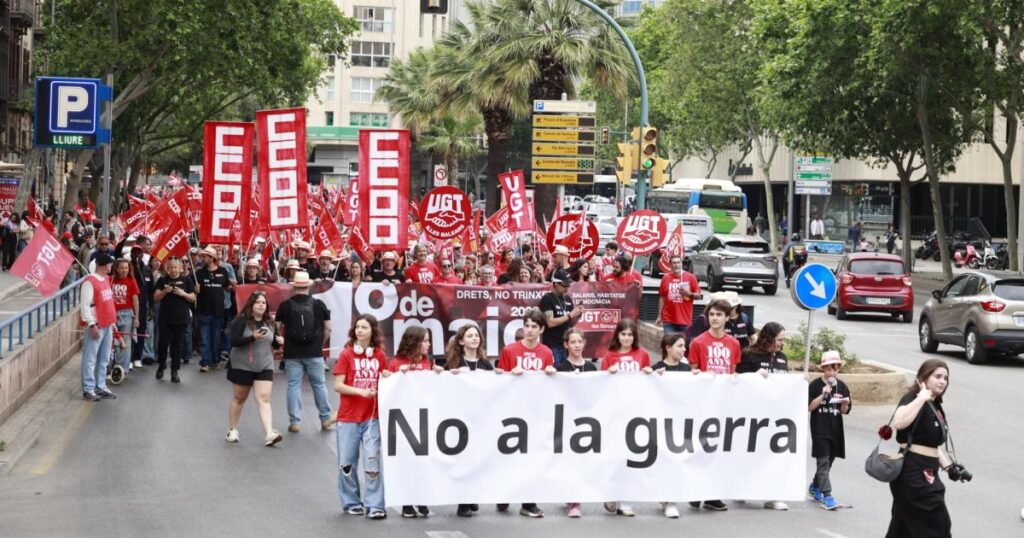
Eight out of ten Spaniards are concerned about the war in Iran, as they believe it affects them personally and poses a significant risk to international peace, whilst 60.4% believe that Spain’s image in the world has improved thanks to Prime Minister Pedro Sánchez’s stance against the bombings by Israel and the United States, according to the April Barometer of the Centre for Sociological Research (CIS).
Specifically, 83.9% of Spaniards are concerned about this armed conflict – in detail, 29.1% are very concerned, 39.3% quite concerned and 15.5% somewhat concerned – whilst 7.3% say they are not very concerned and 6.2% say they are not concerned at all.
Furthermore, 86.4% of those surveyed believe that this war poses a significant risk to world peace, compared to 10.1% who do not. And as many as 52.6% fear that the current conflict could lead to the use of nuclear weapons, compared to 39.6% who reject this and 7.3% who do not know.
In its questionnaire, the polling institute headed by José Félix Tezanos asks how much Spain’s image abroad has improved following Sánchez’s stance against this war, and the majority view it positively: 20.8% believe it has improved a great deal, 17.8% quite a lot and 11.8% somewhat, whilst 13.1% say it has improved little and 29.5% say it has not helped at all.
58.5% say this war is affecting them personally. Among them, what is affecting them most is the rise in fuel prices (for 94.3%), the rising cost of the shopping basket (92.5%), the rise in the cost of electricity and gas (80.1%), a greater sense of insecurity or risk (69.6%), and the impact on their emotional well-being or state of mind (56.3%).
The past weeks have not been reassuring for those who thought that Europe could navigate its tricky relationship with U.S. President Donald Trump. Trump this week lashed out at German Chancellor Friedrich Merz over his criticism of the Iran war, calling him “totally ineffective.” On Friday, the Pentagon said it would cut 5,000 of the 36,400 troops it has stationed in Germany, and increase tariffs on cars and trucks from the European Union, a move that will hit Germany hardest.
Trump has taken aim at British Prime Minister Keir Starmer in strikingly personal terms, saying that he is “not Winston Churchill,“ and threatening to impose a “big tariff” on imports from the UK. Trump’s Defense Department has floated punishing NATO allies that it believes are not supporting U.S. operations in the war with Iran, including suspending Spain as a member and reviewing U.S. recognition of the Falkland Islands as a UK possession.
“It’s unnerving to say the least,“ said one European diplomat. “We are braced for anything, anytime.”
The latest U.S. broadsides, fired over disagreements about the Iran war, have seemingly turned U.S.-Europe relations back to the early days of the second Trump administration and raise fresh questions about the best way to handle a mercurial ally.
A second European diplomat said former German Chancellor Angela Merkel, who had a rocky relationship with Trump during his first term, had modeled the right approach. “We’ve all learned a bit how to handle Trump by now. You must not react immediately, you must let the storm pass, while standing firmly on your positions,“ the diplomat said.