
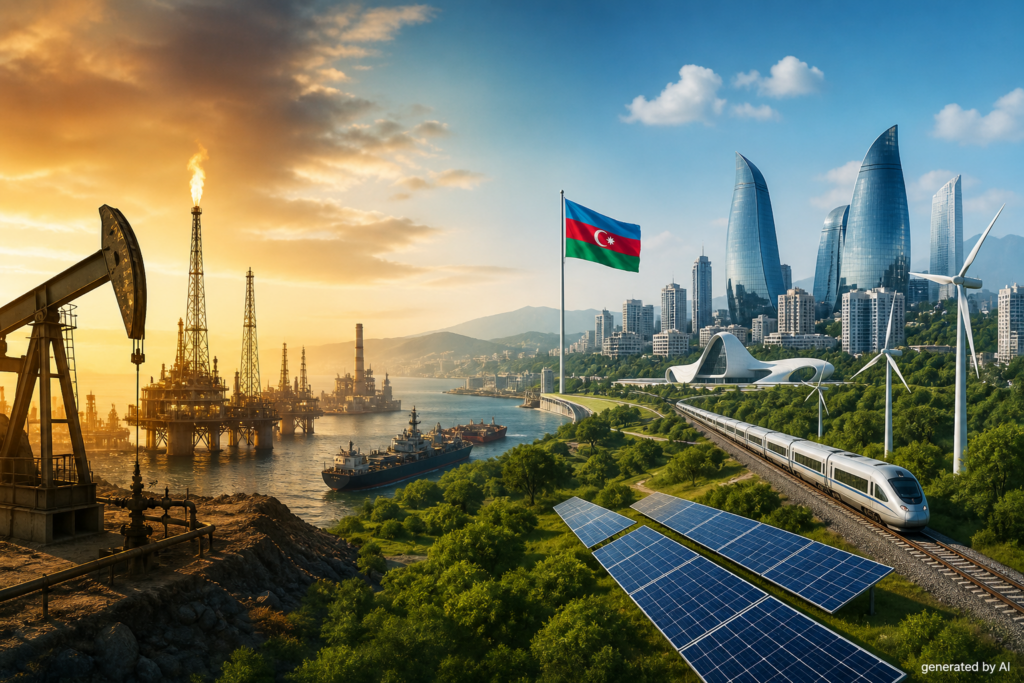

The prospect of Azerbaijan’s strategic currency reserves
climbing toward the 94-billion-dollar mark by 2028, as projected by
the International Monetary Fund, is a defining moment for the
nation’s long-term sovereignty. For a country situated at the
volatile crossroads of Eurasia, these figures represent much more
than passive wealth; they are the architectural blueprints of a
future designed to withstand the inevitable transition away from a
hydrocarbon-dominated global economy. To understand the gravity of
this projection, one must look beyond the sterile columns of
financial reports and recognize the accumulation of these reserves
as a strategic “fortress” policy. In an era where global energy
markets are increasingly characterized by erratic price swings and
geopolitical tensions frequently disrupt traditional trade routes,
the ability to amass a financial cushion that nearly equals the
nation’s entire annual economic output is a rarity that provides
Azerbaijan with a unique degree of geopolitical agency. This
massive accumulation acts as a sophisticated insulation layer,
protecting the domestic economy from the “Dutch Disease” that has
historically crippled many resource-rich nations. By funneling
energy revenues into the State Oil Fund (SOFAZ) and maintaining
robust Central Bank reserves, the state effectively de-links its
internal fiscal stability from the daily volatility of Brent crude
prices. This stability is most visible in the resilience of the
national currency, the manat. While many neighboring economies have
been forced into painful devaluations that eroded the purchasing
power of their citizens, Azerbaijan’s immense reserves have allowed
for a controlled and predictable monetary environment. This
predictability is the lifeblood of a growing non-oil sector, as it
gives local entrepreneurs and foreign investors the confidence to
plan projects that span decades rather than months.
Furthermore, the strategic accumulation of nearly 100 billion
dollars serves as a powerful instrument of foreign policy.
Financial independence is often the precursor to political
independence; a nation that does not need to seek emergency loans
from international lenders or adhere to the stringent
conditionalities of foreign aid is a nation that can set its own
internal and external priorities. For Azerbaijan, this means the
ability to self-finance massive infrastructure projects, such as
the restoration of the liberated territories, without increasing
its external debt burden to dangerous levels. The reconstruction of
Karabakh is perhaps the most poignant example of why these reserves
matter. Transforming a region that suffered decades of neglect and
destruction into a modern, digitally integrated economic hub
requires a level of capital expenditure that few developing nations
could afford out of pocket. Yet, because of the disciplined saving
habits reflected in the IMF’s report, Azerbaijan is doing exactly
that, essentially investing its past energy successes into its
future territorial and economic integrity. There is also a profound
intergenerational aspect to this wealth. The philosophy behind the
State Oil Fund has always been to ensure that the finite wealth
extracted from the Caspian seabed benefits not just the generation
that drilled the wells, but also those who will live in an
Azerbaijan where oil is no longer the primary driver of growth. By
growing these reserves to such staggering heights, the state is
creating a permanent endowment. The dividends and interest earned
from these global investments will eventually provide a sustainable
stream of income that can fund education, healthcare, and
technology long after the last drop of oil has been exported. This
shift from a resource-based economy to a capital-based economy is
the ultimate goal of any forward-thinking state.
However, the true test of this 94-billion-dollar milestone will
not be the number itself, but how the “power of the purse” is
leveraged to accelerate the diversification of the real economy.
The IMF’s optimistic forecast should be viewed as a window of
opportunity—a period of grace where the country is shielded from
external shocks, allowing it to take calculated risks in developing
its human capital and green energy potential. As the world pivots
toward renewable energy, Azerbaijan is already using its financial
strength to position itself as a key player in the “Green Energy
Corridor,” connecting the wind and solar potential of the Caspian
to the European market. These projects require immense upfront
investment, and having a fortress of reserves allows Azerbaijan to
enter these partnerships as a lead investor rather than just a host
country. In conclusion, the IMF’s projection is a testament to a
decade of disciplined fiscal stewardship. It signals to the world
that Azerbaijan is not just an energy exporter, but a sophisticated
financial actor with the resources to navigate a complex century.
These reserves are the ultimate insurance policy against
uncertainty, the engine for national reconstruction, and the bridge
to a post-oil era that promises to be as prosperous as the age of
energy. As the 94-billion-dollar horizon approaches, the focus
remains clear: the wealth of the nation is being stored today to
ensure the strength of the nation tomorrow.