
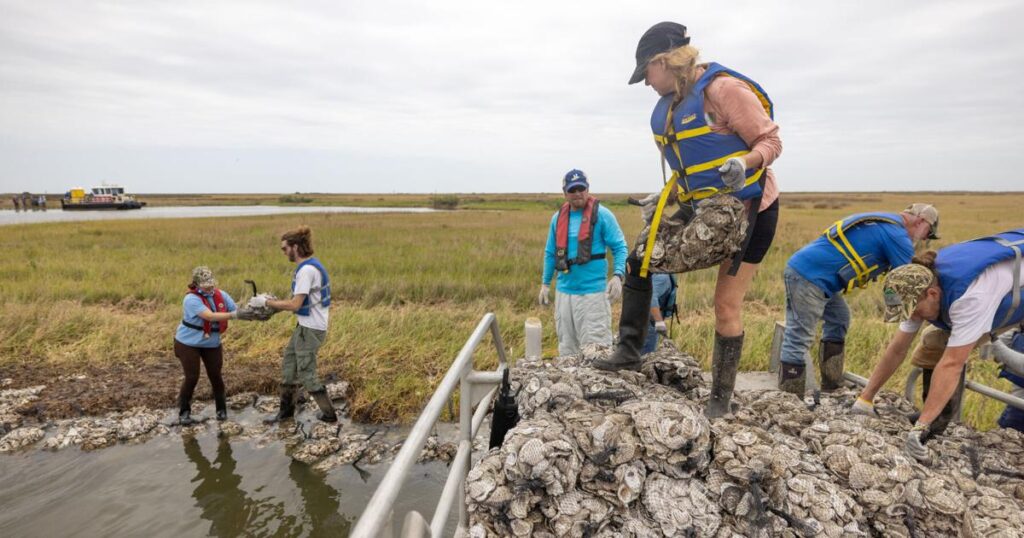
On the far reaches of the Louisiana marsh, a few dozen volunteers were engaged in a weightlifting workout with unconventional equipment: 30-pound bags of recycled oyster shells.
The volunteers for the Coalition to Restore Coastal Louisiana passed the oyster bags in a line of people toward a muddy shoreline along the eastern edge of the Biloxi Marsh, the last piece of land before the Chandeleur Islands.
“We are protecting a small but mighty sliver of the marsh,” said Fiona Lightbody, CRCL’s program manager for oyster recycling.
They were building what is called a “living shoreline,” a growing tool for coastal protection across Louisiana, considered a promising nature-based strategy in the battle against land loss. By no means a solution on their own, especially considering the state’s huge coastal dilemma, such projects can, however, play a meaningful role when combined with other approaches, scientists say.

Recycled oyster shells line a shoreline at Morgan Harbor Pass in St. Bernard Parish, forming part of a living shoreline project designed to reduce erosion and create habitat. (Staff photo by Brett Duke, The Times-Picayune)
STAFF PHOTO BY BRETT DUKE
And in a state that cherishes its oysters, recycling them for coastal protection and to produce more of the beloved shellfish holds special appeal. Last month’s work in the Biloxi Marsh, near a site formerly inhabited by the Chitimacha Tribe, was a pearl of an example.
Over the course of six days, CRCL placed 250 tons — over 550,000 pounds — of oyster shells to construct 1,000 linear feet of new reef, built to encourage oyster habitat and reduce shoreline erosion. They also planted 4,000 mangroves in the area.
Anyone eating oysters in New Orleans and Baton Rouge may have contributed.
The organization has collected shells from restaurants in those two cities over the last dozen years and returned them to Louisiana waters, creating thousands of feet of new oyster reef. The structures have a twofold benefit: The reefs promote more oyster growth while the structures reduce shoreline erosion.
Oysters, because of the way they feed, also improve water quality by filtering it, while the reefs they form are beneficial to a wide range of marine life.
Bags of recycled oyster shells are stacked along the shoreline during a Coalition to Restore Coastal Louisiana event at Morgan Harbor Pass in St. Bernard Parish on Friday, April 17, 2026. The shells are used to help build a living shoreline to reduce erosion and create habitat. (Staff photo by Brett Duke, The Times-Picayune)
STAFF PHOTO BY BRETT DUKE
Placement is important. In the case of the new CRCL reef, it complements a nearby project built by the state’s coastal agency. Pilings and poles marking the state’s Biloxi Marsh restoration project could be seen in the distance from the CRCL boats carrying the thousands of pounds of oyster shells.
“We’ve been strategically aligning our project with other work being done by the state,” Lightbody said. “Because our reef, by itself, will have some value of impact, but added onto this much larger project, it’s just a multiplicative effect of ecological benefits.”
The two coastal projects may be working symbiotically, but their methods are very different. While the volunteers planted native grasses and lined the receding marsh with oyster shells, the Louisiana Coastal Protection and Restoration Authority used different types of concrete to build a roughly 12-mile stretch of breakwater.
Still, both projects are considered what scientists call a “living shoreline.” The state’s concrete breakwater will eventually be covered in new oyster reefs, too.
Standing on the stern of the large oyster boats CRCL was using to build the reef, Craig Gothreaux, a fish biologist for the National Oceanic and Atmospheric Administration, passed bag after bag of oyster shell to another volunteer waiting in the shallow water.
A bag of recycled oyster shells is placed along the shoreline at Morgan Harbor Pass in St. Bernard Parish. The shells are used to help build a living shoreline to reduce erosion and create habitat. (Staff photo by Brett Duke, The Times-Picayune)
STAFF PHOTO BY BRETT DUKE
Gothreaux has volunteered for a number of CRCL’s reef builds, which he noted replicates the traditional process of returning oyster shells to the water to create new habitat for the species. He explained that Louisiana lacks “hard substrate,” like rock, that marine organisms need to grow on.
“Both of these living shorelines represent that hard material,” Gothreaux said of the two Biloxi Marsh projects. “It’s just using different materials to achieve that.”
The causes of land loss in Louisiana are many, but shoreline erosion is an important one. That’s where living shorelines can play a role since they keep waves and tides from repeatedly battering the marsh.
Louisiana Sea Grant notes that living shorelines “can combine plantings with structural elements.” In other words, that can mean oyster bags stacked along the shore – such as with the CRCL project – as well as cement domes with holes for oysters to attach, like the state project.
Birds gather and take flight from recycled oyster shells placed along the shoreline at Morgan Harbor Pass in St. Bernard Parish. (Staff photo by Brett Duke, The Times-Picayune)
STAFF PHOTO BY BRETT DUKE
Beyond oysters and concrete, living shoreline initiatives might also incorporate rock jetties, vegetation and recycled sand, such as in a Jefferson Parish Bucktown shoreline project.
Gothreaux explained the spectrum of shoreline techniques ranging from the greenest – which would use vegetation only – to the grayest, like a bulkhead.
“Depending on the environment and the wave energy, you kind of have to go to a grayer or a harder technique,” he said.
‘A house and a skyscraper’
The state’s living shoreline falls on the grayer, more engineered side of the spectrum, though the agency still designed the Biloxi Marsh project to attract oysters and other marine habitat. David Chambers, a CPRA field engineer for the project, said that the concrete structures “serve as a kind of refuge” for fish and other sea creatures potentially hiding from predators, but also help reduce wave energy that accelerates erosion.
Completed in July 2023, the state’s $66 million Biloxi Marsh project used settlement funding from the 2010 BP oil spill to construct nearly 12 miles of breakwater and “marine mattresses,” or bags filled with rock, near the shoreline.
Unlike the volunteer project, the breakwaters don’t touch the marsh edge and sit away from the shore.
“The thing that I liked about what (CRCL) did was that it was right at the front lines of coastal erosion,” Chambers said, allowing the waves to break before reaching into the marsh.
Rudy Simoneaux, chief of engineering at CPRA, said that living shorelines are very effective at attenuating wave energy, though the structures like those in the Biloxi Marsh are historically more expensive and complex to install than rock or bulkhead.
Bags of recycled oyster shells are stacked along the shoreline during a Coalition to Restore Coastal Louisiana event at Morgan Harbor Pass in St. Bernard Parish on Friday, April 17, 2026. The shells are used to help build a living shoreline to reduce erosion and create habitat. (Staff photo by Brett Duke, The Times-Picayune)
STAFF PHOTO BY BRETT DUKE
“Living shorelines are not the agency’s primary method for shoreline protection, but they have been done before,” Simoneaux said.
The agency doesn’t currently have any large-scale living shorelines underway, Simoneaux said, but that doesn’t rule out a future scenario where implementing one would make sense. Any project that would help the agency reach its primary goal of protecting the shoreline is a method worth pursuing, he said.
‘A house and a skyscraper’
During a lunch break from reef building, Andrew Ferris, a coordinator for CRCL’s native plants program, explained that as sea levels rise, the new oyster reefs will grow with it.
“A wall or a rock dam – these things have a discrete lifespan that a living shoreline just doesn’t have,” Ferris said.
Still, he compared the difference in scale between the nonprofit project and the state agency project as “the difference between a house and a skyscraper.” The $500,000 CRCL volunteer project yields a fraction of the footage of the state project, but it also reflects a difference in aims, Ferris said.
Birds gather and take flight from recycled oyster shells placed along the shoreline at Morgan Harbor Pass in St. Bernard Parish. (Staff photo by Brett Duke, The Times-Picayune)
STAFF PHOTO BY BRETT DUKE
There is also a less visible goal associated with such projects, he said. New coastal advocates can be recruited by illustrating the connection between a night out at a restaurant with marsh protection.
“We are part of the coastal ecosystem, and we have always been part of the coastal ecosystem down here,” Ferris said. “And so part of our living shoreline projects are that we are creating a more engaged and educated base of Louisiana residents.”