
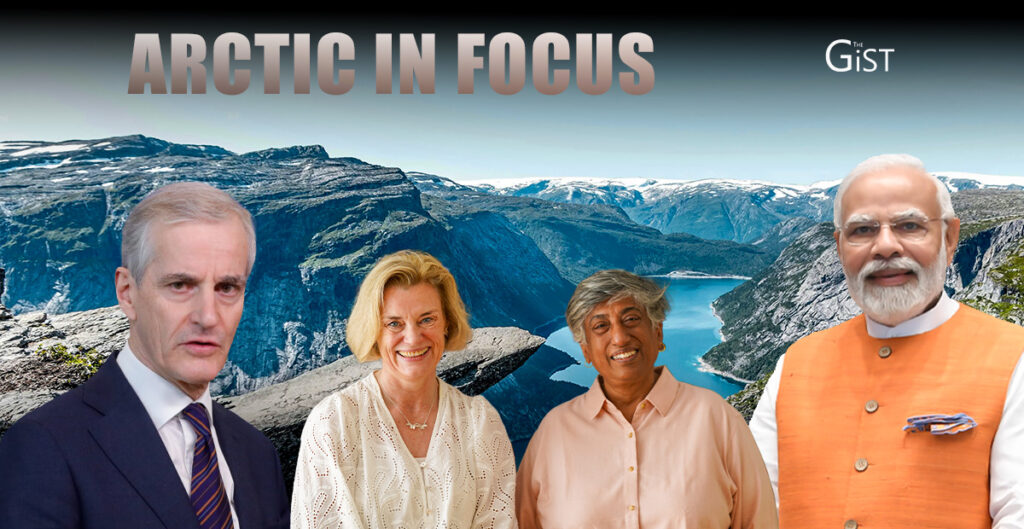
At a time of expanding geopolitical interest in the Arctic, Prime Minister Narendra Modi heads for the third India–Nordic Summit in Oslo on May 18th. The summit will also bring together the heads of state of Sweden, Finland, Denmark and Iceland. Earlier summits were in Stockholm and Copenhagen.
India is an observer on the Arctic Council and in that capacity, has been a ringside witness to recent developments that have emphasised the power politics at play. From new sea routes to sources of energy and minerals, the Arctic could be the new frontier shaping great power relations.
It’s a point Norway’s Ambassador to India May-Elin Stener, underscored in an exclusive conversation with StratNews Global. The summit would cover discussions on “what is happening in the world”, and how countries can work together in the current global order.
That aside, Indian researchers have been active in the Arctic for many years, studying how melting Arctic ice affects the Indian monsoon. There could be more India-Nordic cooperation going forward.
Describing the Indian economy as “very vibrant and rapidly growing,” the ambassador said the summit would explore more areas of cooperation with the focus on green growth and green energy. Ambassador Stener said the Nordic sisters bring capabilities across this sector and are looking to expand cooperation with India.
Norway is a major oil and gas producer in the North Sea, and offshore fields produce natural gas which is rich in butane and propane, major components of LPG. Stener said
Norway is a major exporter globally of LNG, LPG and crude and that discussions are ongoing between Indian stakeholders and Norwegian companies regarding future energy cooperation. The ambassador mentioned that the talks are focussed on getting more LPG.
The ambassador noted that Norway has a long maritime tradition and has developed technologies that are relevant for India. Around 70% of Norwegian companies operating in India are in the maritime sector, working on ship components, design and improving efficiency and sustainability.
She also pointed out that a share of Norwegian-commissioned ships are currently being built in India, and that there is ongoing collaboration aimed at making ships “better” and “greener.”
On trade and investment, Stener referred to the Trade and Economic Partnership Agreement between India and the European Free Trade Association (EFTA), which includes Norway. The agreement has been in force for six months, and she said there is increasing interest from Norwegian companies looking at India.
She noted that the number of Norwegian companies in India has grown, and while it is still early to see full investment outcomes, she expects more developments in the near future. Areas of interest include maritime industries, green energy, and circular economy initiatives such as waste management.
The summit is expected to cover developments in artificial intelligence, particularly in areas such as ethical use, inclusion, and applications in health.