
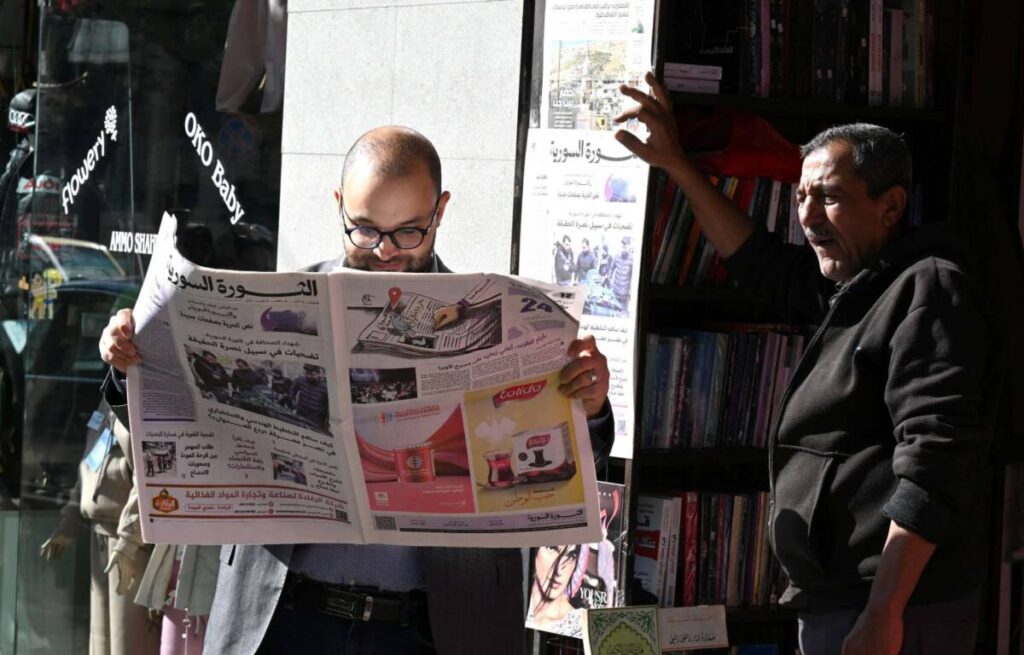
Paris — Syria marked World Press Freedom Day on May 3 with what many describe as a historic leap, rising 36 places to rank 141 out of 180 in the global press freedom index published by Reporters Without Borders, up from 177.
“Under the Assad regime, we knew exactly where we stood and when to stay silent. Personal safety came before everything — even the work itself,” said Simaf Hassan, an independent journalist. “But after its fall on December 8, 2024, it feels like the door has opened slightly, and I can begin to test those limits.”
Syria under Hafez al-Assad and Bashar al-Assad was synonymous with repression. Since 2011, journalists have been killed by all sides in the conflict, though the former regime was responsible for the majority of violations against the press.
The Press Freedoms Center of the Syrian Journalists Association recorded 1,546 violations between March 2011 and the end of 2024, including 478 killings. Of those, 327 were attributed to the Assad regime and 62 to the Islamic State group.
“Voices are louder now, and discussions are happening that were once impossible,” Hassan said. “But I don’t think we’ve fully left the Kingdom of Silence. It has simply changed form — sometimes into a more cautious or selective silence.”
Omar Haj Ahmad, director of press affairs and licensing at the Syrian Ministry of Information, described the improvement as “a qualitative shift made possible by the combined efforts of journalists, media institutions, and professional bodies, working alongside the ministry.”
The “comparison trap”
Sources who spoke to Syria Direct welcomed Syria’s progress, even as the index pointed to a global decline in press freedom, now at its lowest level in 25 years. More than half of all countries are classified as having a “difficult” or “very serious” media environment.
While there is broad agreement that press freedom has improved compared with the Assad era, journalists and rights groups warn that the gains remain fragile and require legal and institutional safeguards.
The Syrian Journalists Association described the progress as “a positive indicator reflecting the transformations of 2025,” calling it “a year of expanding media freedoms, with fewer direct restrictions than in previous years,” according to its vice president, Imad al-Tawashi.
However, he cautioned that the improvement “does not fully reflect a safe and stable environment for journalistic work,” noting that protections for journalists remain weak and insufficient.
A report by the Syrian Center for Press Freedoms documented 11 violations in the first quarter of 2026, involving multiple actors, including Kurdish-led forces, government forces, and armed factions in Suweida, as well as incidents caused by leftover mines.
These cases point to a “structural gap between expanding freedom and providing legal protection,” the report said, despite what it described as a continued, gradual improvement in broader freedoms.
Bassam al-Ahmad, director of Syrians for Truth and Justice, warned against using the Assad era as a benchmark.
“It is not valid to compare the current situation to the former regime,” he said. “That leads to a methodological error. The regime should not be the standard for measuring freedom.”
Instead, he argued, Syria should be assessed against international minimum standards of freedom of expression — standards that are only partially met today, and not for everyone.
Syria reshapes its media identity
On December 1, 2025, Al-Thawra al-Souriya relaunched with its first experimental print edition since the fall of the regime. The newspaper has broken with traditional state media by publishing bold reporting on corruption and issues affecting ordinary citizens — even when it reflects poorly on the government.
“From the beginning, we aimed to build a national media that bridges the gap between citizens and the government,” said editor-in-chief Nour al-Din al-Ismail. “It should reflect people’s concerns while also presenting the government’s work — without ignoring its shortcomings.”
“After the fall of the regime, we had a historic opportunity to create real media, where journalism truly functions as a fourth estate, not just in name,” he added.
The paper has published critical pieces on issues such as nepotism and judicial independence — topics that would have been unthinkable under the previous system.
“In the past, there was no real media — only propaganda,” said investigative journalist Mohammed Basiki. “It was one narrative, one direction, with no space for criticism.”
Now, he said, “the limits of what can be reported have expanded,” with international outlets entering Syria and shedding light on current conditions and ongoing violations.
“People are expressing their views more and more, and we are all still learning how to do that,” said journalist Malak al-Shanwani, who noted it took her six months after the regime’s fall to feel comfortable discussing politics over the phone.
Red lines and lingering fears
Despite the progress, concerns remain about the emergence of new “red lines.”
Major events — including violence on the coast in March 2025 and clashes in Suweida later that year — have been widely covered, but questions remain about the limits of acceptable reporting.
“Can the findings of investigations into these massacres be criticized as freely as issues like electricity or fuel shortages?” al-Ahmad asked.
Journalists say sensitive topics — particularly those involving security forces or ongoing abuses — are still difficult to report on freely.
“What limits coverage is not just one factor,” Hassan said. “There is a deep legacy of fear, and there are also actors who use intimidation in the absence of real legal protections.”
“If these freedoms remain unprotected, they can easily be rolled back,” she warned. “This is a test for everyone — the authorities, society, and the media.”
The barrier to information
In many countries, laws guarantee the right of citizens and journalists to access information. Jordan was the first Arab country to adopt such a law in 2007.
In Syria, however, journalists say access to information remains limited.
“There is still a barrier between journalists and government institutions,” Basiki said. “Information flow is very limited and largely one-directional.”
He called for legislation guaranteeing the right to access information, describing it as a potential turning point that could significantly improve transparency and press freedom.
At the same time, rights advocates warn of the challenge of distinguishing between fact and exaggeration — a “very fine line” that must not be used as a pretext to restrict freedom of expression.
Basiki said he hopes Syrian journalism will become “more independent, with a much higher level of freedom,” particularly through strengthening investigative reporting as a tool for accountability.
Hassan expressed a similar hope: “I want to see freedoms become a guaranteed right, not a privilege — where journalists can work without fear, criticize without worrying about personal consequences, and where the media reflects the voices of all Syrians, including women, young people, and marginalized communities.”
“Syria is not just overthrowing a regime,” she said. “It is building a new culture — one where freedoms are no longer negotiable.”
