
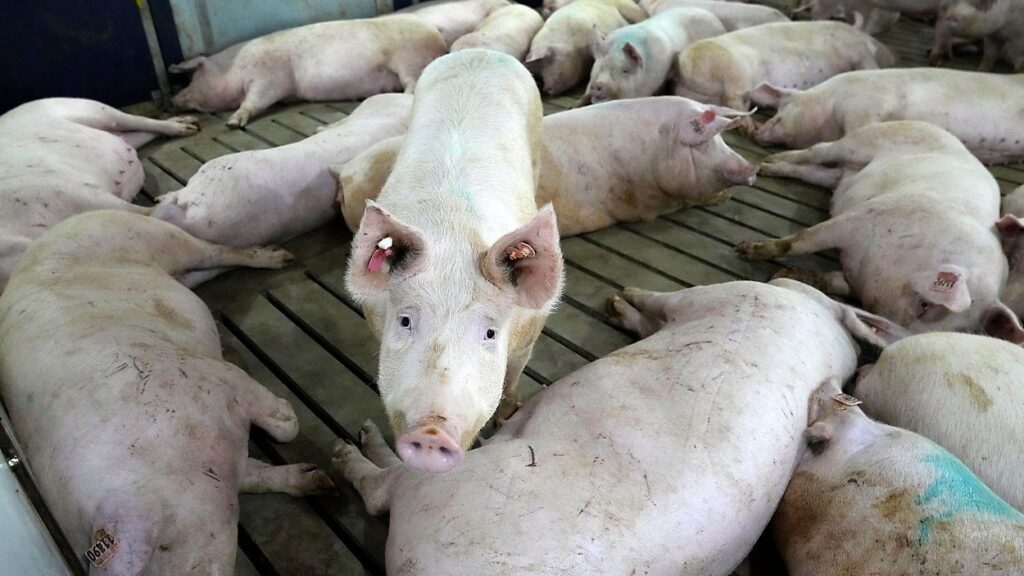
For years, pork producers across the country have fought California’s Proposition 12, a statewide referendum that appeared on the ballot in 2018.
Voters elected to support the landmark law requiring that all pork, veal and eggs sold in the state come from animals raised within a specific minimum space requirement. Almost immediately, pork producers challenged the law in the courts, taking their appeal all the way to the Supreme Court.
Ultimately, the justices ruled against the pork producers, but left the door open for Congress to create a federal standard for the living conditions of pigs and other livestock. The National Pork Producers Council has been lobbying lawmakers to act ever since.
“The problem with Prop. 12 and the way it currently is today is more about the patchwork that could be developed within individual states,” Todd Marotz, vice president of the NPPC, told Spectrum News. “It’s one thing to have a set of standards for one or two things, but we can have 50 different regulations that restrict how producers are raising their livestock and not allowing access within that area.”
The massive farm bill approved by the U.S. House last week includes a provision that would essentially invalidate Proposition 12. It states that while California can enforce the rules of Proposition 12 within state borders, no state can enact or enforce, directly or indirectly, a standard on the production of livestock.
“I think it’s a balanced approach,” said Rep. Glen ‘G.T’. Thompson, R-Pa., who chairs the House Committee on Agriculture. “It doesn’t interfere with how states oversee and conduct their own agriculture practices, it doesn’t interfere with animal health or anything like that. But clearly what it states is a state cannot dictate to other states these practices.”
But Kathy Hessler, the Assistant Dean for Animal Legal Education at The George Washington University Law School, said that rather than setting a national standard as the Supreme Court suggested, Congress is doing the opposite.
“The federal government’s approach seems to be, ‘we don’t want the states to decide for themselves what the rules should be, but we’re not going to decide either. And that’s chaos, right? That just doesn’t make any sense. And that’s not our system of federalism,” Hessler said.
She also cautioned that this could have wide-ranging impacts beyond pork.
“Once we say that the federal government can tell states that they can’t decide for themselves who does business in their state under what terms, then we’ve opened the door to all kinds of decision-making that’s going to be problematic across the board,” she said.
California Democrats, such as Rep. Lou Correa, call the provision an infringement of states’ rights.
“We believe animals should be treated humanely. And so for the federal government to come in and say, ‘you’re wrong,’ that’s wrong,” Correa said. “We hope the government, federal government backs off. We hope that the Senate fixes this.”
But Marotz says California is the one encroaching on states’ rights.
“They’re dictating to other states [that] if you want to market your pigs into California, you have to do it under the rules that they set up. And so you have states’ rights for California, but you’re infringing on states’ rights for everybody else that wants to market within theirs,” Marotz said.
The farm bill now heads to the Senate for consideration, where the Proposition 12 provision could be removed. If it remains in the bill, Hessler said there could be legal challenges to the provision.