
A 40,000-acre hyperscale data center and power generation campus cleared its first regulatory hurdle in northern Utah this week. The developer’s commitments on water, grid independence, and environmental impact are specific enough to evaluate. So are the questions that remain open.
The Box Elder County Commission voted on May 4 to authorize the Military Installation Development Authority (MIDA) to establish the Stratos Project Area in Hansel Valley, approximately 60 square miles of privately held vacant land in unincorporated western Box Elder County. The vote was not unanimous in public sentiment. Hundreds of residents packed a fairgrounds facility to protest, the meeting was moved to Zoom after repeated disruptions, and over 2,500 public comments had been submitted in the weeks prior.
Developed through O’Leary Digital, the project is designed to become one of the largest data center and power generation campuses in the country. State and military leaders have framed it in national security terms. Residents have framed it in water and air quality terms. Both framings are worth taking seriously.
What the Stratos Project Actually Proposes for Power and Water
The center is designed to operate as an energy island. All power generation will happen on-site using natural gas from the Ruby Pipeline, a major natural gas corridor with direct access to the Hansel Valley location. The developer’s position is that the campus will add no additional demand to the regional electrical grid, and may feed surplus power back into it. At Phase 1, the commitment is 3 gigawatts; full buildout targets 9 GW in Utah as part of a broader 15 GW multi-site strategy.
Water has been the sharpest point of public concern, and the developer’s answer is more detailed than most opponents have acknowledged. According to MIDA project materials, the natural gas generation component uses air-cooled heat exchangers with zero evaporative water loss. The data center cooling system uses a closed-loop configuration that recycles treated water with minimal evaporation and rejects heat to the atmosphere rather than to a body of water. The water rights the project would draw on are existing rights already attached to the property, and the developer states that net consumption under the project would be lower than current agricultural and ranching use on the same land, which it describes as a net benefit to the Great Salt Lake watershed. Those claims have not been independently verified through Utah’s Division of Water Resources permitting process, which lies ahead.
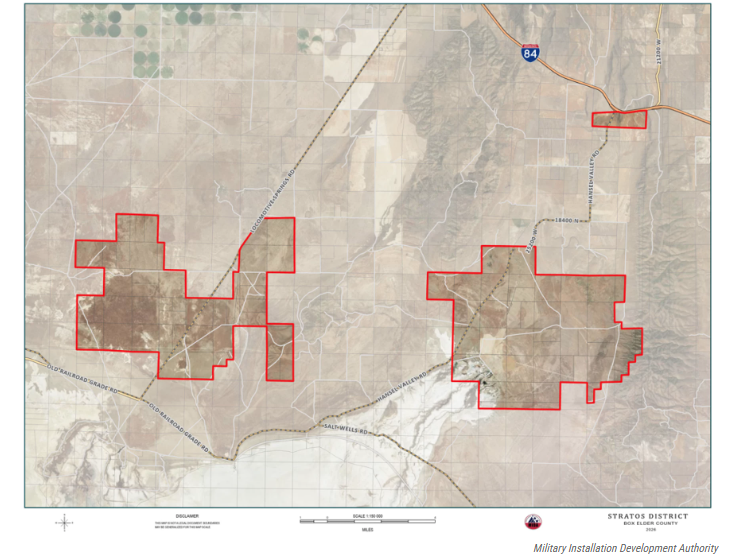
Stratos Project Area Map
Box Elder County, Utah
Why the Community Opposition Is More Than Symbolic
The volume and geography of opposition caught county leaders off guard. Of the 2,500-plus comments received, only 300 came from Box Elder County residents, a detail commissioners highlighted to contextualize the protest. Kevin O’Leary, chairman of O’Leary Digital, went further in a post on X on Tuesday, claiming that more than 90% of protesters were not Utah residents and had been organized from outside the state. Those claims are unverified.
What is verifiable is the pattern of concerns. Residents cited utility cost increases, air quality impacts from natural gas combustion at scale, and the pace of the approval process as primary objections. The county did negotiate specific guardrails into the interlocal agreement, including noise limits of 55 decibels at the site boundary, dark sky compliance requirements, restrictions on building heights tied to local fire response capacity, and a requirement that the developer fund all public infrastructure including roads, sewer, and water systems. The developer has committed $16.2 million in upfront funding to offset initial county budget impacts. Whether those conditions are sufficient is a question state regulators will continue to assess through subsequent permitting stages.
What Operations and EHS Teams Should Watch as This Moves Forward
The Stratos approval is not a final permit. MIDA’s enabling authority under Utah law governs the project area designation. State regulatory permitting, including air quality review by the Utah Division of Air Quality and water rights adjudication, follows separately. For facilities and operations professionals tracking hyperscale data center siting decisions and their downstream effects on regional grid load and water basins, Box Elder County is now a live case study. The Utah Drought Monitor currently shows portions of northern Utah in moderate to severe drought conditions, which adds context to any water use claims that remain unverified by independent review.