
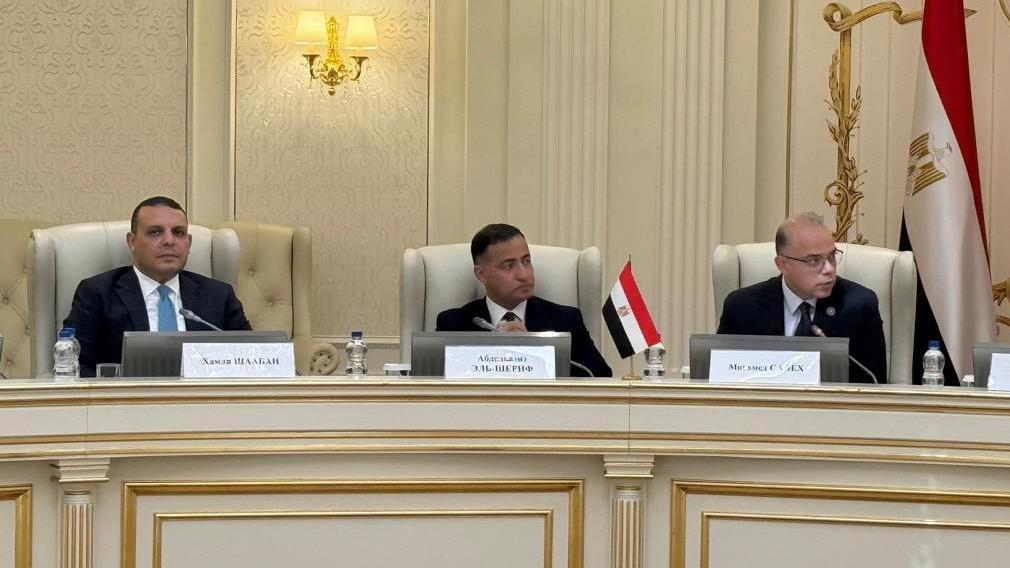
Minister of Investment and Foreign Trade Mohamed Farid Saleh said on Thursday, May 7, 2026, Egypt and Belarus have a strong political will to elevate bilateral ties to a fully-integrated industrial partnership, stressing the next phase aims to move beyond traditional trade exchange toward joint manufacturing and technology localization in a way that serves the interests of both countries and enhances economic integration between them.
Saleh made the comments during a keynote speech that he delivered at the opening of the 8th session of the Egyptian-Belarusian Joint Trade Commission, which was held in the Belarusian capital Minsk, as part of his current visit to Belarus to head the Egyptian side in the committee’s meetings.
The minister said the joint commission represents a pivotal platform for promoting economic, trade and investment cooperation between the two countries, noting that Egyptian-Belarusian relations have witnessed remarkable progress in recent years, driven by high-level reciprocal visits between the leaderships of both countries, reflecting the depth of political ties and the keenness of both sides to expand prospects for economic and investment collaboration.
He explained the joint commission tackled a wide range of sectors, including trade, investment, industry, agriculture, grain storage, financial cooperation, customs, scientific research, technology, higher education, information technology and tourism, reflecting the diversity and breadth of cooperation between the two countries.
Saleh pointed out that the volume of trade exchange between the two countries, which reached around $60 million in 2025, does not reflect the real available potential, stressing there are major opportunities to increase Egyptian exports to the Belarusian market, especially in agricultural crops, fish, essential oils, cosmetics, textiles, furnishings, plastic products, pharmaceuticals and medical supplies.
The minister also reviewed opportunities for expanding Belarusian products in the Egyptian market, particularly tractors, trucks, dairy products, timber and flax, noting Egypt serves as a strategic gateway for Belarusian investments and exports to Arab and African markets.
He called on Belarusian companies to expand in the Egyptian market through establishing productive and investment partnerships and benefiting from the incentives offered by Egypt’s investment climate, in addition to the network of trade agreements linking Egypt with several regional and global markets.
Saleh affirmed the Egyptian State has implemented wide-ranging institutional and legislative reforms in recent years that contributed to facilitating investment procedures and reducing the time and cost of establishing companies, thereby enhancing the attractiveness of the business environment and supporting the role of the private sector in economic development.
The minister underlined the importance of focusing on a number of priority sectors, foremost among them heavy industries, machinery and equipment, tractors, pharmaceutical industries, transport equipment, information technology, dairy products and timber industries, considering them promising areas for industrial integration between the two countries.
Saleh also reviewed three key pillars for enhancing future cooperation, including food security and agricultural mechanization through establishing assembly and manufacturing lines in Egypt using Belarusian technology, in addition to expanding pharmaceutical cooperation through the production of human and veterinary medicines and the establishment of a joint pharmaceutical manufacturing zone serving the African market, as well as boosting tourism cooperation and increasing mutual tourist flows between the two countries.
The minister concluded his speech by affirming the significance of joint institutional frameworks, foremost among them the working group concerned with industrial collaboration and the joint business council, expressing confidence the outcome of the eighth session of the Egyptian-Belarusian Joint Commission would open broader horizons for economic integration and strategic partnership between the two countries.
MENA

Listen to the word paragraph