
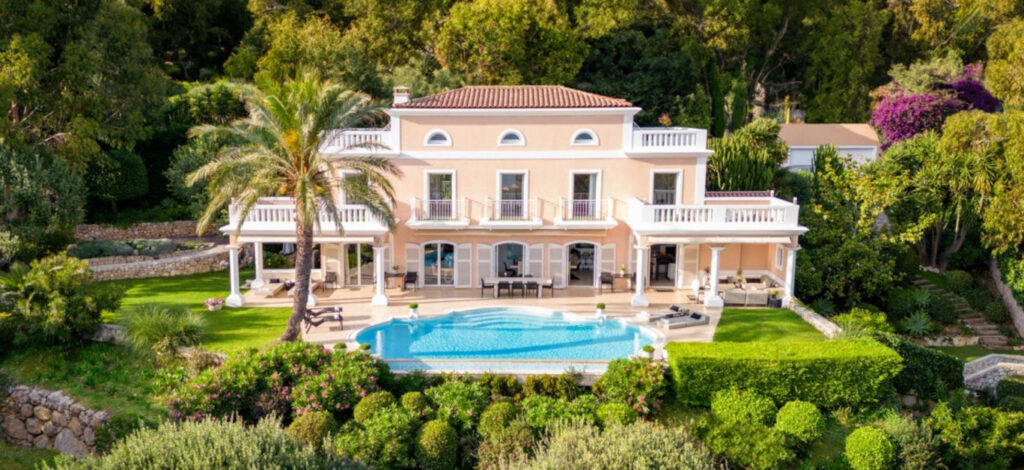
Like Chateau Marmont in Los Angeles, certain places carry a presence that goes beyond architecture. Villa Monaco, set at the border of Monaco in Cap-d’Ail, belongs to that rare category – an interior with its own rhythm, where design is not staged, but lived.
There is a deeper resonance here, rooted in the history of the Côte d’Azur. Since the Belle Époque, this coastline has attracted connoisseurs and collectors, people drawn not only to light and landscape, but to art, craftsmanship, and the quiet rituals of refined living. Villa Monaco continues that tradition, not as a statement, but as a lived environment.
Set on a former olive plantation with its 200 years old trees, and concealed behind high hedges but at the same time overlooking the Mediterranean Sea, the estate reveals itself only gradually. The gates open, a long driveway unfolds, and then the two villas appear composed, assured, and timeless.
What emerges is not display, but a certain inherited sensibility: discretion, permanence, and an ease that suggests continuity across generations. A Riviera retreat in the truest sense.
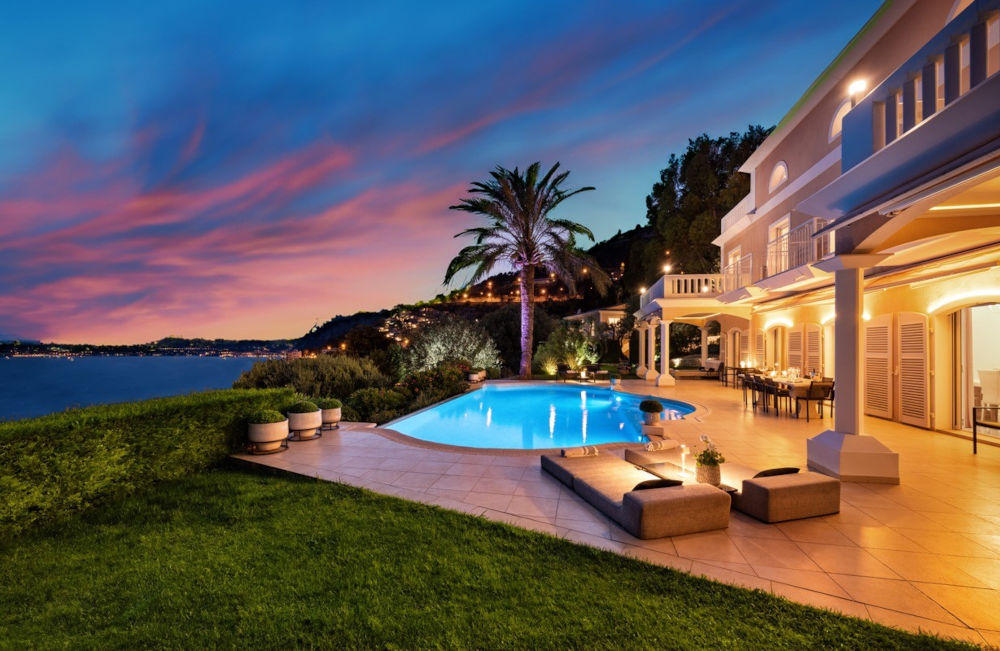 Outside, an infinity pool stretches toward the horizon
A living space without borders
Inside, the ground floor opens into a composition where dining and living areas flow together without separation. At its centre, a long custom made marble table stretches across the room, surrounded by 14 vintage designer chairs in beige and black leather.
Here, Italian postmodernism meets early modernist Vienna: Regia chairs by Antonello Mosca for Ycami and Luisa chairs by Marcello Cuneo are anchored by the Purkersdorf armchair by Josef Hoffmann, created with Koloman Moser.
Even without knowing their origins, the impression is immediate: these are pieces that carry history.
Seating as an exploration of design history
In the adjoining living area, arranged around a large central handcrafted firestone fireplace, seating becomes an exploration of design history.
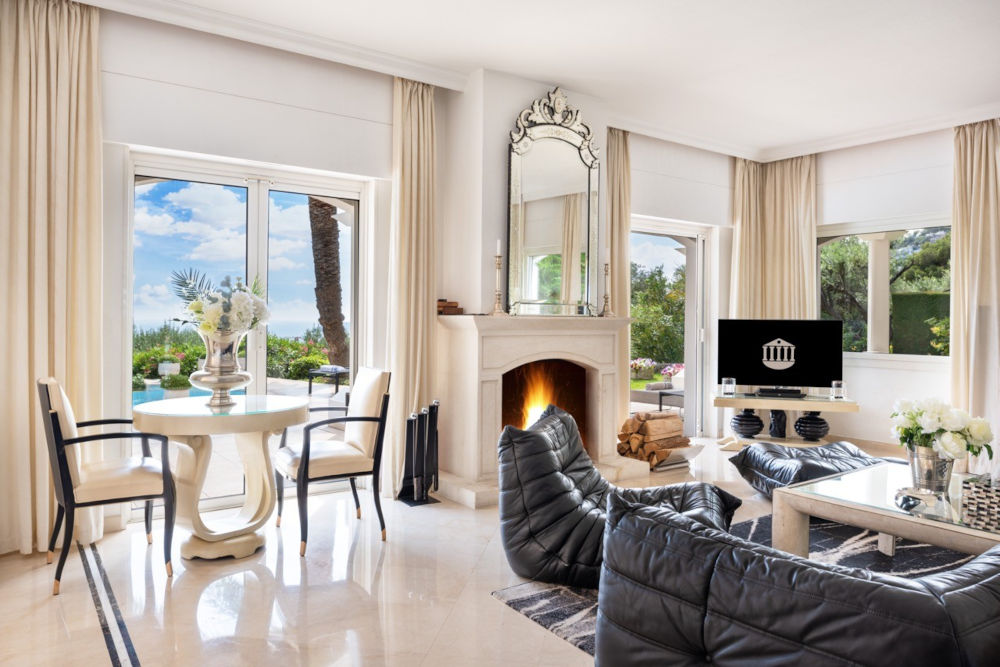 Italian postmodernism meets early modernist Vienna in the interiors at Villa Monaco
The fire introduces a changing atmosphere – architectural clarity by day, warmth and intimacy by night. Around it, different design languages converge: a big travertine and glass couch table by Roche Bobois surrounded by the softness of the Togo sofas by Michel Ducaroy for Ligne Roset and the structured geometry of the Kubus sofa by Josef Hoffmann, and Art Deco armchairs in the tradition of Émile-Jacques Ruhlmann.
The pieces coexist naturally. Sitting moves fluidly between them. Modern comfort, early modernist geometry, and Art Deco elegance, without visual tension. It is a reminder that strong interiors do not rely on uniformity, but on balance.
A European dialogue in objects
What distinguishes Villa Monaco is the clarity of its international origins. Each piece contributes to a wider European conversation.
From France, the legacy of Art Deco and modern comfort is ever-present: works associated with Jacques Adnet, original side tables from the 1920s, and Ruhlmann inspired dining chairs reflect a period of precision and craftsmanship. Overhead, silver chandeliers by Christofle add a quiet brilliance. Bedrooms continue this lineage with contemporary pieces from Ligne Roset.
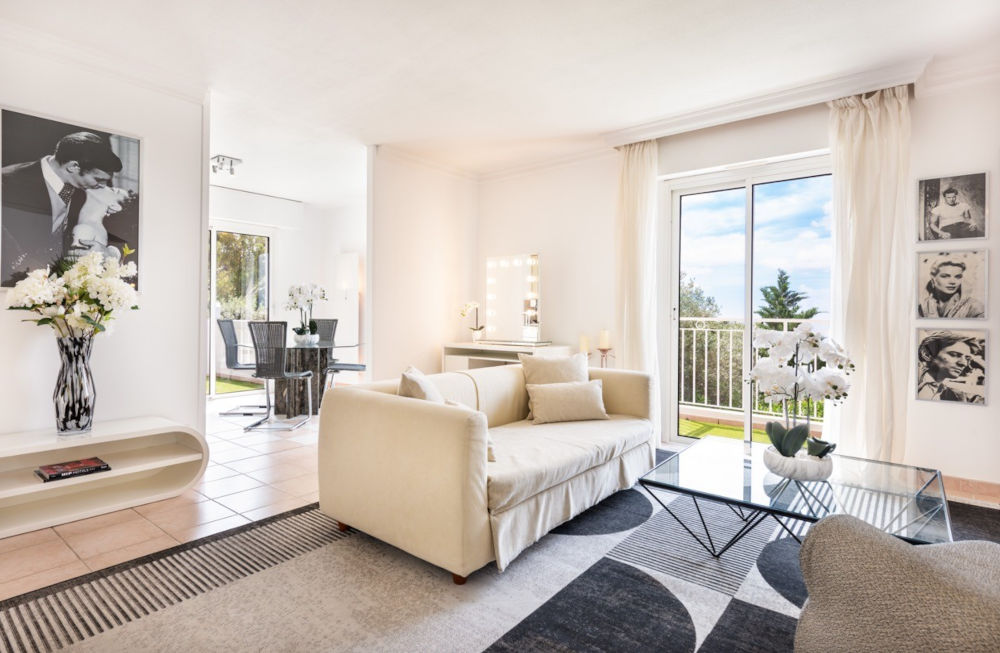 What distinguishes Villa Monaco is the clarity of its international origins
Italy introduces a different rhythm – more expressive, more sculptural. The original 19th century Murano glass mirror, rooted in centuries of Venetian craftsmanship, reflects both light and time, while the Alanda coffee table by Paolo Piva for B&B Italia brings a precise, architectural lightness.
From Austria, the influence of early modernism is unmistakable in Josef Hoffmann’s designs, where geometry becomes structure, and structure becomes identity.
Germany contributes a functional clarity through the tubular lighting system by Rolf Krüger, designed in 1967 and awarded the iF Design Award. Even the outdoor and leisure elements reflect this precision, with handcrafted sunbeds by April Furniture.
Belgium extends the dialogue outdoors through furniture by Royal Botania, designed by Kris Van Puyvelde, while a singular American note appears in the form of a 1918 New York barber chair – an object that carries its own cultural narrative.
Light, sea, and continuity
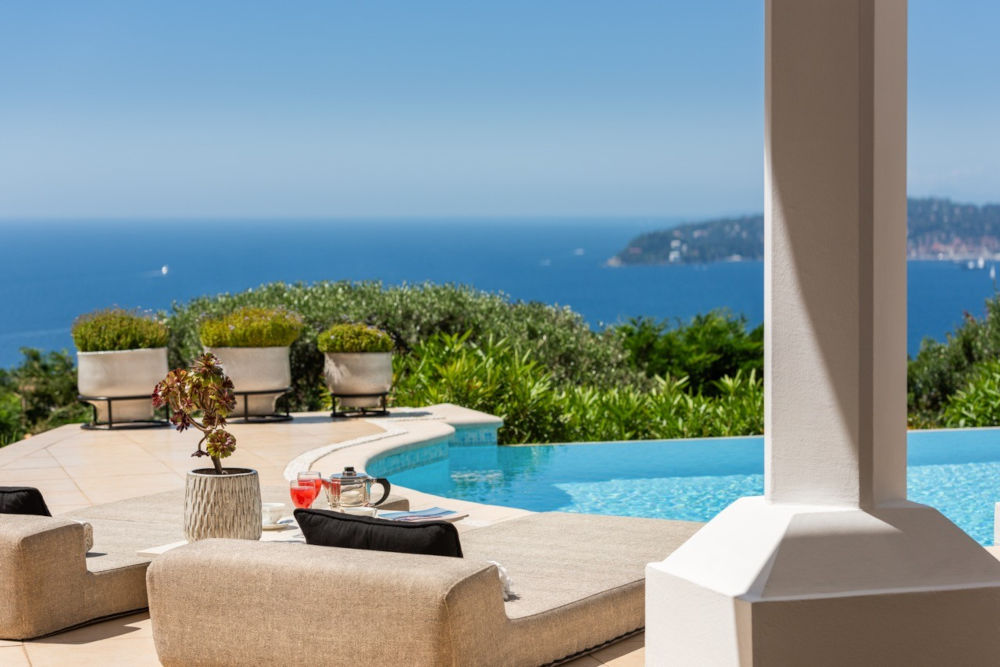 From every room, the gaze extends outward to the Mediterranean Sea
From every room, the gaze extends outward to the Mediterranean Sea. Its shifting azur tones mirror the calm palette inside, creating a constant dialogue between interior and landscape.
Outside, an infinity pool stretches toward the horizon, dissolving the boundary between architecture and nature. The effect is quiet, almost meditative.
Objects that carry time
Details deepen the experience. At dinner, the table is set with vintage silver cutlery, Model Monte Carlo, produced by the Nice-based silversmith Royal. Once used in the grand hotels of the Riviera, these pieces bring with them a memory of another era – of service, ceremony, tradition and time.
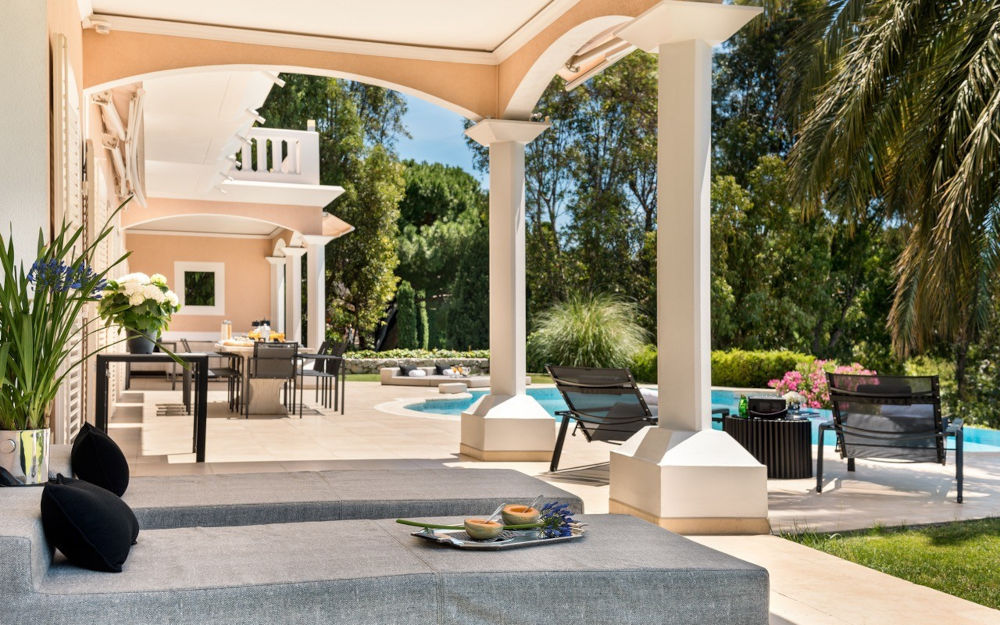 Villa Monaco is set on a former olive plantation with 200 years old trees
Living with design
Villa Monaco is not a collection to be observed, but an environment to be experienced. You sit on it, move through it, live with it.
Over time, distinctions between countries, periods, and styles begin to dissolve. What remains is something more essential: proportion, material, atmosphere.
In this sense, Villa Monaco stands as a hidden interior design gem on the French Riviera. A place where objects are not isolated, but part of a larger continuity. And where every piece, when touched, carries a quiet sense of where it has been.
Factbox
Address: 9-11 Chemin des Eucalyptus, 06320 Cap d’Ail, France
Website: www.villa-monaco.fr
Imagery credit: David Capellari