
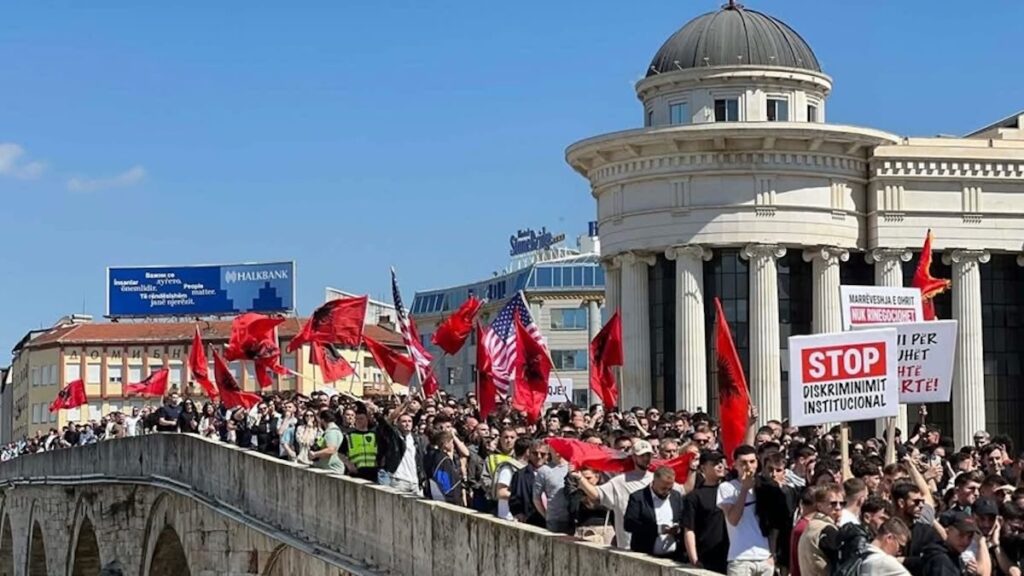
In April of 2026, ethnic Albanian students and faculty took to the streets in Skopje, North Macedonia to protest the inability to take the law bar exam in Albanian. Ethnic Albanians make up over 25 percent of the country’s population, and yet, are unable to take this test in their primary language. The lack of access to an examination in their own language not only has massive economic and career consequences, (1) but it also limits the legal minority rights granted in international human rights conventions. Thus, I argue that because there are ample domestic and international human rights documents that supports ethnic minorities have access to education examinations in their own language, the government should immediately move to rectify this failure and ensure Albanian language tests are made available to those who request them.
The Republic of North Macedonia has ratified several international human rights documents recognizing minority rights in matters of education. Beginning with the United Nations, North Macedonia is a party to the Convention against Discrimination in Education, (2) where the document, among other protections, “promotes equality of educational opportunity”. (3) Along with this convention, North Macedonia has also ratified the Council of Europe Framework Convention for the Protection of National Minorities (FCNM). (4) This document calls for various rights for ethnic minorities, including rights that align with demands for minority language in education. For example, Article 6 of the (FCNM) states that “The Parties shall encourage a spirit of tolerance and intercultural dialogue and take effective measures to promote mutual respect and understanding and co-operation among all persons living on their territory, irrespective of those persons’ ethnic, cultural, linguistic or religious identity, in particular in the fields of education, culture and the media.” Offering education examinations in the student’s language of study fits squarely within promoting said understanding and cooperation within the realm of education. Moreover, Article 10 of the framework convention notes that “In areas inhabited by persons belonging to national minorities traditionally or in substantial numbers, if those persons so request and where such as request corresponds to a real need, the Parties shall endeavour to ensure, as far as possible, the conditions which would make it possible to use the minority language in relations between those persons and the administrative authorities.” Creating and administering Albanian language examinations is a direct example of the use of Albanian to further support ethnic minority rights and illustrates the North Macedonian government’s recognition of these protections as required by international law.
Along with North Macedonia’s commitment to such global human rights documents, one can look to the 2001 Ohrid Framework Agreement (5) –a peace deal to settle fighting between Albanian minorities and the Macedonian state–to find further government legal protections, which include matters of education for ethnic minorities within North Macedonia. For example, in the Ohrid Agreement, it states clearly that “Any other language spoken by at least 20 percent of the population is also an official language, as set forth herein. In the organs of the Republic of Macedonia, any official language other than Macedonian may be used in accordance with the law…B. Any person living in a unit of local self-government in which at least 20 percent of the population speaks an official language other than Macedonian may use any official language to communicate with the regional office of the central government with responsibility for that municipality; such an office will reply in that language in addition to Macedonian. Any person may use any official language to communicate with a main office of the central government, which will reply in that language in addition to Macedonian.” By not offering Albanian-language bar exams, the state is violating the right of full communication by the ethnic minority, both in discourse with the state. Later articles (such as Article 6.7) further call for minority language support in matters “criminal and civil judicial proceedings”, something that becomes quite limiting if Albanian speaking lawyers feel discouraged in any way from entering the legal profession.
Therefore, in the spirit of international human rights documents, as well as the 2001 Ohrid Agreement, North Macedonian leaders must commit to fostering equal opportunities for the Albanian minorities, which should include the offering of testing in Albanian language. By following through with this request, The Republic of North Macedonia is not only abiding by international human rights treaties that they have ratified, but they are also showing the region, the European Union, and the world, of their commitment to democracy. However, the avoidance of offering examinations in Albanian not only violates the spirit of these global human rights conventions but also suggests that state majority leaders are willing to prioritize ethnic politics over equality for its entire population. Such discrimination must not only be stopped, but any continuation of these restrictive policies must continue to be met through protests and calls for minority rights justice.
Endnotes:
- Rexhaj, Xhavit (2026). Testing the Future: North Macedonia’s Non-Existent Albanian Language Bar Exam. Prishtina Insight, 15/04/26. Available Online: https://prishtinainsight.com/testing-the-future-north-macedonias-non-existent-albanian-language-bar-exam-mag/
- UNESCO Convention Against Discrimination in Education (1962). Available Online: https://www.unesco.org/en/legal-affairs/convention-against-discrimination-education#item-2
- UNESCO (2024). Convention Against Discrmination in Education. UNESCO, 18 September, 2024. Available Online: https://www.unesco.org/en/right-education/convention-against-discrimination
- Council of Europe Framework Convention for the Protection of National Minorities (FCNM). Available Online: https://www.coe.int/en/web/minorities
- Ohrid Framework Agreement (2001). Available Online: https://cdn.osce.org/sites/default/files/f/documents/2/8/100622.pdf