
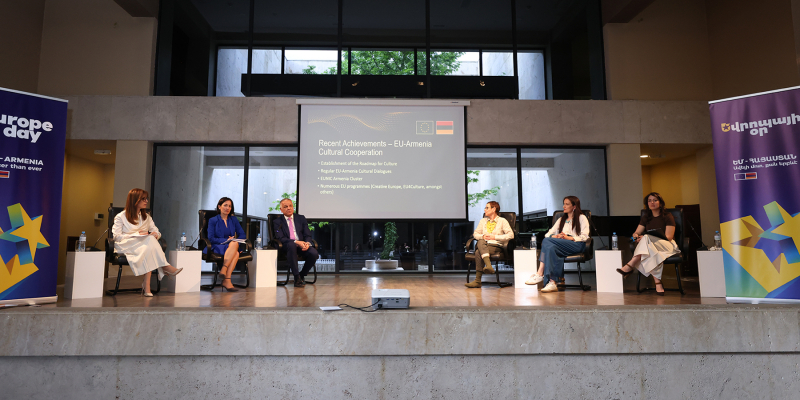

Days after the first historic EU summit in Yerevan, which reaffirmed the strategic importance of the partnership between the European Union and Armenia, the second meeting of the Armenia-EU Cultural Dialogue took place yesterday at the Komitas Museum-Institute.
It provides an opportunity to translate political commitments into concrete cultural actions, demonstrating how creativity, heritage, and innovation can strengthen social stability, create new economic opportunities, and foster people-to-people connections.
The cultural sector’s response with creative and innovative approaches
The event was organized by the EU Delegation to Armenia and the RA Ministry of Education, Culture and Sports, in cooperation with the EUNIC Armenia cultural cluster. The event was attended by the Minister of Education, Culture and Sports, Zhanna Andreasyan; the Head of the EU Delegation to Armenia, Ambassador Vasilis Maragos; the Deputy Minister, Artur Martirosyan; artists; policymakers; and international partners.
Welcoming the attendees, Zhanna Andreasyan thanked the EU delegation for effective cooperation in the field of Culture. According to her, this platform is an important opportunity not only to ensure the visibility of bilateral cooperation, but also to generate new ideas and set new targets. The Minister noted that recent events have opened new opportunities in Armenia-EU relations, and that the cultural sector, in particular, must respond to these processes with creative and innovative approaches. According to her, Culture’s mission is to formulate goals that seem unattainable at first glance, uniting the public.
Zhanna Andreasyan referred to the Strategy for the Preservation, Development, and Popularization of the Culture of the Republic of Armenia for 2023-2027, approved in 2023, which was developed through the joint work of international partners, creators, non-governmental organizations, and sector representatives. She noted that already today, ahead of the 2027 review stage, significant progress is visible. Expenditures on cultural heritage preservation in 2025 increased by 542 percent compared to 2022. This is the result of a policy not only of preservation, but also of making heritage accessible to the public. I believe that monuments should be considered not only as preserved values, but also as active components of public life and tourism development.”
The Minister of Culture, Sports and Tourism also highlighted initiatives in the museum sector, noting that the state will continue its policy of returning and acquiring cultural values. As an example, he mentioned the medieval door leaf acquired for the History Museum of Armenia and Arshile Gorky’s work for the National Gallery. According to him, this policy simultaneously strengthens the state’s responsibility towards cultural values and makes museums more attractive and accessible to the public.
According to the Minister, museum visits have increased by about 40 percent compared to 2021, and the “Museum Night” event has already become a major public event.
Armenian Culture as a direction of public development
Regarding the relationship between Culture and the economy, Zhanna Andreasyan noted that, for many years, Culture has been perceived as a sphere that only needs patronage. However, she is convinced that Armenian Culture has a self-sufficient potential that contributes to economic development: “The Culture of Armenia can become a direction of public development and proudly record that it does not absorb, but rather gives the public a great potential for the development of creativity and cultural production. I believe that the task of the state is to set the right incentives to develop this potential, and this is precisely what the programs approved by the culture strategy and implemented in recent years are aimed at.”
The Minister also highlighted the introduction of a new financing model for theater and concert organizations, noting that it has contributed to increased financial flows and the revitalization of cultural life. In particular, A. The activity recorded at the Spendiaryan National Academic Opera and Ballet Theater, the Hovhannes Tumanyan National Puppet Theater, and the Yerevan State Chamber Theater, as well as the tours and programs implemented in the regions, have proven the effectiveness of the new model.
Promoting equal opportunities for talent development
The decentralization of cultural life is also, according to the Minister, one of the key directions of the 2023-2027 Strategy for the Preservation, Development, and Popularization of Culture of the Republic of Armenia. The “Festival” music and tourism festival, implemented in the regions, serves this purpose by bringing major cultural events to different communities. He also attached particular importance to cultural education, noting that more than 330 thousand students, about 84 percent of schoolchildren, are already using the school subscription program. According to the Minister, the state will continue to develop the cultural educational environment, ensuring proper conditions for art and music schools, so that children can discover and develop their talent.
Head of the EU Delegation to Armenia, Ambassador Vasilis Maragos, in the context of the dynamic development of Armenia-EU relations, particularly attached importance to the development of cultural ties: “Culture is intertwined with society. It is a platform that gives us identity, voice, and a sense of belonging. For the European Union, cultural dialogue with Armenia is not just an exchange of traditions. It marks our common values: freedom, democracy, inclusiveness, diversity, innovation, and the conviction that our cultural heritage and creativity build bridges between the past and the future. The EU-Armenia Cultural Engagement Roadmap will be a key component of our connectivity and partnership, according to which Culture is the basis of trust, mutual understanding, and joint progress.”
Deputy Minister of Culture, Youth and Sports Artur Martirosyan, in his welcoming speech, noted that such a platform for Armenia-EU dialogue creates an opportunity to discuss the current situation in the field of Culture, achievements, problems, as well as to understand the ways of integrating into the Culture of the greater European area.
“We encourage contacts with the European region in various formats, including at the level of cultural institutions, individual creators, and self-employed artists. Armenian Culture is an integral part of European Culture. In the development of capacities and the introduction of procedures, we attach importance to European standards and the support of the European Union and member states for their compliance,” said the Deputy Minister of Culture, Youth and Sports, and thanked the ambassadors of European countries to Armenia for their continuous cooperation in the field of Culture. Artur Martirosyan emphasized Armenia’s participation in the European Union’s Creative Europe platform and the EU4Culture program as a broad opportunity to promote cooperation in the field of Culture.
From policy to practical steps: The power of cultural cooperation
In recent years, Armenia’s cultural sector has undergone significant transformations, based on several important strategic documents, such as the Strategy for the Preservation, Development and Promotion of Culture of the Republic of Armenia 2023–2027 and its Action Plan, as well as the EU-Armenia Comprehensive and Enhanced Partnership Agreement (CEPA) and the Armenia-EU Cultural Roadmap.
The results of cooperation in the field of Culture are visible and multifaceted, ranging from the restoration of historical and cultural monuments to the empowerment of emerging artists and the digitization of cultural heritage.
The Armenia-EU cultural dialogue focuses on the following questions: how can Armenia’s cultural and creative sectors thrive in an increasingly interconnected world, what role can Culture play in deepening Armenia-EU relations, and how can artists, institutions, and policymakers work together to ensure the preservation and development of Armenia’s rich cultural identity and vitality. Strengthening cultural cooperation between the European Union and Armenia is essential for building a sustainable and inclusive society.
The meeting addressed the challenges facing the region, from funding gaps to the need to strengthen links between cultural initiatives and private investment.
The participants also had the opportunity to hear from leading representatives of the Armenian cultural sector, who highlighted the diversity and dynamism of the Armenian cultural landscape.