
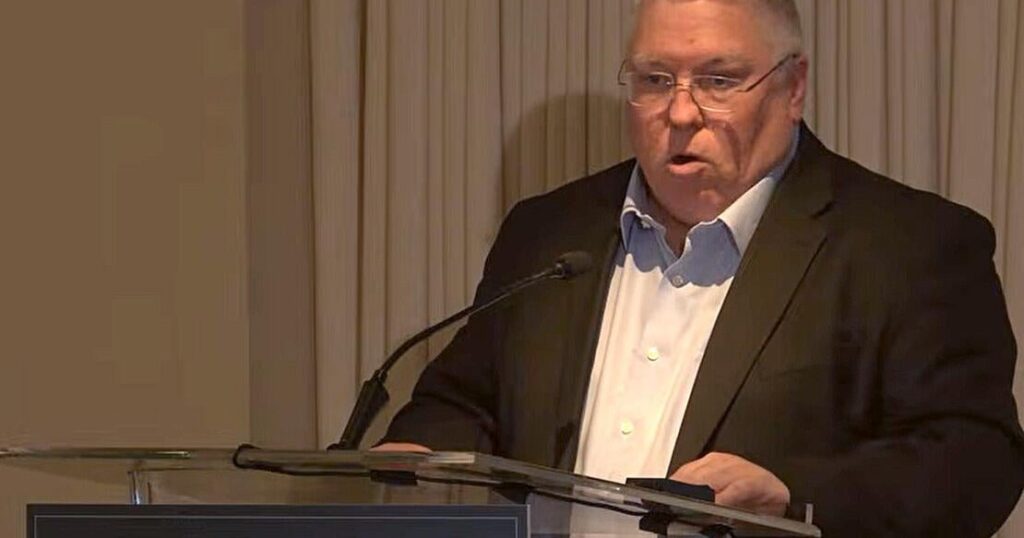

In this frame grab from video, Gov. Patrick Morrisey delivers a lunchtime keynote address during the second day of the Heartland Institute’s International Conference on Climate Change on April 9, 2026 at the Hotel Washington in Washington, D.C.
The Heartland Institute | Courtesy image
The governor of West Virginia stood against established scientific consensus in Washington, D.C., last month.
Patrick Morrisey did so by standing with leaders and supporters of the Heartland Institute, a think tank known for denying the scientific consensus that climate change is real and a human-driven threat to global health via extreme weather events and air pollution that proliferate disease and limit food availability.
The event, the 16th International Conference on Climate Change, was hosted by the Schaumberg, Ill.-based institute, which bills itself as one of the world’s leading free-market think tanks but is best known for its advocacy denying climate change.
The Heartland Institute has been funded by ExxonMobil and other energy industry groups before they moved away from climate denialism.
The institute reported in its Form 990 form for 2024 to the IRS that it has 13 websites, 474,000 Facebook page fans, over 94,000 X (then Twitter) followers, podcasts downloaded hundreds of thousands of times and videos attracting over 2.5 million views.
Morrisey opened his nearly 40-minute address on April 9 by recalling his “first experience with this incredible group” when he was deputy staff director and chief health counsel for United States House Energy and Commerce Committee, posts he held from 1999 to 2004.
“I remember always enjoying my meetings with Heartland, because you would get the most fascinating, interesting and correct interpretations of issues,” Morrisey told those in attendance.
Morrisey boasted about his subsequent work as attorney general fighting federal environmental regulations, including via West Virginia v. Environmental Protection Agency. That case prompted a U.S. Supreme Court ruling in 2022 that limited the EPA’s ability to regulate greenhouse gases.
Morrisey suggested that climate regulations were designed to force “hundreds of thousands of people … into poverty in Appalachia” and said efforts to “shut down coal and eliminate the use of gas” were “an affront to basic moral decency.”
But Morrisey wasn’t the event headliner.
That billing went to EPA Administrator Lee Zeldin, who spoke the day before Morrisey at the two-day conference.
“Wow. This is exciting. I feel a little bit like the guy who’s introducing Elvis or, ladies and gentlemen, the Rolling Stones,’” Craig Rucker, cofounder of Committee For A Constructive Tomorrow, a Washington, D.C.-based climate denialist group, said upon introducing Zeldin on April 8.
Zeldin touted the EPA’s February 2026 reversal of its 2009 landmark finding that greenhouse gases threaten public health, what’s known as the Endangerment Finding.
Based on assessments of U.S. and international science advisers, that finding has provided the legal underpinning for EPA standards for greenhouse gas emissions that worsen climate change responsible for increasingly extreme weather patterns that have proven economically and environmentally costly in West Virginia.
The EPA had, in proposing rulemaking rescinding the finding, cited a new Department of Energy report to claim that “extreme weather events have not demonstrably increased relative to historical highs.”
But scientists said the DOE report relied on climate disinformation, cherry-picking data to undermine climate science established through decades of peer-reviewed research.
The U.S. experienced one inflation-adjusted billion-dollar disaster every four months in the 1980s, according to the most recent congressionally mandated National Climate Assessment, released in 2023 and removed from its original website under the Trump administration. The assessment found that disaster frequency had escalated to one every three weeks on average.
Nearly a quarter of West Virginia’s billion-dollar disasters from 1980 to 2024 (11 out of 45; 24%) came in just the last five years of that span, according to National Oceanic and Atmospheric Administration data.
“Fortunately, because of the election of [President] Donald Trump, which many of you worked very hard to make possible, you were given a great surprise decades earlier than expected,” Zeldin told conference-goers, praising the climate denialist chief executive who appointed him head of the EPA. “There might have been times when you were wondering whether or not that vindication was going to come any earlier than 2100. This morning and today, all of you gathered here in D.C., is a moment to celebrate. It is a day to celebrate vindication.”
As the conference continued, the rhetoric got darker.
Benjamin Zycher, senior fellow at the American Enterprise Institute, a right-wing think tank, called the “climate alarmist stance” “fundamentally antihuman,” likening it to Nazism.
“The alarmist view is that humans are little more than environmentally destructive mouths to feed without moral standing, without the inventiveness, ingenuity and intelligence to solve problems,” Zycher asserted. “That is the basic philosophical stance, which is inconsistent with the adaptation model. The Nazi term was ‘useless eaters,’ and that is literally how the environmental leftists view humanity.”
Despite incontrovertible evidence that people are amplifying the natural greenhouse effect by adding more carbon dioxide to the atmosphere, thus triggering a global temperature increase, William Happer, climate science skeptic and Princeton University physics professor emeritus, denied that “temperature has had much consequence from CO2.”
But according to an analysis by the National Oceanic and Atmospheric Administration Global Monitoring Laboratory, carbon dioxide alone is responsible for about 80% of the total heating influence of all human-produced greenhouse gases since 1990.
“Lots and lots of people have been brainwashed into thinking that there’s a crisis and therefore we have to fix it,” Happer said.
Harrowing evidence of climate change in W.Va.
Those who deny climate change on Earth deny a harsh climate reality for West Virginia.
West Virginia suffered 380 flash flood events from 2019 through 2023, according to NOAA data — an average of one in every 4.8 days.
Those flash flood events marked a 26% increase over the 301 the NOAA recorded in the previous five-year span, a 51% climb over the 252 recorded from the five-year span before that and a 169% rise from the 141 recorded from 2004 through 2008.
Of Kanawha County’s 81 flash floods from the start of 2004 through March 2025, 64, or 79%, have come since the June 2016 flood, demonstrating the increasing frequency of the events.
Climate change has triggered longer and more intense allergy seasons in West Virginia, where average annual temperatures have climbed 2.9 degrees Fahrenheit since 1970, according to an analysis by Climate Central, a nonprofit group of scientists and communicators.
The 2023 National Climate Assessment found that risks from extreme weather events were increasing, causing direct economic losses through infrastructure damage, disruptions in labor and public services and losses in property values. The report noted a rise in heat-related illnesses and death, costlier storm damages, longer droughts that lower agricultural output and strain water systems, and more severe wildfires that threaten homes and degrade air quality.
West Virginia’s disproportionately high greenhouse gas emissions raise the stakes for environmental protection — or lack thereof — from the EPA, driven by a clinging to coal that has kept those emissions from dropping as they have in neighboring states.
West Virginia’s average carbon dioxide emissions rate exceeded 2,000 pounds per megawatt-hour in 2024, just as it did in 2005, according to data from PJM Interconnection LLC, the regional grid operator that covers West Virginia and all or part of 12 other states.
But the average carbon dioxide emissions rate across all PJM territory plummeted from just under 1,300 pounds per megawatt-hour in 2005 to below 750 in 2024 — roughly a third of West Virginia’s rate.
West Virginia’s energy-related carbon dioxide emissions per capita have increased 62.5% from 25.9 metric tons in 1960 to 42.1 in 2023 — the fourth-highest total nationwide below only Wyoming, North Dakota and Alaska, all states with populations less than half of West Virginia’s.
Meanwhile, the U.S. per capita energy-related carbon dioxide emissions rate fell from 16.1 metric tons in 1960 to 14.2 in 2023 — an 11.8% decrease over the same span as West Virginia’s 62.5% increase.
The EPA has held under Trump that greenhouse gas emissions from fossil fuel-fired power plants don’t contribute significantly to dangerous air pollution.
West Virginia had the second-highest asthma prevalence rate nationwide in 2021, per Centers for Disease Control and Prevention data.
W.Va. group: Endangerment Finding ax ‘has no basis in law’
Still, in recent years, there has been hope for a brighter climate future and legal precedent with which to pursue it.
Projections from scientists at NASA and Duke and Columbia universities published in 2021 held that reducing global emissions over the next 50 years to keep global warming under 2 degrees Celsius through the end of the century would prevent about 4.5 million premature deaths, 1.4 million hospitalizations and emergency room visits and 300 million lost workdays in the U.S.
A 2007 Supreme Court decision, Massachusetts v. EPA, that indicated the EPA had the authority to regulate greenhouse gases and that the EPA could not decline to exercise that authority for policy reasons.
“That EPA would prefer not to regulate greenhouse gases because of some residual uncertainty … is irrelevant,” then-Justice John Paul Stevens wrote in the court’s opinion.
On the same day that Zeldin addressed the Heartland Institute conference, the West Virginia Highlands Conservancy joined other environmental groups as well as Alaskan tribes to sue the EPA, contending they had unlawfully repealed the Endangerment Finding in addition to motor vehicle emissions standards.
“[T]he EPA is ignoring decades of scientific evidence and turning its back on its legal obligation to protect human health and welfare,” Olivia Miller, interim executive director of the West Virginia Highlands Conservancy, said in a statement last month. “By weakening these protections, this decision puts West Virginians’ health and safety at even greater risk. It has no basis in law, science, or reality, and that is why we are challenging it in court.”
State group argues against ‘weak coal ash enforcement’
The next day, April 9, the EPA proposed a major rollback of its 2024 move under the Biden administration to close a regulatory loophole on coal ash that harms air, drinking water, groundwater and waterways.
The EPA had in 2024 issued a rule tightening regulations at inactive coal ash surface impoundments at inactive facilities, known as legacy surface impoundments.
The rule looms especially large in West Virginia given the state’s high concentration of shuttered coal-fired plants that have legacy surface impoundments, which are more likely to be unlined and unmonitored, making them more vulnerable to leaks and structural issues.
Also known as coal combustion residuals, coal ash is a product of coal-fired power plants. The residuals include fly ash, a powdery material made mostly of toxic silica dust. Some power plants dispose of coal ash in surface impoundments or landfills.
The EPA published a list of nearly two dozen legacy coal ash surface impoundments in West Virginia out of nearly 200 nationwide upon releasing its rule targeting such impoundments in April 2024.
The EPA has estimated annual monetized costs of $214 million and $240 million as well as benefits of $53 million to $80 million a year, plus nonmonetized benefits that include:
-
Boosts to human health from reducing lead exposure linked to increased cancer risk and cardiovascular mortality
-
Healthier ecosystems from avoided exposure to heavy metals in coal-ash effluent
-
Increased property values near closed and remediated coal ash units and option values for remediated land
But the EPA under Trump and Zeldin has proposed what it has called an “alternative compliance pathway” for coal combustion residual units complying with groundwater monitoring, corrective action and closure requirements under permits, allowing in part for site-specific cleanup levels during corrective action for constituents without a federal maximum contaminant level.
The EPA’s proposal is expected to narrow the scope of coal property cleanups and ease coal ash reuse.
Earthjustice, a national nonprofit environmental law firm, predicted the proposal would result in more toxic waste leaking into drinking water, rivers, lakes and streams.
“We cannot allow for weak coal ash enforcement and continued corporate irresponsibility,” Lisa Di Bartolomeo, Sierra Club West Virginia’s Beyond Coal campaign organizer, said in a statement. “Stringent standards and strong enforcement ensure compliance, weakening standards or delaying enforcement do not.”
A 2019 report from Earthjustice and the Environmental Integrity Project, an environmental advocacy group, found that 91% of U.S. coal plants were causing unsafe levels of groundwater contamination, often with arsenic, a carcinogen.
“The Trump administration just took a sledgehammer to the health protections in place for toxic coal pollution,” Lisa Evans, senior counsel at Earthjustice, said in a statement last month. “This is yet another handout to the coal power industry at the expense of our health, water, and wallets.”
Morrisey to Heartland: ‘I’ll look forward to seeing you’
Yet, West Virginia job figures suggest the state’s coal industry has struggled under Trump.
Mining and logging jobs in West Virginia fell 17.8% over the course of Trump’s first term to 17,100, climbed back up by 22.8% to 21,000 from January 2021 to January 2025 under then-President Joe Biden and then dropped again by 2.9% from January 2025 to January 2026 upon Trump’s White House return, according to U.S. Bureau of Labor Statistics data.
Morrisey wound down his speech by expressing support for the Endangerment Finding repeal, suggesting it would help “limit all the damage when the other side is in office.”
Then he thanked those before him for “all of your support over the years.”
“I’ve seen a lot of friends in the audience,” Morrisey said, “and I’ll look forward to seeing you again at the next event.”