
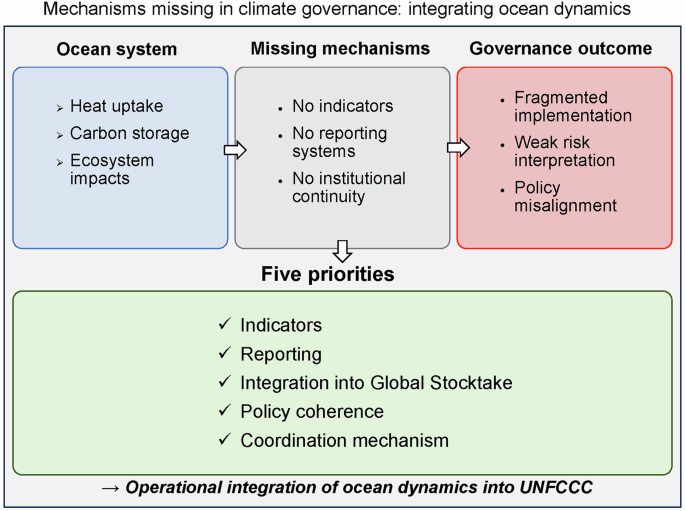
This structural limitation can be understood as an “ocean blind spot” in climate governance, where ocean dynamics are acknowledged conceptually but remain absent from operational mechanisms. Climate governance relies on a set of core mechanisms that translate scientific knowledge into policy and implementation. In the case of the ocean, three elements remain underdeveloped or absent: standardized indicators, systematic reporting and institutional continuity.
The UNFCCC lacks the institutional tools required to translate ocean science into climate governance. COP decisions often reference the ocean through broad “considerations”, but these do not trigger reporting, accountability or alignment5. Climate governance depends on indicators—metrics widely used in IPCC and WMO assessments1,3—yet none of the Essential Ocean Variables defined by GOOS are incorporated into UNFCCC reporting requirements or decision-making processes13. Without standardized indicators, ocean change cannot be systematically incorporated into climate assessments or policy processes. The result is structural under-specification: the ocean is acknowledged conceptually, yet absent operationally. Without agreed metrics, Parties cannot track trends, evaluate policies or integrate ocean dynamics into their planning cycles.
Continuity mechanisms are also missing. Parties are not required to report regularly on ocean-relevant data, no established process brings ocean information into Global Stocktake inputs or outputs4, and no institutional body coordinates ocean–climate coherence. Without regular reporting, ocean dynamics remain disconnected from national planning cycles and global stocktake processes. This pattern is consistent with broader dynamics in climate governance, where science–policy integration depends on the existence of institutional mechanisms capable of translating knowledge into decision-making. Without institutional continuity, scientific signals fail to translate into sustained governance processes.
This weakens the impact of the Stocktake itself: ocean dynamics shape emissions pathways and adaptation needs, yet their exclusion limits the ability of Parties to course-correct4. Addressing this requires a small number of well-designed mechanisms—indicators, reporting cycles, coherence frameworks and dedicated institutional capacity—that allow the UNFCCC to reflect the full climate system (Fig. 1).
 The alternative text for this image may have been generated using AI.
Ocean processes shape the pace and expression of climate risk, but remain weakly integrated into climate governance due to the absence of key institutional mechanisms, including standardized indicators, systematic reporting and institutional continuity. As a result, ocean dynamics are not consistently reflected in decision-making processes under the UNFCCC, leading to fragmented implementation and limited capacity to anticipate and respond to emerging risks. The proposed priority actions outline a pathway to operationally integrate ocean dynamics into reporting, Global Stocktake processes and policy coordination.