
Waitress The Musical has opened at Melbourne’s Her Majesty’s Theatre with Natalie Bassingthwaighte leading the Australian premiere of Sara Bareilles’ Broadway favourite, a production balancing emotional sincerity, glossy Americana and a story that still divides audiences a decade after its debut.
by Paul Cashmere
The long delayed Australian premiere of Waitress finally reached Melbourne on Thursday night, opening at Her Majesty’s Theatre with a high-profile cast led by Natalie Bassingthwaighte, Rob Mills and John Waters. Directed by Diane Paulus, the production arrives ten years after the musical first premiered on Broadway and almost two decades after Adrienne Shelly’s original 2007 indie film. The result is a polished, musically assured production that succeeds largely on the strength of Sara Bareilles’ score and a committed local cast, even while some of the show’s themes and storytelling now feel out of step with contemporary audiences.
Waitress carries considerable Broadway pedigree. The musical earned four Tony Award nominations following its 2016 Broadway debut and became historically significant as the first Broadway musical with women occupying the four principal creative roles. Bareilles composed the music and lyrics, Jessie Nelson adapted the book, Diane Paulus directed and Lorin Latarro choreographed the original production.
That history matters because Waitress still stands apart from many contemporary Broadway imports. Rather than spectacle-driven musical theatre, the show leans into intimacy, character and emotional confession. Bareilles’ folk-pop songwriting remains its defining feature, particularly the signature ballad She Used To Be Mine, which has evolved into one of the most recognisable modern musical theatre songs outside traditional Broadway circles.
At the centre of the Australian production is Bassingthwaighte as Jenna Hunterson, a waitress and gifted pie baker trapped in a coercive marriage while navigating an unexpected pregnancy and an affair with her obstetrician Dr Pomatter, played by Rob Mills. Bassingthwaighte delivers a measured performance that avoids melodrama, grounding Jenna in exhaustion and quiet resilience rather than theatrical excess.
Vocally, Bassingthwaighte builds carefully through the production before reaching the emotional peak of She Used To Be Mine late in Act Two. It is the evening’s defining performance moment and drew the strongest audience response of opening night. Her chemistry with Mills gives the production much of its warmth, even if the relationship itself remains one of the musical’s more problematic narrative devices.
Mills approaches Dr Pomatter with awkward charm and broad physical comedy, softening a storyline that still raises ethical questions around the doctor-patient relationship at the centre of the plot. The production never fully interrogates those implications, something that has increasingly become part of the broader conversation surrounding Waitress internationally.
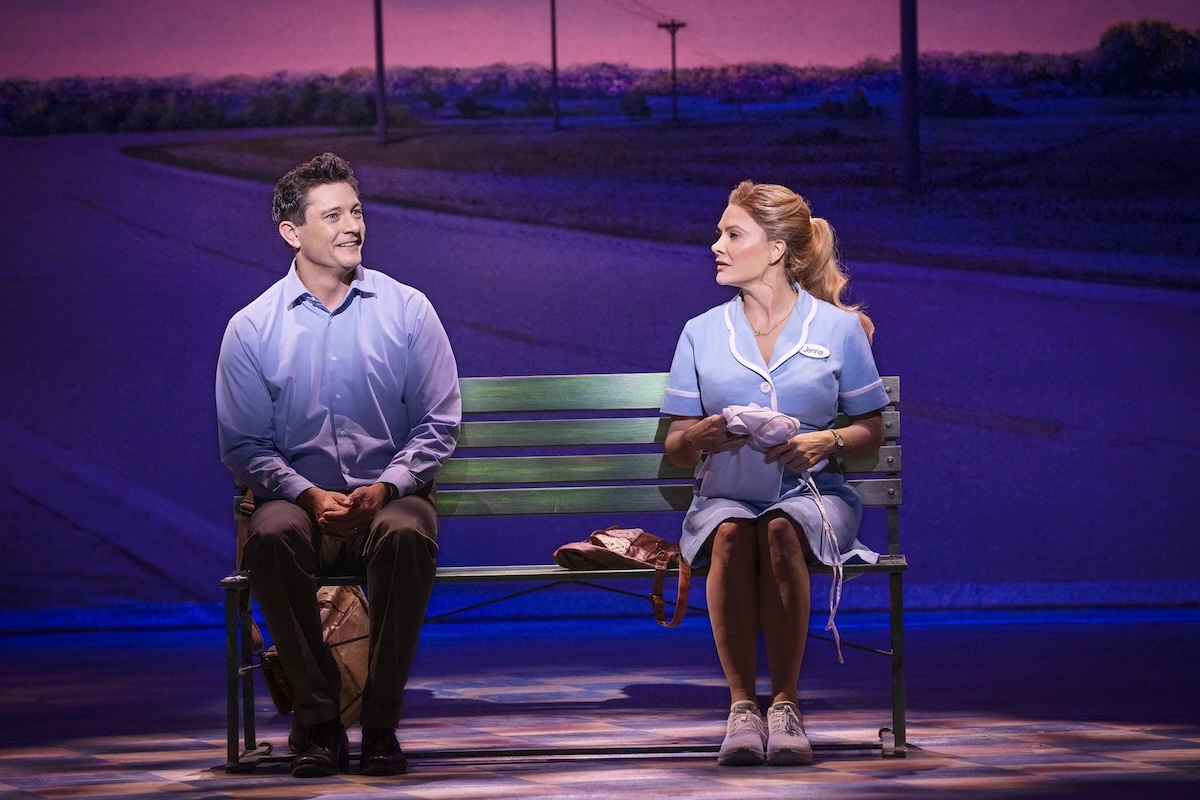
Waitress Rob Mills and Natalie Bassingthwaighte photo by Jeff Busby
Gabriyel Thomas brings authority and humour to Becky, while Mackenzie Dunn’s Dawn delivers much of the production’s lighter comic energy. Gareth Isaac nearly steals the first act with Never Ever Getting Rid Of Me, performed with precision comic timing that momentarily shifts the show into outright farce. John Waters adds gravitas as diner owner Joe, providing the production with its emotional anchor.
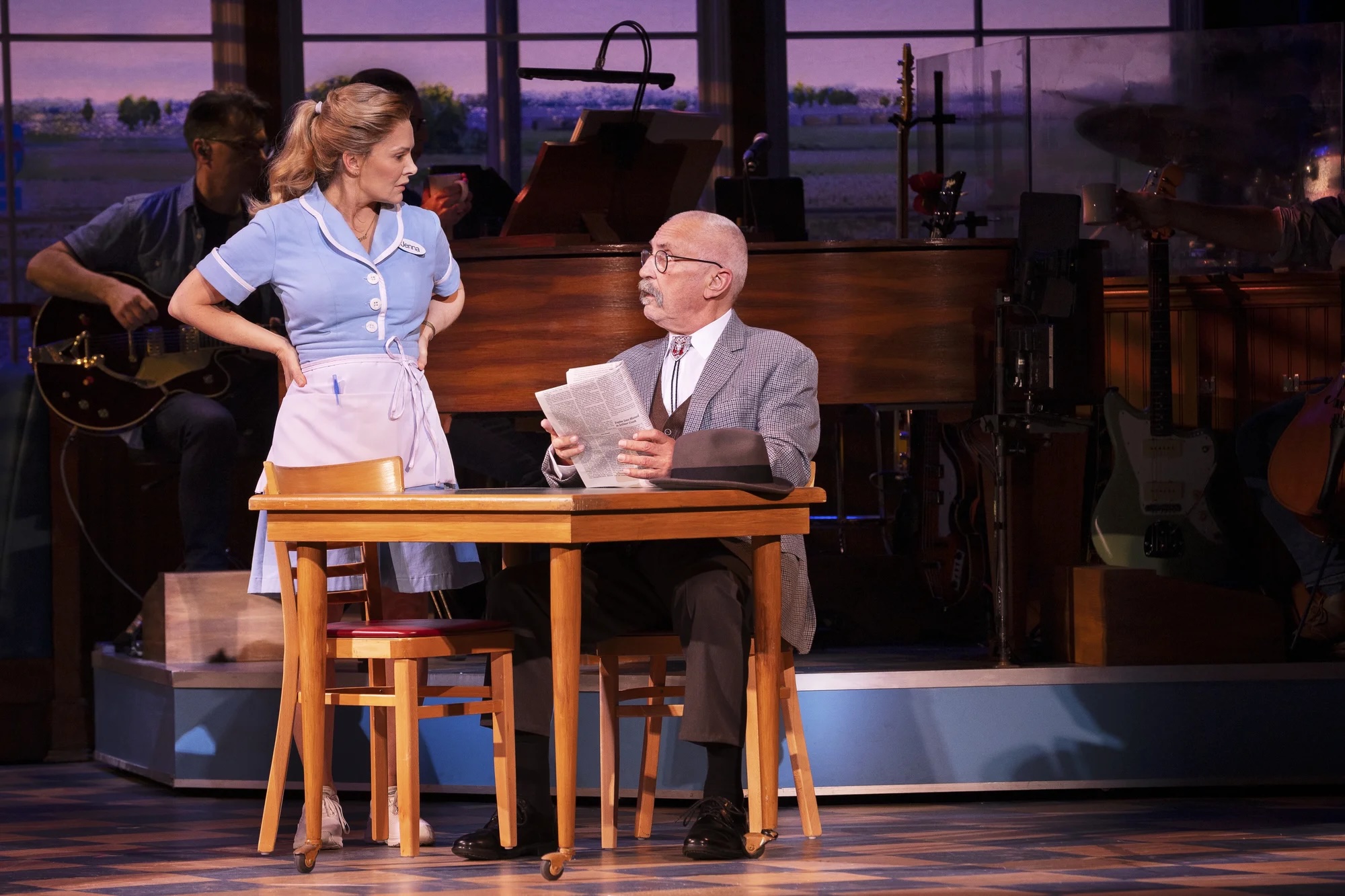
Waitress Natalie Bassingthwaighte and John Waters photo by Jeff Busby
Technically, the Australian production is exceptionally strong. Scott Pask’s diner-centred set design favours fluid transitions and avoids excessive digital staging, a welcome contrast to many contemporary musicals. Ken Billington’s lighting evokes the faded melancholy of small-town Americana, while Suttirat Anne Larlarb’s costumes maintain a grounded realism throughout.
The onstage band, under the musical direction of Geoffrey Castles, captures the warmth and rhythmic looseness of Bareilles’ score. Rather than traditional Broadway orchestration, Waitress draws heavily from pop, folk and singer-songwriter traditions, giving the production a sonic identity closer to a live concert than classic musical theatre.
Yet for all its technical polish and emotional sincerity, Waitress remains a complicated work. The musical’s central themes of empowerment and escape often sit awkwardly beside its romantic framing of adultery and its relatively simplistic treatment of domestic abuse. Earl, played with intensity by Keanu Gonzalez, is written with such overt villainy that the character rarely feels fully dimensional.
Some audience members will embrace the show’s optimism and emotional accessibility. Others may find its gender politics and relationship dynamics increasingly dated in 2026, particularly given the more nuanced storytelling now common in contemporary musical theatre. The tension between sincerity and sentimentality has followed Waitress since Broadway, and the Australian production does little to resolve that contradiction.
Still, the production arrives at a time when Australian audiences remain highly receptive to emotionally driven Broadway imports. The success of Come From Away and Dear Evan Hansen demonstrated a strong appetite for musicals grounded in contemporary emotional realism rather than spectacle alone. Waitress fits within that lineage, even if its storytelling occasionally struggles under modern scrutiny.
The Australian staging also marks another major theatrical role for Bassingthwaighte, whose transition from pop artist and television personality into musical theatre has steadily strengthened over recent years. Her performance here confirms her capability as a leading musical theatre performer able to carry both the vocal and emotional demands of a substantial role.
For audiences unfamiliar with Waitress, the production ultimately succeeds less because of its plot than because of the humanity inside Bareilles’ music. The songs provide the emotional texture that the script sometimes avoids confronting directly. In Melbourne, that emotional connection was enough to carry opening night.
Waitress now begins its Melbourne season before transferring to Sydney later this year, giving Australian audiences their first full-scale local production of one of Broadway’s most commercially successful modern musicals.
Dates:
Thursday 7 May 2026, Melbourne, Her Majesty’s Theatre
1 August 2026, Sydney, Sydney Lyric Theatre
Stay updated with your free Noise11.com daily music news email alert. Subscribe to Noise11 Music News here
Be the first to see NOISE11.com’s newest interviews and special features on YouTube. See things first-Subscribe to Noise11 on YouTube
Follow Noise11.com on social media:
Bluesky
Instagram
Facebook – Comment on the news of the day
X (Twitter)