
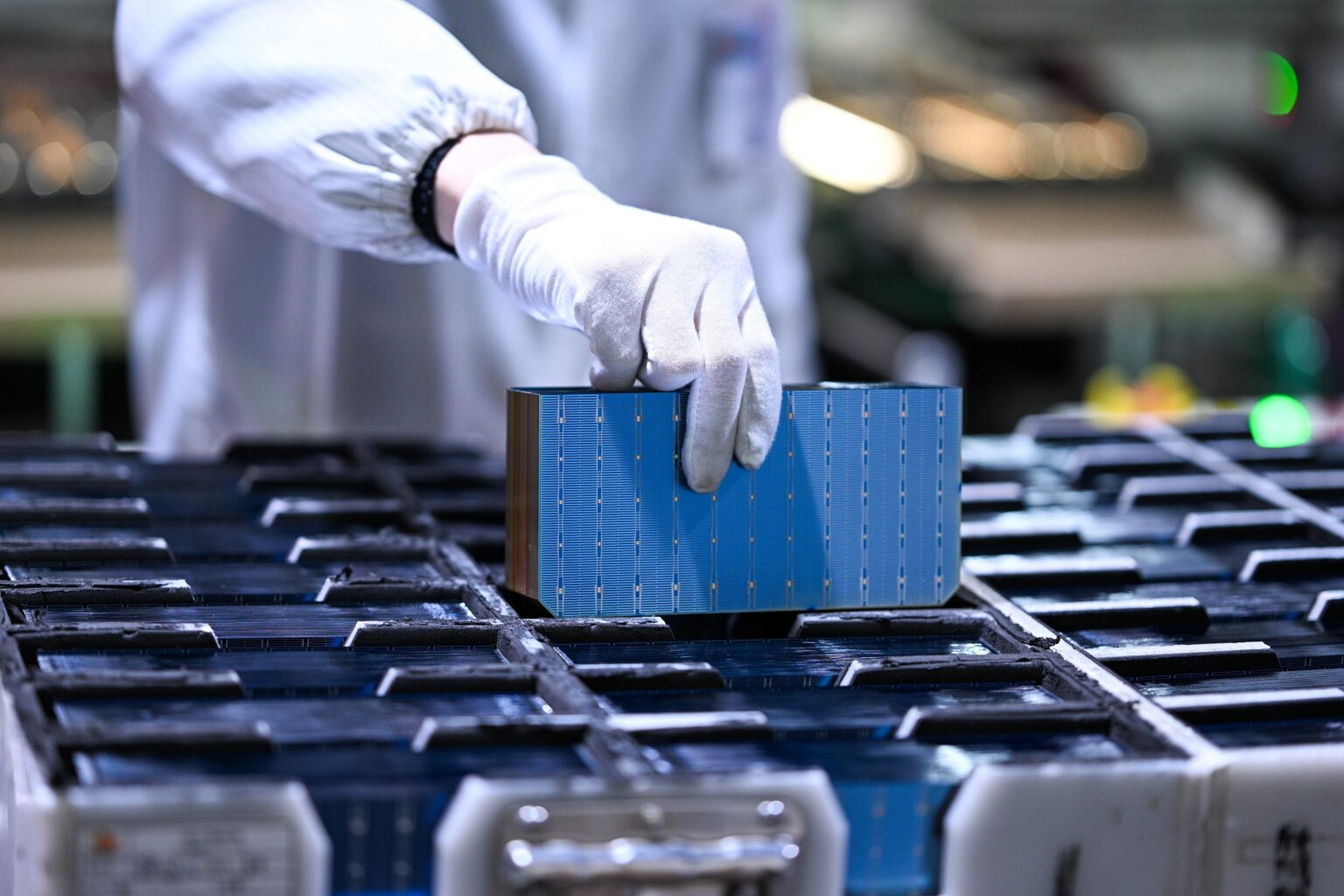
Investment in clean technology manufacturing facilities is falling worldwide. After peaking at $70 billion in 2023, quarterly manufacturing investment more than halved to $35 billion by end-2025. This is despite global demand for clean technologies growing rapidly. Since 2020, solar installations have more than tripled in China (+250 percent), while more than doubling in the United States and European Union (+132 percent and +125 percent, respectively). Also since 2020, electric vehicle (EV) sales in China have grown nearly tenfold, in the US fourfold and in the EU threefold. These three economies host 86 percent of total clean-technology manufacturing investment since 2018.
In the context of growing demand, why is global clean-tech manufacturing investment slowing? We examine the three largest clean-tech sectors: solar, batteries and EVs. The headline fall largely reflects an oversupplied market, especially falling Chinese investment in solar photovoltaic manufacturing (Figure 1) – in this respect the decline is not a cause for concern. However, the drop in battery manufacturing investment that has followed abrupt US policy changes is worrying. Amid the slowdown, European investment remains largely stable.
Overcapacity and policy reversals
Most of the global clean-tech investment drop relates to China, where investment in 2025 was down nearly 70 percent from a peak in 2023 (Figure 2). This followed years of state-led investment that secured dominance for China in solar, battery and EV supply chains and allowed Chinese firms to produce at prices no competitor could match. But the strategy also drove overcapacity and domestic price wars. To rein in overcapacity, the Chinese government has adjusted policy since 2024 (Davidson and Qian, 2026).
Meanwhile, access to foreign markets for Chinese goods has tightened, with steep US tariffs on Chinese clean technology and European tariffs on EVs. This has led some Chinese companies to shift investment overseas.
Declining clean-tech investment in the US is driven by policy, especially the dismantling under President Donald Trump of the 2022 Inflation Reduction Act (IRA), which provided clean-tech subsidies. Since mid-2025, some subsidies have been cut and certain tax credits phased out. Many clean-tech manufacturing projects have since been cancelled, with €7 billion worth of project cancellations in the first quarter of 2025 and another €5 billion in the second quarter (Rhodium Group, 2025).
European manufacturing investment has remained stable, though EV investment has slowed because of weaker than expected demand growth, partly driven by a European Commission proposal to reduce to 90 percent a goal for zero-emission passenger vehicles to comprise 100 percent of new sales in 2035 (European Commission, 2025). Unlike the US however, the EU remains broadly committed to its climate targets, which favours clean-tech investment. The EU Net-Zero Industry Act (Regulation (EU) 2024/1735) sets a target for the bloc to meet 40 percent of its clean-tech demand from domestic manufacturing by 2030. European governments have provided subsidies to support manufacturing projects for selected clean technologies, especially batteries and EVs. The rollback of US climate policy and imposition of tariffs is reducing an important export market for EU manufacturers. Monthly net EU EV exports to the US have fallen from €1.5 billion to €300 million since the beginning of 2025.
Supply-demand imbalances contribute to slowing solar investment
More than 90 percent of the world’s solar PV manufacturing capacity is in China, with just one percent in the EU and two percent in the US (Rhodium Group, 2025). The Chinese government identified solar energy as a strategic sector in the early 2000s, and a combination of land subsidies, cheap loans and low-cost financing backed an enormous manufacturing push. Five-Year Plans set binding targets for installation, creating certainty on the demand side (IEA, 2022). As factories expanded, solar panel costs fell and Chinese companies became the default suppliers for buyers worldwide.
Intense Chinese competition saw solar module prices fall by about two thirds between 2022 and 2024. Subsequently, changes were made to Chinese state support to reign in price wars and rationalise the industry (Davidson and Qian, 2026). Since 2024, firms must fund at least 30 percent of project costs through equity rather than debt and new efficiency standards have been introduced. New power-market reforms now expose solar to market-based pricing. Consequently, Chinese solar manufacturing investment fell from €83 billion in 2023 to €15 billion in 2025, the single largest driver of the global clean-tech investment slowdown.
This however will not fundamentally change China’s dominance of global solar PV manufacturing. Current Chinese solar cell manufacturing capacity of 1,200 GW already meets annual domestic solar demand four times over and global demand more than twice over. Already underway investment is on track to add an additional one third to Chinese capacity in the next few years (Figure 3).
Solar manufacturing investments in the US and EU are not comparable to China. The IRA encouraged through tax credits US solar manufacturing investment, leading to a rapid expansion of domestic capacity. However, the Trump administration has shortened eligibility windows for credits and tightened sourcing restrictions, slowing new developments. This has reduced the business case for new projects, and announced US solar manufacturing investment fell to $3.25 billion in 2025, down from a peak of $11.25 billion in 2023.
Europe’s manufacturing capacity remains limited. Enel’s 3SUN gigafactory is the largest operational plant in Europe with a 3 GW capacity, equivalent to approximately 5 percent of annual European solar PV demand. A handful of projects concentrated in Spain, France and the Netherlands are at a very early stage and considering final investment decisions.
From 2026, under the Net-Zero Industry Act, European governments must introduce requirements for public authorities to favour bids that diversify away from dominant third-country suppliers, in sectors in which the EU is particularly dependent on a single country. This is the case for EU imports of Chinese solar PV, and the change will marginally reduce the attractiveness of Chinese imports. However, the economic rationale for replacing Chinese solar panel supply with domestic production is weak (McWilliams et al, 2024). Governments remain reluctant to offer the necessarily substantial fiscal support to domestic solar manufacturers.
Europe is adopting a more targeted approach aimed at reducing dependence on Chinese supply for solar components that are considered security relevant. In May 2026, the EU barred the use of Chinese inverters, which convert solar energy into a form suitable for the power grid, for European publicly funded solar projects. The European Commission considers the inverter to represent a cybersecurity risk because of the possibility of remotely operated shutdowns.
Sharp contraction in battery manufacturing investment is a concern for the US
Similarly to solar PV, China remains the dominant global battery and EV market and manufacturing hub, but is entering a managed slowdown phase after years of state-led expansion. A comprehensive policy framework, including purchase subsidies since 2013, the Dual-Credit Policy (ICCT, 2017) and sustained industrial planning, have framed the rapid development of a fully integrated supply chain. The Dual Credit Policy sets rising annual EV credit quotas that carmakers can trade, with foreign battery-makers excluded from subsidies during this crucial phase.
Since 2023, Chinese battery and EV investment has declined as margins have fallen and authorities respond to overcapacity and falling profitability. Policy adjustments in 2024-2025, including tighter battery regulations and revised credit rules, aim to curb price wars and rationalise the industry, shifting towards higher-quality growth.
Some of the slowdown has been offset by growth in the stationary storage market. In 2025, two-thirds of the announced battery investments in China were earmarked for stationary storage, compared to about 15 percent in 2021.
In the US, the IRA shaped battery and EV investments. In 2022, the IRA introduced a $7,500 consumer EV tax credit, alongside manufacturing subsidies and loans. This support triggered a rapid expansion in battery production and vehicle assembly. Battery manufacturing accounted for three-quarters of the growth in US clean-tech investment between 2021 and the 2024 peak, with investment rising more than fivefold over that period.
However, unlike in China – where the investment slowdown comes after global leadership has been secured – US industrial policy support ended before domestic manufacturing had scaled sufficiently or a robust home market took hold. Changes introduced by the US Congress preserve manufacturing credits in principle but introduce ‘foreign entity of concern’ restrictions that require 60 percent of qualifying battery inputs to come from non-Chinese sources by 2026, rising to 85 percent by 2030 (Elizalde et al, 2025). For most US battery manufacturers, whose supply chains run through China, compliance means costly restructuring or losing the credits entirely. The IRA manufacturing loan programme has been eliminated, while new tariffs have increased import prices.
US EV demand has also fallen sharply, with the expiry of the $7,500 vehicle tax credit in September 2025. Consumer spending on EVs fell 43 percent in the last quarter of 2025 after the previous quarter’s record high, and was down 31 percent on the last quarter of 2024. The EV demand outlook has also weakened following federal rollbacks of vehicle emission standards and fuel economy penalties. The abrupt policy shifts on both the supply and demand side of the EV supply chain have dampened battery manufacturing investment, with $11 billion of investment cancelled in 2025, more than ten times the 2024 level (Figure 4). In two quarters of 2025, cancellations exceeded new announcements. A further $51 billion of investment for US battery projects is still in the planning or construction stages and vulnerable to cancellations or delays.
European EV investment steady for now
In the EU, battery investment remained relatively high throughout 2025, between $1.7 billion and $2.4 billion per quarter, and continues to grow. EV manufacturing investment in the EU has slowed slightly. South Korean companies own most of the operational battery cell capacity in Europe, while Chinese companies are responsible for close to half of ongoing investments. European governments have provided upfront subsidies to these investments and to notable investments by domestic manufacturers, such as Verkor in France.
For the EU, EV and battery demand is guided by a regulation to phase out the sale of new passenger vehicles with exhaust emissions by 2035 (Regulation (EU) 2023/851). Alongside government purchase support, this regulation supports manufacturing investments. The steady tightening of the regulation since 2019 has been mirrored by a steady growth in manufacturing investment. In 2025, a proposal by the European Commission to weaken the 2035 target (European Commission, 2025) partly disrupted what was a stable policy framework. However, the proposed weakening is relatively minor in reducing the 2035 target for zero emission vehicles from 100 percent to 90 per cent (see above). European demand for EVs continues to grow, especially in the context of high petrol and diesel prices since the US-Israel war against Iran and the closure of the Strait of Hormuz.
EV production capacity in the EU is already substantial at 4.8 million vehicles annually, compared to a demand close to 2.5 million (Figure 3). The EU has introduced tariffs on the import of Chinese electric vehicles, but these are far lower than those imposed by the US. In 2024, the US was the destination for €10 billion (one quarter) of EU EV exports; the imposition since then of vehicle tariffs by the US has hurt.
References
Bruegel Dataset (2025) ‘European Clean Tech Tracker’, version of 10 January 2026, available at https://doi.org/10.64153/HYOM7675
Davidson, M. and S. Qian (2026) ‘China’s Solar Industry Is in Upheaval—The Effects Will Be Global’, CSIS Briefs, Center for Strategic & International Studies, available at https://www.csis.org/analysis/chinas-solar-industry-upheaval-effects-will-be-global
Dornoff, J., C. Baldino, S. Díaz de Aguilar, E. Mulholland, M. Negri and M. Vega Gonzalo (2025) ‘Unwrapping the package: A review of the European Commission’s CO2 standards proposal’, Policy Brief, International Council on Clean Transportation, available at https://theicct.org/wp-content/uploads/2025/12/ID-537-%E2%80%93-EU-CO2-proposal_policy-brief_final.pdf
Elizalde, D., Z, Urecki and X, Fishman (2025) ‘Unpacking the FEOC Provisions in the House Ways and Means Reconciliation Bill’, Issue Brief, Bipartisan Policy Center, available at https://bipartisanpolicy.org/issue-brief/2025-reconciliation-feoc-provisions-house-ways-and-means-bill/
European Commission (2025) ‘Proposal for a Regulation of the European Parliament and of the Council amending Regulation (EU) 2019/631 as regards CO2 emission performance standards for new passenger cars and new light commercial vehicles’, COM(2025) 995 final, available at https://eur-lex.europa.eu/legal-content/EN/TXT/?uri=celex:52025PC0995
ICCT (2017) ‘China’s New Energy Vehicle Mandate Policy (Final Rule)’, Policy Update, International Council on Clean Transportation, available at https://theicct.org/wp-content/uploads/2021/06/China_NEV_mandate_PolicyUpdate-_20180525.pdf
IEA (2022) Solar PV Global Supply Chains, International Energy Agency, available at https://www.iea.org/reports/solar-pv-global-supply-chains
McWilliams, B., S. Tagliapietra and C. Trasi (2024) ‘Smarter European Union industrial policy for solar panels’, Policy Brief 02/2024, Bruegel, available at https://www.bruegel.org/system/files/2024-02/PB%2002%202024_3.pdf
Rhodium Group (2025) ‘Clean Investment Monitor: US Q2 2025 Update’, 28 August, available at https://www.cleaninvestmentmonitor.org/reports/q2-2025-update