
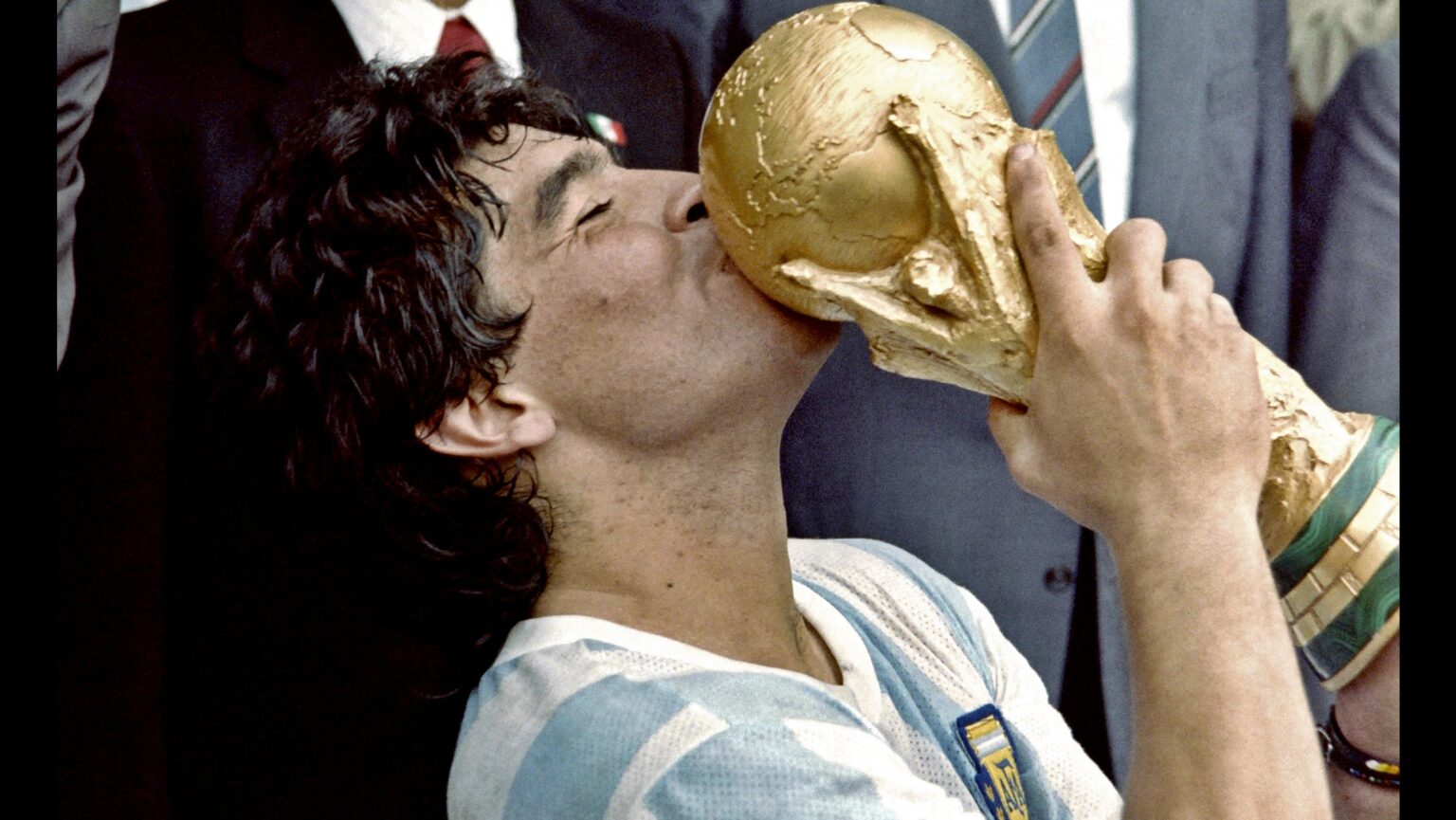
The 23rd quadrennial FIFA World Cup hosted by the United States, Canada, and Mexico is just one month away, with the opening match between Mexico and South Africa taking place on 11 June 2026 in Mexico City, Mexico. As we await the great tournament to start, let’s take a look at what happened in some of the World Cups of the past.
Before even the qualifiers started, the 1986 FIFA World Cup was hit with a curveball that had never happened before, nor has it happened since: the original host nation withdrew from organizing the tournament.
The South American nation of Colombia won the hosting rights in 1974. However, in 1982, President Belisario Betancur of Colombia decided it was not economically feasible for his country to meet all of FIFA’s demands about stadium capacities, hotel price freezes, and even a fleet of limousines for FIFA executives.
The football world had less than four years to find a new host. In that pressing time strain, it was only logical to go for a country that had recently held the great sporting event. Thus, 1970’s hosts Mexico became the first country in football history to host more than one World Cup—and right now they are preparing for the third Mundial as co-hosts.
24 teams got to qualify for the 1986 FIFA World Cup. This was the second expanded line-up after FIFA raised the number of participants from the traditional 16, in place since 1934, to 24 for the 1982 event. Hosts Mexico and defending champions Italy were spared the qualification process.
Hungary were drawn into a four-team qualification group with Cyprus, Austria, and the Netherlands. Head coach György Mezey’s boys passed the challenge surprisingly easily, winning all five out of their first five games, including against the formidable Dutch side on the road (2–1 with goals by Lajos Détári and Márton Esterházy). By the time it was time for the rematch in Budapest, Hungary had already secured qualification, so the 0–1 loss really didn’t cause any concerns.
Because of the impressive qualification campaign, and a 3–0 victory over Brazil in a friendly in Budapest ahead of the World Cup, Hungary were actually considered a dark horse candidate to win the trophy. Alas, the tournament itself played out very differently—more on that later…
The Netherlands eventually missed out on the World Cup, after losing the European play-off to Belgium. Another notable absentee not to clear the qualification: two-time World Cup finalists (just like the Dutch at the time) Czechoslovakia. Portugal, on the other hand, made it to a World Cup for the first time since their bronze-medal finish in 1966.
In South America, Colombia failed to make it to the World Cup that they were supposed to host, losing to Peru in the first round of the continental play-off. The traditional ‘big dogs’ of the continent—Brazil, Argentina, and Uruguay—topped their respective qualification groups and got to the tournament with ease.
There, Argentina was drawn in Group A with defending champions Italy, along with Bulgaria and South Korea. Diego Maradona, a just 5’5 (165 cm) tall, 25-year-old attacking midfielder playing for the Italian club Napoli at the time, gave early signs of his legendary tournament form already. He gave the assists for all three of his side’s goals in a 3–1 victory over the Koreans, then scored himself against Italy in a 1–1 tie. Argentina’s win over Bulgaria sent them to the top of the group. Italy came in second, while third-place finisher Bulgaria also advanced to the knockout stage, leaving only South Korea behind.
In Group B, hosts Mexico, Paraguay, and Belgium got through in that order, while World Cup debutants Iraq finished last with no points. In Group D, Brazil came in first with a 100-per-cent record, followed by Spain. However, the one point taken by Northern Ireland in third place was not enough. They drew Algeria, with whom they finished level on points but still ahead on goal difference.
Group E featured a Scottish side coached by future Manchester United manager legend Sir Alex Ferguson. Ferguson took over his national team for the tournament on an interim basis following the tragic death of head coach Jock Stein. However, he failed to lead Scotland out of the group, taking last place with one point, behind Denmark, West Germany, and Uruguay (in that order). An impressive Danish side won all three of their games, including a 6–1 thrashing of Uruguay, brought on in part by a hat-trick from Hellas Verona striker Preben Elkjær.
Defying expectations, Morocco finished on top of Group F. Despite beating England 1–0 in their first World Cup game in 20 years, Portugal ended on the bottom of the group with those two points. Morocco got four points on their tally, followed by England and Poland with three each.
And now, on to Hungary.
The country’s last World Cup appearance, much like their last World Cup final in 1954, is a bittersweet memory for the nation, which it only learnt to appreciate over time. As we wrote above, the Hungarians came into the tournament in Mexico with high expectations, yet they kicked off their campaign in Group C with a 0–6 battering by the Soviet Union. Given the oppressive relationship between the two countries, it was a special hurt for the nation. In the next game, Hungary recovered with a 2–0 win over Canada (Lajos Détári scored the last Hungarian World Cup goal to date in the 75th minute). However, France also triumphed over the red-white-and-greens in a 0–3 match. The two major defeats ensured that Hungary could not qualify for the knockout stage as third-place finishers due to their poor goal difference, despite coming in ahead of Canada. Only the USSR and Ballon d’Or title holder Michel Platini’s France made it out of the group.
In the Round of 16, Argentina and Uruguay got to play the only rematch of the first-ever 1930 FIFA World Cup final in a WC setting. It was decided by a strike from Pedro Pasculli, 1–0 to Argentina. After storming through the group stage, Denmark ran into an unexpected 5–1 battering by Spain. Real Madrid striker, the legendary Emilio Butragueño scored four in the game for the Spaniards. Defending champions Italy were beaten out by France; while Brazil and England got through with comfortable wins over Poland and Paraguay, respectively.
West Germany snatched a win against Morocco with a late goal from Lothar Matthäus. For the USSR, a hat-trick by Igor Belanov still was not enough against Belgium. The Belgian side advanced 4–3 after extra time.
The Quarter-Finals of the 1986 FIFA World Cup gave us one of the most memorable games in football history—for reasons good and bad.
Argentina faced off against England. In the 51st minute, Maradona contested a high ball a few yards from the English six-yard spot with goalkeeper Peter Shilton, after English midfielder Steve Hodge clumsily kicked the ball high in the air in a botched clearance. Keep in mind that, as we noted earlier, Maradona was 5’5, while Shilton stood at 6’ and was legally allowed to use his hand. Yet Maradona won that aerial duel and guided the ball into the net—based on that description alone, evidently, with his hand… However, Tunisian official Ali Bin Nasser and his linesman did not put that picture together on the field. Thus, the goal, known today as ‘the Hand of God’ goal after a comment Maradona made himself about the incident, was allowed to stand.
Just four minutes later, Maradona received the ball on his own half near the halfway line, then went on to dribble past five England defenders, rounded the keeper, and passed the ball into the empty net. As a testament to his remarkable feat, both goals scored by the Argentine football legend in that game have their own nicknames: this one is simply known as ‘the Goal of the Century’, arguably the greatest solo goal in the history of the sport. Everton striker and eventual 1986 FIFA World Cup Golden Boot winner Gary Lineker pulled one back for England in the 81st minute, but it was not enough. Argentina went through to the last four standing with a performance for the ages by Maradona.
The other three Quarter-Finals of the tournament seem to pale in comparison to this game in retrospect. Interestingly, all three of them were decided by penalty shootouts: France beat out Brazil that way. In the PK contest between West Germany and Mexico, the German side came out on top after goalkeeper Harald Schumacher saved two out of three spot kicks; while Belgium knocked out Spain.
Argentina then faced Belgium in the Semi-Finals. The game ended 2–0 to the South Americas after a brace from—who else—Diego Maradona. In the other bracket, left-back Andreas Brehme gave West Germany an early lead in the ninth minute against France, which was then doubled by Werder Bremen striker Rudi Völler just before full-time, taking the Germans to their second consecutive World Cup final after 1982.
In the third-place play-off, France defeated Belgium 4–2 after extra time, which sets us up for the final. Argentina v West Germany, at Estadio Azteca in Mexico City, Mexico, in front of 114,000 people on Sunday, 29 June 1986.
Defender José Luis Brown, who played much of the game with a dislocated shoulder, gave Argentina the lead in the 23rd minute after a header from a set-piece. The game seemed to be decided in the 56th minute, when Jorge Valdano put away a breakaway chance, doubling the lead for the Albiceleste. However, the Germans were not ready to throw in the towel just yet.
Inter Milan’s Karl-Heinz Rummenigge halved the deficit in the 74th minute after a corner. Seven minutes later, Völler found the net with a header after another German corner kick, bringing the score level again.
Diego Maradona did not score himself in the final. However, he still made sure to give a key contribution to the game. In the 84th minute, he assisted Jorge Burruchaga with a low throughball to behind West Germany’s defence. Burruchaga was able to pass the ball into the net beside Schumacher, setting the final, 3–2 score to Argentina.
Argentina claimed their second FIFA World Cup title after 1978. West Germany, meanwhile, lost their second World Cup final in back-to-back tournaments after 1982. The very same two sides met again in the 1990 World Cup final four years later—that time, the Germans came out on top.
Related articles: