
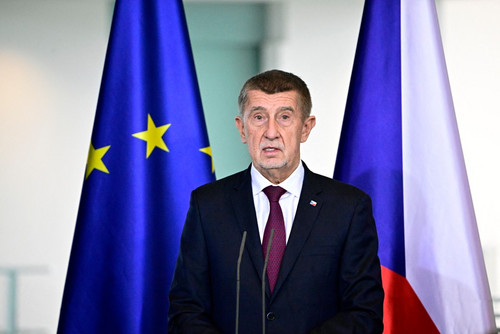
At its meeting in Paris from 4 to 7 May, the Congress of the International Federation of Journalists (IFJ) unanimously adopted an urgent motion proposed by the Syndicate of Journalists of the Czech Republic. The motion warns that the Czech government is effectively nationalising public service media by abolishing licence fees and transferring funding to the state budget, and demands the immediate withdrawal of both the law and the parliamentary amendment proposed by the coalition parties.
The Syndicate of Journalists of the Czech Republic, together with the unions of Czech TV and Czech Radio, warns that the Czech government is moving to effectively nationalise public service media by abolishing licence fees and transferring funding to the state budget, with implementation planned for January 1, 2027.
The proposed law fails to guarantee Czech public service media predictable and sustainable funding, while significantly increasing political control over them.
In parallel, a parliamentary amendment by coalition parties is being rushed through to exempt, as quickly as possible, a significant number of households from paying licence fees (currently approximately $10 per month per household).
This populist step would lead to the closure of regional editorial offices, which are often the only media in remote parts of the country, and paralyse public service media as early as July 2026—in a crucial time—well before the regional and Senate elections scheduled for October 2026.
The government of Andrej Babiš, ruling with far-right parties (SPD and Motorists), will be aiming to gain a majority in the upper house.
The legislative process is being conducted at breakneck speed—without prior notification of legislative intent and without any public or expert debate.
This draft law dismantles a functioning system that has been recognised across Europe as a model for economic and editorial independence in public service media, contributing to the Czech Republic’s 10th place in the global media freedom index (Reporters Without Borders).
The proposed changes are in clear violation of the EMFA, contain serious legislative flaws, and, if implemented, will destroy both the economic and editorial independence of public service media. The highest Czech authorities have pledged to comply with it and are now acting in contradiction.
It also does not even consider services for minorities. The Czech Republic risks sliding toward a situation comparable to Hungary under Prime Minister Orbán and Slovakia under Prime Minister Fico; media freedom across Central Europe is at stake.
The attacks by the government of Prime Minister Andrej Babiš on Czech media must be treated seriously. In 2013, this oligarch captured two major newspapers: the most influential daily, Mladá fronta DNES, and the oldest daily, Lidové noviny (the Czech equivalent of Le Monde). Mladá fronta DNES became another tool of Babiš’s power, Lidové noviny was later resold and, in its printed version, no longer exists.
Andrej Babiš has also initiated SLAPP lawsuits against journalists and continues to concentrate political, economic, and media power. His conflict of interest remains unresolved.
Employees of Czech Television and Czech Radio have declared a state of strike alert. These institutions enjoy strong public support, as demonstrated by approximately 280,000 people who have taken to the streets in Prague to protest the actions of the government.
The Syndicate of Journalists of the Czech Republic therefore calls on the IFJ Congress to:
- Mandate the incoming IFJ Executive Committee and General Secretary to urgently address Prime Minister Andrej Babiš and demand the immediate withdrawal of both proposals: the law and the parliamentary amendment by coalition parties.
- Call on the Czech government to ensure full compliance with all European Media Freedom Act (EMFA) requirements adopted by the European Union in any reforms affecting public service media, including the provision of adequate and sustainable funding.
- Urge the IFJ to address the EBMS (European Board for Media Services) and the European Parliament’s Committee on Culture and Education (CULT), which approved the EMFA, and to request, as a matter of urgency, a formal position from Prime Minister Babiš and, by extension, from the Czech government.
UPDATE
On 11 May, IFJ President Zuliana Lainez and General Secretary Anthony Bellanger wrote a letter to Prime Minister Andrej Babiš demanding him the immediate withdrawal of the law and the parliamentary amendment proposed by the coalition parties. Read the letter (in Czech): here.