
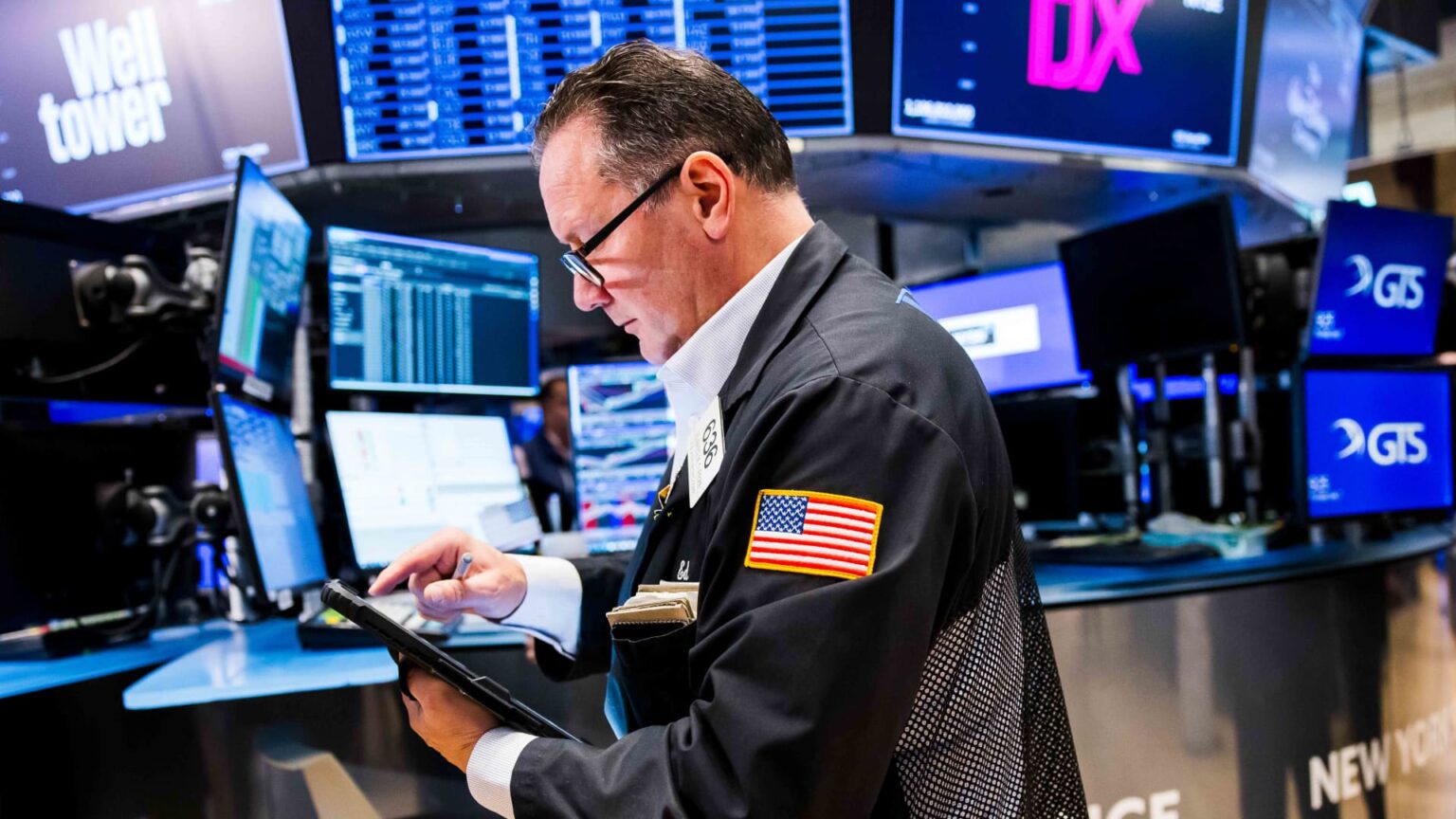
Traders work at the New York Stock Exchange on May 7, 2026.
NYSE
The Dow Jones Industrial Average fell on Wednesday after another hotter-than-expected inflation report sent Treasury yields to a 10-month high, while gains in chip stocks boosted the Nasdaq Composite.
The 30-stock Dow shed 211 points, or 0.4%, while the S&P 500 rose 0.3%, and the tech-heavy Nasdaq added 0.9%.
Technology stocks outperformed from the rest of the market, as inflation fears spurred by higher energy prices due to the Iran war weighed on other sectors such as retail and banking. Nvidia shares traded higher by more than 2%. Micron Technology gained more than 3%. The VanEck Semiconductor ETF (SMH) advanced 1%.
“In some sense, chips and AI infrastructure are moving completely on their own, but at some point those investors will look up and, if they find a macro environment that has really turned against them, might look around and be like, ‘Alright, it’s time to take a few gains, because the promise that the war would be over quickly has clearly not materialized,'” Ross Mayfield, Baird investment strategist, told CNBC.
Those moves comes after Nvidia CEO Jensen Huang joined President Donald Trump on his trip to China to meet Chinese President Xi Jinping. The decision signaled to investors that there could be positive developments regarding Nvidia being able to sell its artificial intelligence chips in Chinese markets, according to Mayfield, whose expectations for the meeting are still “fairly muted.”
Semiconductor stocks in particular have been on a tear of late, leading the broader market back to record highs, amid renewed enthusiasm in the AI trade.
To be sure, the S&P 500 and Nasdaq slipped from all-time highs on Tuesday following the release of hotter-than-expected U.S. consumer inflation data.
On Wednesday, the producer price index jumped 1.4% in April. That marked the largest increase on a monthly basis since March 2022 and was much more than the 0.5% rise that economists polled by Dow Jones were expecting. Additionally, wholesale inflation gained 6% in April on an annual basis — the biggest since December 2022. That figure was also above the 4.9% consensus estimate.
“The earnings story is what’s driving markets here. The fundamentals are sound and profit margins are at all-time highs, but PPI inflation being this high really starts to chip away at that narrative having any durability,” Mayfield said. “It’s eating into the into the margins of all these companies, whether it’s on the services or the good side of the coin.”