
A lot of vendors are realizing that it’s not just about the big logos and refocusing their approach to the SMB market.

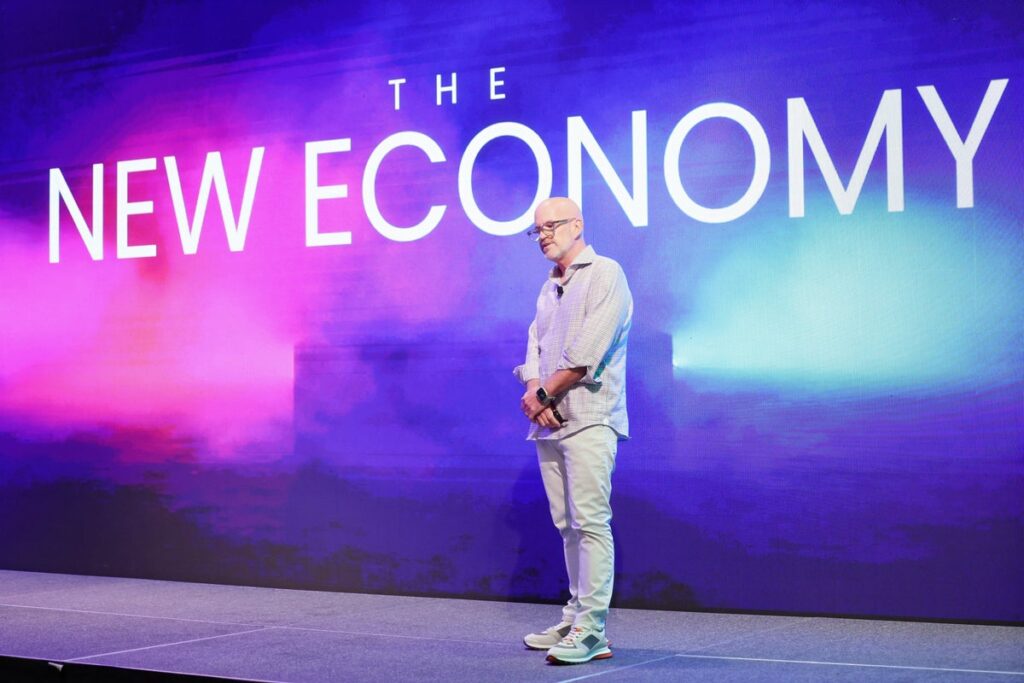
As Pax8 remains focused on serving the small and medium-sized businesses (SMB) market, Scott Chasin, CEO of Pax8 pointed out that more ISVs and vendors are starting to realize the power of the SMB market.
While lot of vendors have shied away from the SMB market in the past, their main reason for this was because they felt cost was too prohibitive to service the SMB and required a lot of intensive care and support.
But what’s interesting is that these vendors and ISVs have noticed how Pax8 has presented an opportunity to get access to the SMBs through its partner ecosystem to go downstream in a way that isn’t cost prohibitive.
In fact, Chasin stated that he predicted this a few years ago, whereby the SMB addressable market would massively expand due to AI. Reports also show that the SMB addressable market surpassed or eclipsed the enterprise IT spend for the first time last year.
“So, we’re starting to see it. And there’s evidence that it’s continuing to grow. The TAM of the small and medium business market is growing very quickly. Take for example, Apple’s app store last quarter grew 87% after being flat for the last three years. New business inception in the United States is up 35% since last summer. The .com TLD zone file has seen a spike plus 10% over the last couple of years. So new businesses are coming online. And these are AI native businesses. These are businesses that are embracing AI to build something,” he explained.
At the same time, Chasin reiterated that Pax8 as a marketplace will continue to serve the SMBs, and this is waking up a lot of vendors who are realizing that it’s not just about the big logos.
“But there’s another thing to consider on that point, which is AI is fundamentally changing or redefining what it means to be small. We’re starting to see small businesses with revenue for the size of a large enterprise. We fully expect to see in the next couple of years a two-man or a one-man unicorn. The opportunity, perhaps even, for a global brand to be a small business. This is the power of AI. And so that’s also a big magnet,” he explained.
This has created an attraction for large software vendors and small software vendors that want to access that last mile of opportunity. As such, the industry is not just witnessing existing large vendors that are transforming themselves, but also small vendors and AI-native vendors that are coming into the market.
“They will have incredible technology and value that we will absolutely put into our marketplace. This is part of what it means to be a marketplace. This is the responsibility in bringing the future forward to our providers to make sure that they have the services and the solutions that their customers need,” he added.
Managing geopolitics and governance
Looking at the current geopolitical climate, Chasin pointed out that geopolitics have always had an impact on technology.
“When has geopolitics not had an impact on any technology? Of course, there’s a race that’s happening here. Geopolitical influences will leave their mark, no doubt about that. But the technology that we’re talking about here is unprecedented. It is an opportunity that represents value for all humanity, regardless of geopolitics,” Chasin said.
When asked about the rise of Chinese tech vendor adoption among businesses in Southeast Asia, Chasin pointed out that its actually an interesting balance.
“There’s obviously an equilibrium at play. If you look at China, as an example, there’s certainly a much larger focus on open source. And the performance of open source models coming out of China is great. It’s actually leading the industry in terms of open source. In the US, it’s mostly these frontier labs and proprietary models. And if you look at it, I think that there is an opportunity to create the equilibrium, the balance, for both.”
“And so we think there’s an orchestration layer that’s going to be created that will allow managed intelligence providers to be able to have the flexibility of creating policy so that they can optimize cost, expense, token consumption, based off of open source opportunities or closed source opportunities,” he said.
For Chasin, there will be a balance and both open source and the frontier models have the opportunity to be integrated in a way where any business can essentially create the optimization needed to use, whether that’s for cost optimization or capability, to use open source or to use closed source.
“I think you’ll start to see more of a focus towards the end of this year and into next year around the management and cost optimization of token consumption. We are entering this next phase of the token economy. And whether you’re talking about open-source inference or you’re talking about a frontier lab model, it really is moving towards consumption-based. And there needs to be a layer of management and optimization on consumption. And that’s no different than what we’ve seen historically with cloud infrastructure,” he added.
On increasing regulatory requirements in the region, Chasin shared that Pax8 is still trying to understand the nuance and build the muscle to be able to deploy AI at scale.
“And within that deployment, there will be all kinds of new capabilities and concerns that will have to be managed, either from a policy perspective or from a regulatory and governance perspective. I think we’re still in the early days of that. And as the largest marketplace, it’s our responsibility to bring those concerns to our partners and to make sure that knowledge and the potential around legislation is known,” he concluded.