
Three current and two former Evergreen student employees who have worked in writing training dialogues have been given pseudonyms so they may speak candidly about their experiences. Quinn, Charlie, Olivia and Rebecca said they used AI to write dialogues as project assistants. Georgia, who was a content reviewer for Evergreen, said she did not use generative AI in her work. Quinn, Charlie and Olivia are still employed by Evergreen; Rebecca and Georgia said they voluntarily left the project. Numerous Evergreen student employees declined to comment.
Student employees at the College’s mental health project Evergreen AI have been using artificial intelligence to generate dialogues used to train the project’s chatbot, against Evergreen’s stated policy. The Dartmouth spoke with several students who said they have submitted AI-generated or -assisted content to Evergreen — which is “grounded in vetted content created by and for students,” according to its website — without detection or consequence.
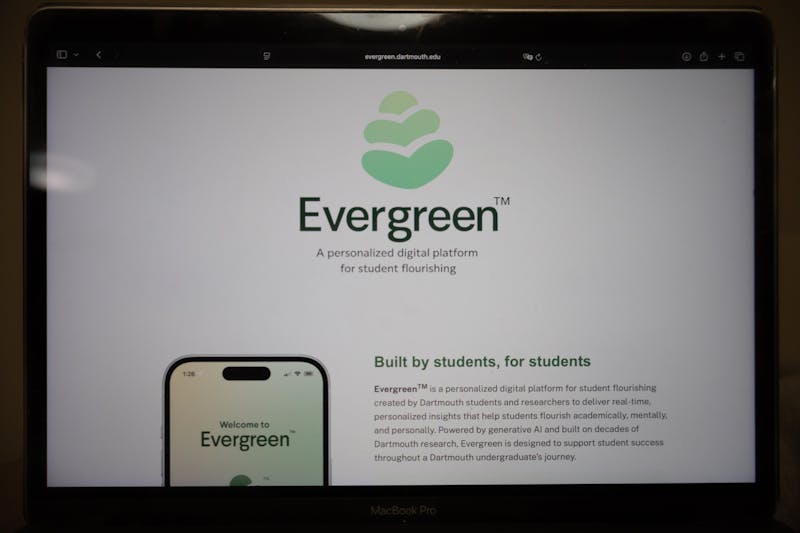
Once released to campus, Evergreen, the world’s first college-specific wellness artificial intelligence, will offer wellness check-ins, organizational tools and Dartmouth-specific social advice to students through a chatbot interface. Evergreen’s functionality will scale as the user provides more personal information, such as academic assignments, health data and location, according to past coverage from The Dartmouth. As of Nov. 5, 2025, the College had raised $5 million for the project from parents and alumni out of its goal of $16.5 million. Fundraising is still ongoing.
Training dialogues are fictitious chat conversations of 100 or more messages between a hypothetical Dartmouth student and the Evergreen chatbot, intended to be written entirely by a student employee. The dialogues will be used to teach the chatbot how to “talk like a Dartmouth student and be familiar with undergraduate life,” according to the project’s website.
In an email statement to The Dartmouth, Evergreen project lead and Geisel School of Medicine professor Lisa Marsch wrote that Evergreen takes the use of AI-generated dialogues “seriously.”
“If a student employee used AI-generated content in violation of our clearly stated workplace policy, that is an employee conduct matter we would address immediately upon discovery,” she wrote.
Marsh added that student employees are “explicitly instructed not to use generative AI to create training content.”
“Evergreen’s value depends on it being grounded in evidence-based, high-quality information as well as authentic, Dartmouth-specific student voices, which AI-generated content cannot replicate,” she wrote.
Marsh wrote that submitted training dialogues undergo a “structured review.”
“All content is screened during peer and expert review, and any content flagged as potentially AI-generated is halted and the writer is contacted directly,” she wrote. “Nothing reaches final approval without expert review and sign-off.”
According to an Evergreen onboarding presentation obtained and reviewed by The Dartmouth, student employees found to be using AI to write dialogues receive a “warning” after the first incident. “Multiple warnings” will result in “termination of employment.”
Still, the detection system is not infallible. Quinn, a current project assistant who said he used AI to generate dialogue input, said that not only have his AI-generated submissions not been flagged, they have gotten “pretty good” ratings from reviewers. When employees submit dialogues, they are given a rating on a scale of one to five and receive feedback that they are expected to use to revise the dialogue.
“The ones where I use AI actually have higher ratings, surprisingly,” Quinn said.
In an example generative AI prompt submitted to Evergreen and reviewed by The Dartmouth, Quinn requested that an external large language model write a dialogue for him. Quinn provided the LLM with his assignment’s parameters, internal Evergreen documents on wellness strategies and an explanation of the hypothetical student user’s socioeconomic status, Dartmouth courses and club involvements.
The LLM’s output, which was not flagged as AI-generated, received a four out of five rating and a three out of five from two student reviewers, according to documents obtained and reviewed by The Dartmouth.
Georgia, a former Evergreen dialogue reviewer, said that when she was a reviewer, Evergreen “fired a lot of people” for using AI to write dialogues.
“Using AI defeats the whole point of the app,” Georgia said. “I understand why people used it. A lot of people lied about their hours. They would use AI and then write a dialogue in 10 minutes and log four hours. It’s free money.”
Student project assistants for Evergreen earn $16.50 an hour, log up to 20 hours per week and must submit a minimum of two dialogues per week, according to documents obtained and reviewed by The Dartmouth. Students self-report their hours.
Georgia said it was “very easy” to tell if a dialogue was written using AI.
“They all looked the same and missed the point of the dialogue,” Georgia said.
Charlie, a current project assistant who said he used AI to assist in drafting his dialogues, said his AI-assisted dialogues “usually” receive lower ratings, but none have been flagged for AI use during review.
“In meetings, they’ll be like, ‘We’ve had people use AI,’ so they are definitely aware of that, but they never accused me of using AI,” Charlie said.
Olivia, a current project assistant who said she did use AI to generate dialogues, said she “only” used AI to write dialogues three times.
“I rushed to meet quotas on a Saturday night and wasn’t able to come up with scenarios on my own,” Olivia explained. “One time in the feedback area where they say whether they think it had AI, the box said ‘Yes,’ but [Evergreen] didn’t do anything about it.”
When The Dartmouth reviewed the feedback for Olivia’s dialogue, there was no mark in the checkbox labeled “This dialogue appears to be Al-generated.”
Rebecca, a former project assistant, said she used AI to write dialogues and thought that “everyone” else was doing so as well.
“There’s no real way for reviewers to tell that, and I don’t think the system works in a way that makes it actually catchable,” she said.
Former Special Advisor to the Provost on AI James Dobson wrote in an email statement to The Dartmouth that using AI-generated text to train LLMs may “dilute the influence” of human-authored responses.
When AI-generated data is used in the training process, it causes a “reduction of diversity in generated responses and a model less responsive to a range of human-authored inputs,” Dobson wrote.
“Our review process is rigorous and multi-layered, and we stand behind it,” Marsch wrote. “We’re also committed to continuous improvement, as with any research program of this scale and ambition.”
A spokesperson for the College redirected requests for comment to Marsch.
Alex Klee ’29 is a reporter from Woodbridge, Conn. He plans to major in economics and minor in math. He enjoys live music, skating and climbing.