
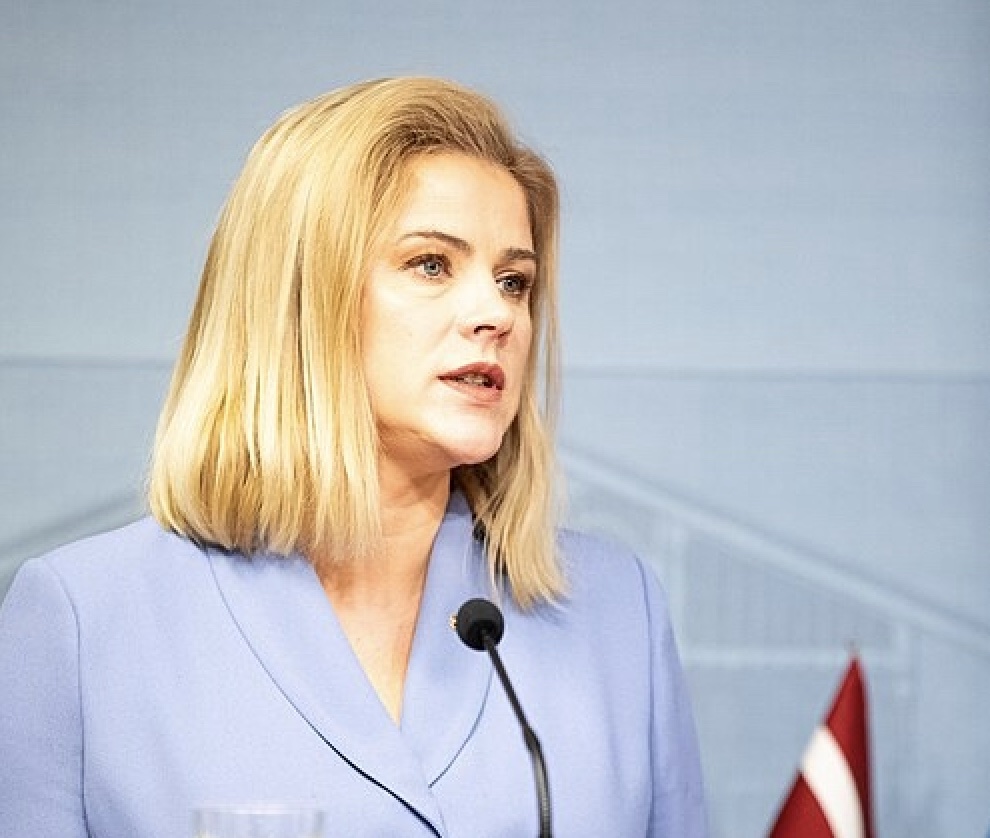
On Thursday, Latvia’s prime minister, Evika Siliņa, resigned after her fragile coalition unravelled amid mounting criticism over repeated drone incursions that have exposed alarming weaknesses in the country’s air defences.
Her departure comes less than six months before parliamentary elections and threatens to plunge one of Nato’s most strategically exposed member states into political uncertainty at precisely the moment when tensions with Moscow are intensifying.
The immediate trigger for the government’s collapse was the withdrawal of support by the left-leaning Progressives party after Mrs Siliņa dismissed the defence minister, Andris Sprūds, one of its senior figures.
But the roots of the crisis run deeper than coalition infighting. They lie in a growing public unease that Latvia, despite years of warnings about Russian aggression, remains dangerously vulnerable to the new realities of modern warfare.
Mrs Siliņa accused Mr Sprūds of failing to ensure the rapid development of anti-drone systems after a succession of unmanned aircraft, believed to have originated from Ukraine and strayed through Russian territory into the Baltics, crossed into Latvian airspace.
The final blow came after two drones exploded at an oil storage facility on May 7, provoking outrage and raising uncomfortable questions about the state’s ability to monitor and defend its own skies.
“That clearly demonstrates that the political leadership of the defence sector has failed,” the prime minister declared earlier this week, insisting that public confidence had been shattered.
More troubling still was the admission from Latvia’s military leadership that the drones had not been detected before impact.
For a country sharing a border with Russia and Belarus, and sitting only a short distance from the heavily militarised Russian enclave of Kaliningrad, such an acknowledgement is politically toxic.
The Baltic states have spent the past three years warning western Europe that the Kremlin’s ambitions extend beyond Ukraine. Yet the drone incidents have highlighted the uncomfortable gap between rhetoric and readiness.
Since March, numerous drones linked to the war in Ukraine have crossed into the airspace of Latvia, Lithuania and Estonia, often unintentionally, after veering off course during operations over Russian territory.
While none appear to have been deliberate attacks on Nato territory, the incidents have underscored how easily the conflict could spill across borders — whether through accident, miscalculation or escalation.
Critics of the Latvian government argue that ministers were slow to grasp the seriousness of the threat. Opposition politicians and security analysts have questioned why a nation so vocal about Russian dangers failed to invest more quickly in layered anti-drone capabilities.
The issue resonates deeply with voters. Latvia, with a population of fewer than two million people, has long viewed its security through the prism of occupation and invasion. Memories of Soviet rule remain fresh, and support for Ukraine has been among the strongest in Europe.
That public mood has left little tolerance for perceived complacency.
The resignation of Mrs Siliņa now leaves President Edgars Rinkēvičs with the difficult task of assembling a new coalition capable of governing until October’s elections.
He is expected to meet party leaders on Friday in an attempt to broker a fresh administration, though few expect negotiations to be straightforward.
The political turmoil also arrives at an awkward moment for Nato. The alliance has sought to reassure its eastern members through troop deployments, air policing missions and promises of collective defence. Yet incidents such as these reveal the challenge posed by cheap, hard-to-detect drones capable of slipping through conventional air defence networks.
Across Europe, military planners are increasingly confronting the reality that the drone age has altered the nature of security. Multi-million-pound missile systems are poorly suited to intercepting small unmanned aircraft costing a fraction of the price.
For Latvia, the lesson has been painfully immediate.
A government has fallen not because of a conventional military attack, but because a handful of wandering drones exposed a deeper fear: that even now, after years of war on Europe’s doorstep, the Baltic frontier may still be more fragile than its leaders care to admit.
Main Image: FinnishGovernment – Prime Minister Orpo and Prime Minister of Latvia Evika Siliņa met in Helsinki 24. November 2023
Click here for more News & Current Affairs at EU TodayClick here to check out EU TODAY’S SPORTS PAGE!
___________________________________________________________________________________________________________________
Post Views: 786