
It is good that we are a member of NATO, because otherwise even worse things could happen.
As long as Prime Minister Hristijan Mickoski remains in office, North Macedonia will not move from its current position and will make no progress toward the European Union. This is an anti-Macedonian policy, because Macedonia’s place is in the European Union, among the community of modern civilized nations. You can expect several consecutive formal invitations from PM Mickoski and our ministers to Bulgarian Prime Minister Rumen Radev and ministers from his government to visit Macedonia. Mickoski will manipulate this in the direction of: “Look, Bulgaria is refusing a meeting with Macedonia.” The first to benefit from this is neighboring Serbia, because it is restoring the domination it had during Yugoslavia. It is even worse, as if we were living in the time of royal Yugoslavia.
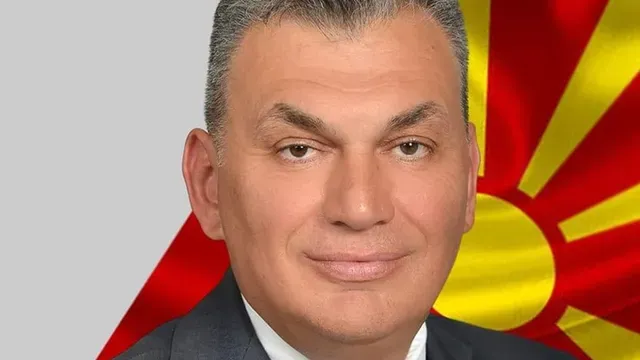
Oliver Andonov, a university lecturer and representative of VMRO-DPMNE’s “Faction for Democratization and Revival”, said this in an interview with BGNES.
BGNES: Where is the current government leading North Macedonia with its refusal or postponement of the implementation of the negotiating framework with the European Union, including the constitutional amendments?
Andonov: Nowhere. The question is already being raised whether we are standing still, moving backwards, or heading in some wrong direction. This must be clear to everyone. As long as Mickoski is prime minister, we will not move from the point where we are now, nor will we move toward the European Union. The EU will have an empty space here in which, sooner or later, it will have to intervene in order to establish some kind of control, conditionally speaking, because on many issues we will get out of control.
It is good that we are a member of NATO, because otherwise even worse things could happen.
What is particularly worrying is that Mickoski is not interested in us moving toward the European Union. He will try in every possible way to present relations between Macedonia and Bulgaria to the Macedonian public as problematic, as a problem created by Sofia.
We heard the latest statement by Petrova-Chamova, Bulgaria’s new foreign minister. In it, she said “the Macedonian foreign minister” two or three times, and only at the end used the phrase “our North Macedonian partners”, probably referring to the name of the state. We are somehow allergic to Bulgaria calling us North Macedonia, although this is the official, constitutional name of the state. Bulgaria is not to blame for that. Those who changed the name are to blame.
This will be used to incite hysteria in Macedonian politics and as justification for the policies pursued by Mickoski.
There is another interesting thing that Mickoski will also abuse. You can expect several consecutive formal invitations from PM Mickoski and our ministers to Bulgarian Prime Minister Rumen Radev and ministers from his government to visit Macedonia.
The public should know that interstate visits at prime ministerial and ministerial level do not happen the way you and I can agree to sit down somewhere for coffee. This is a protocol that determines what will be discussed, what topics will be put on the table, and what concrete outcome will be sought from the talks, including possible additional agreements.
This is a serious issue on which I guarantee, as a Macedonian, that Radev will never agree, nor will anyone in Bulgaria. It is clear that no Bulgarian government will agree to discuss the “French proposal”, that is, the European agreement, because this is no longer truly a bilateral dispute between Macedonia and Bulgaria. I do not even know what such a bilateral dispute would consist of, since we have already said that we have no problem with accepting the Macedonian identity, the Macedonian language, the state, the people and the nation.
We have issues that relate more to certain historical interpretations, where we need to look at things as they are. In this context, no Bulgarian government will accept talks in that way, and this will not be a point of discussion. This means that Mickoski will not be able to hold a meeting from the outset and will manipulate this in the direction of: “Look, Bulgaria is refusing a meeting with Macedonia.”
As a university lecturer, as a member of VMRO-DPMNE, as a former interior minister and as someone who has worked actively in society for many years, I have my position. As a faction within VMRO-DPMNE, we also have a position, and we know how this can be overcome and regulated very well.
First of all, I must recall that we, as a faction, support the French proposal and believe that Bulgarians should be included in the Constitution of Macedonia. Everything else can be discussed and relations can be eased. It is precisely this easing of relations that does not suit Mickoski.
To put it simply: we will not go anywhere. We will remain where we are, with a tendency to start falling drastically behind and to face other problems.
BGNES: You said that this Macedonian policy is leading the country nowhere. But you know that there is no vacuum in politics. If it does not lead toward Europe, where does it lead, and is it right to call it Macedonian, or is it rather anti-Macedonian?
Andonov: I agree with you. This is an anti-Macedonian policy, because Macedonia’s place is in the European Union, in the community of civilized modern nations. In 13 years, 100 years will be marked since the beginning of the Second World War. The question is whether we still have living participants in that war. I think we no longer do. We are new generations that do not remember that war and were raised in different times. We also have even newer generations, the so-called Generation Z, which is not interested in the Second World War. For them, even the socialist era is distant.
The problem will be left to these generations.
That is precisely why this position is anti-Macedonian, because these are the generations of modern European nations in a united Europe.
As you said, there is no vacuum. The question is who will fill this empty space and how. There are countless ways, especially in politics, security and the economy. That is why I said at the beginning that it is good we are a member of NATO, because NATO will not allow something else to happen.
BGNES: So you do not see a risk of the country being placed in severe isolation?
Andonov: Risk always exists. Risk is a part of life. As the professor Slatinski, whom I respect, would say, risk is the new name of security.
That is exactly how it is. There is always risk. The question is how great that risk is and to what extent NATO will allow a state on its southern, or southeastern, flank to pose a risk to the Alliance. The question is also how long NATO will refrain from taking measures.
At the moment, the spotlight is not on Macedonia because of the focus on the Middle East and the broader region, tensions between the European Union and the United States, the war in Ukraine, and other major geopolitical developments. Macedonia is a secondary issue. And what Mickoski is presenting here as some kind of dispute is, in fact, not a dispute with Bulgaria at all.
I do not see it that way. For me, there is no dispute with Bulgaria, as long as there is goodwill, honesty and an intention to overcome the issues. The way to overcome them has already been defined.
BGNES: Are foreign interests visible behind Mickoski’s policy? You said that with him at the helm, the country will not be part of the European Union. Who benefits from blocking the European path?
Andonov: Of course. The first to benefit from this is neighboring Serbia, because it is restoring the domination it had during Yugoslavia. It is even worse, as if we were living in the time of royal Yugoslavia.
Here you have an influx of culture, an influx of behavior, even the creation of a mentality, not only political, but a social and civic mentality completely similar to that in Serbia.
Of course, Russia also has an interest, because the tension between Macedonia and Bulgaria suits Russia the most. Why does it suit Russia? Because on NATO’s southeastern wing there is a clash between two member states of the Alliance. Let us put it more clearly: how, if a problem with Russia arises tomorrow, will Macedonian and Bulgarian soldiers stand together in a NATO unit and fight against the common enemy?
This is being done deliberately. This is where the problematic situation lies. Naturally, this is precisely where Serbia’s role comes in, because it has an interest in staying behind the scenes while in fact pursuing its interests through soft power. This is a clear example of the use of soft power.
For example, you have M-Tel in Macedonia. You have every possible Serbian television channel: Pink, Informer, Kurir. These are the regime’s television channels, which can feed you the information they want. There is not a single Bulgarian or Greek production.
I do not remember seeing Croatian productions in Macedonia either, although we lived in the same state with Croatia. There are no Slovenian productions either, although we also lived in the same state with Slovenia. We do not have such productions in Macedonia, for example series to watch.
In Macedonia, through Serbian media, we follow Serbian productions that contain propaganda elements. If you watch the series “Shadows over the Balkans”, you will see a lot of propaganda and false suggestions about the attitude of the Serbian authorities and Serbian society before the Second World War toward Macedonia and Macedonians.
This is completely false. They present us as Macedonians, while at that time they neither recognized us nor even mentioned us as Macedonians. It was forbidden to call yourself Macedonian.
It is very interesting how this picture is being built in Macedonian society through soft power and a propaganda environment. That is why I said, and I have said it many times: Macedonia should thank Bulgaria a thousand times, and Bulgaria should thank Macedonia a thousand times. Looking back historically, we knew, or at least our ancestors knew, how to help each other and live together.
For me, what is happening in relations between Macedonia and Bulgaria is anti-civilizational. Mickoski’s behavior is anti-civilizational. He is not seeking a solution. That is the main problem. Serbia and Russia are trying to fill precisely this space.
BGNES: Why is it that when Serbian scholars and historians today call the territory of the present independent state “Southern Serbia”, “Old Serbia”, “southern province”, and Serbian holidays are celebrated with Serbian flags and Serbian officials, this does not inflame Mickoski and his circle in the same way?
Andonov: Not only does it not inflame Mickoski, but through his propaganda machinery, the population is not inflamed either. I have written several times and spoken publicly on this issue. What is being done is extremely offensive to us, the Macedonians.
Do you know why it is so? Because the bill Mickoski is paying is in Belgrade. The mortgage has been given there.
This matter is very clear. This is the soft power that they periodically demonstrate in another way. What did the commemoration of the anniversary of the breakthrough of the Macedonian Front in Bitola look like? The day before, on September 7, before we marked Independence Day, they were walking around with Serbian flags, carrying Serbian flags up Kajmakchalan on Nidze Mountain. What does that look like?
We have no problem with that. Our government has no problem with it. It also has no problem with commemorating the Battle of Bregalnica. This is a source of many historical falsehoods.
To limit this, Bulgaria needs to have a little more soft power toward Macedonia. Bulgaria is in a better position than Serbia, it is richer, it is a member of the European Union, stable, and a member of NATO. It must take a different approach toward Macedonia in order to prevent Mickoski from spreading disinformation.
I have had several opportunities to tell your politicians in Bulgaria how this should be done. Sometimes it simply needs to be heard clearly and categorically from the mouth of the president or prime minister of Bulgaria: “We have no problem with the Macedonian people, the Macedonian nation, the Macedonian state and the Macedonian language. For us, this is a closed issue. Let us resolve the issues regulated in the French proposal.”
That is the essence of resolving things. I am not saying it will immediately help solve the problem. But it will help Bulgaria’s official position reach the Macedonian public, repeated many times, so that Mickoski can be prevented from spreading negative energy, lies and abusing this topic.
I am convinced that a large part of Macedonian citizens, not only Macedonians but everyone else in Macedonia as well, if we held a referendum today and asked them whether they are “for” the EU, would say “yes”. They do not even have a problem with opening the Constitution and including Bulgarians and all others in Macedonia’s Constitution.
Even if you ask people in VMRO-DPMNE, they will tell you the same thing, but not publicly, because many of them are clientelists or are afraid of Mickoski. | BGNES