
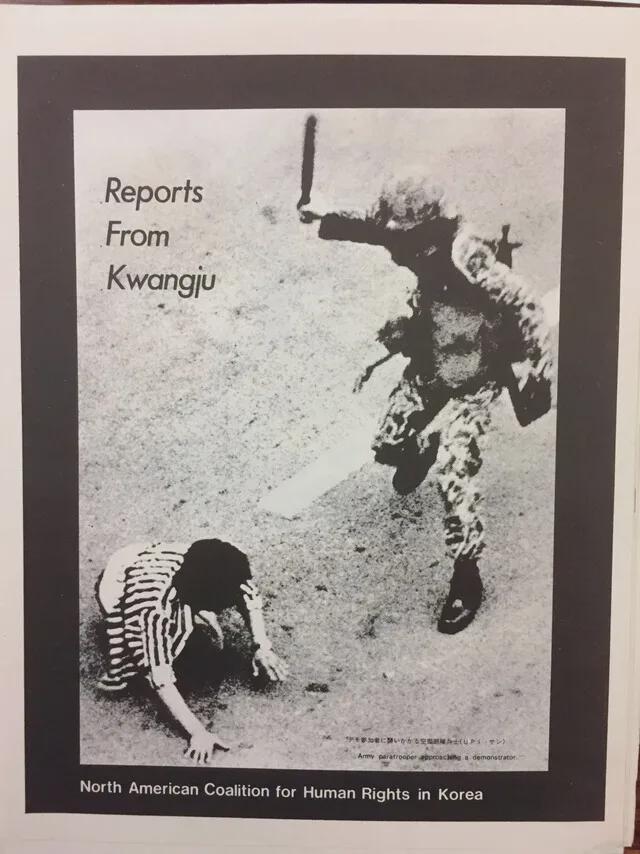
A report prepared by an American human rights group after Chun Doo-hwan ordered the brutal suppression of an uprising in Gwangju in 1980 has resurfaced 46 years later. The report denounced Chun’s dictatorship for its atrocities and predicted its fall, declaring that “ultimately the people will prevail.”
Choi Yong-joo, a former researcher for the May 18 Foundation, gave the Hankyoreh “Reports from Kwangju” (another spelling for Gwangju), which was published by the North American Coalition for Human Rights in Korea in September 1980, shortly after the massacre that May.
The 23-page report documents the Korean government forces’ brutality in Gwangju through reports by journalists, excerpts of witness accounts, a statement by students of Chosun University, a chronology of events in Gwangju and photographs of the victims.
A section titled “A Korean Journalist’s Account” detailed the events witnessed by an anonymous Korean reporter who was in Gwangju at the time. The reporter said that when soldiers started firing on May 21, citizens gathered firearms from the nearby town of Hwasun in an effort to fight back.
“[Claiming that students were armed first] is another thing which has been misrepresented by the Seoul newspapers. The students’ taking of guns was very clearly a response to the slaughter which had already been started by the army,” the reporter said.
The same reporter describes meeting Yoon Sang-won, the spokesperson for the civilian militia who was killed during the fighting at the former South Jeolla Provincial Office. While speaking with Yoon following a press conference for foreign correspondents on May 26, the day before government forces stormed the provincial office, the reporter said he’d “complained to [Yoon] that it wasn’t Korean reporters who didn’t report things, but the government that didn’t let them be printed.”
The reporter recalled feeling “very strange” after seeing Yoon’s dead body the next day and spotting the business cards of several foreign correspondents in his shirt pocket.
US declines to mediate despite appeals of Gwangju citizens
The report includes a lengthy witness account titled “The Torn and Tattered Flag,” as well as excerpts compiled from the testimony and journal entries of Korean citizens and non-Koreans residing in Gwangju at the time. These accounts describe handing out food and donating blood to the wounded, as well as frustration with how the people of Gwangju were being falsely represented as rioters.
The events described in the chronology imply American culpability in failing to stop the massacre. On May 26, Gwangju citizens asked the US to “help negotiate a truce,” but the following day, the US State Department refused to mediate, saying, “We recognize that a situation of total disorder and disruption in a major city cannot be allowed to go on indefinitely.”
“Since the massacre in May, 1980, Kwangju has entered the political vocabulary of Korean history together with the Tonghak rebellion of the 1890s, the March First Independence Movement of 1919, and the Student Revolution of 1960. As long as the Korean people continue to hope and to struggle for the right to determine their own destiny, the sacrifices of those who died in Kwangju this summer will be remembered,” Peggy Billings, chair of the North American Coalition for Human Rights in Korea, wrote in the introduction.
“Yet the story of Kwangju is not finished. The bestiality of the military’s action has left a residue of hatred and distrust which will undoubtedly erupt, sooner or later,” Billings said.
“Ultimately the people will prevail and find the only solace for those lost in Kwangju — rule by law and by the willing participation of the people.”
Choi, the researcher, came upon this report in the Collection on Democracy and Unification in Korea at the East Asian Library at the University of California, Los Angeles, in 2018. He shared the report to commemorate the death last month of Pharis Harvey, an American minister involved in the North American Coalition for Human Rights in Korea who devoted himself to raising awareness of what had happened in Gwangju.
“Harvey was one of three foreigners who contributed to Korea’s democratization in the 1970s and 1980s, along with Rev. George Ogle and Father James P. Sinnott, who spoke the truth about the People’s Revolutionary Party incident,” Choi said.
“This report was sent to the US Congress in an attempt to hold the US accountable. Since it was composed in great haste, its tally of the dead is inconsistent with more recent counts. But these non-Koreans’ noble efforts to raise awareness about Gwangju deserve to be remembered.”
https://english.hani.co.kr/arti/english_edition/e_national/1258509.html
Posted by coinfwip4