
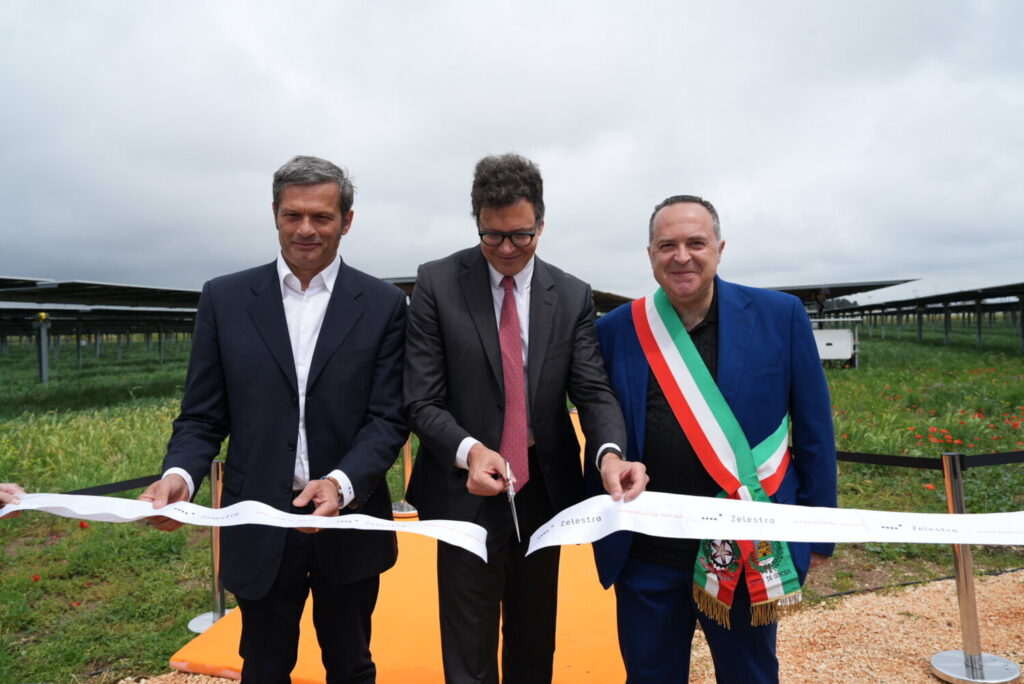
Zelestra has brought its first operational solar project in Italy online with the launch of a 6.5 MWdc agrivoltaic plant in Ginosa, Puglia.
The project is expected to generate 11.7 GWh of clean electricity each year, enough to supply around 4,000 Italian households. It is also projected to avoid almost 3,700 tonnes of CO₂ emissions annually.
For Italy’s renewable energy market, the project is notable not only for its output, but for its land-use model. The plant uses elevated solar modules designed to allow farming activity to continue beneath and around the installation. That makes it part of a wider shift toward agrivoltaic projects that aim to reduce conflict between clean energy development, agriculture and local communities.
Agrivoltaics gain ground in Italy’s renewable energy pipeline
The Ginosa plant represents Zelestra’s first kilowatt-hour produced in Italy and gives the company an operational reference point in a market where it is building a larger portfolio.
Zelestra’s Italian pipeline includes more than 1.4 GW of solar and battery energy storage projects. In that context, Ginosa is less about one individual asset and more about proving a development model that can be applied across future sites.
Land use remains one of the key issues facing utility-scale renewable energy projects in Europe. Agrivoltaics offer one route through that challenge by combining solar generation with continued agricultural activity, rather than treating land as available for only one purpose.
The Ginosa site includes environmental and landscape measures such as perimeter tree strips and monitoring of soil, water, air, noise and biodiversity before, during and after construction. These steps are increasingly important as developers seek to show that renewable energy projects can be built with stronger environmental oversight and local accountability.
Construction of the project created more than 50 jobs. Altenia, part of the Terna Energy Solutions Group, acted as EPC contractor. While construction roles are typically temporary, projects of this type can still support regional supply chains and bring short-term economic activity to local areas.
Long-term PPAs and local training support the project model
The Ginosa plant is backed by a 10-year power purchase agreement with BKW Energy. The agreement forms part of a wider collaboration that also includes the 9.5 MWdc Bellomo agrivoltaic project in Modica, Sicily.
For renewable energy developers, long-term PPAs remain an important tool for reducing revenue uncertainty. For energy buyers, they provide a route to secure cleaner electricity while supporting new renewable capacity.
The project also includes a community education component. Zelestra has launched the Zelestra Energy Academy at the Civic Library of Ginosa, aimed at local students and focused on sustainability, energy and the ecological transition.
That kind of local engagement is becoming more relevant in renewable energy development. Communities are increasingly looking beyond headline generation figures and asking how projects affect skills, jobs, land use and the local environment.
For Puglia, where agriculture, tourism and energy all play important economic roles, the Ginosa project highlights the balance developers are trying to strike. The next test will be whether agrivoltaic projects of this kind can scale while keeping practical benefits for local communities and maintaining credible environmental safeguards.