
Archaeologists excavating Norway’s largest-ever medieval coin hoard have uncovered hundreds more coins, bringing the total to 4,772 so far. Researchers now believe the remarkable Viking Age find may reveal how iron from inland Norway connected the region to vast trade networks stretching across medieval Europe.
The spectacular coin hoard, known as the Mørstad Hoard, was discovered near Rena in Østerdalen earlier this spring by metal detectorists Vegard Sørlie and Rune Sætre. Since then, archaeologists from Innlandet County Authority and the Museum of Cultural History in Oslo have been carefully excavating the site.
The latest fieldwork, completed on May 13th, dramatically increased the size of the find. Archaeologists now expect the final number of coins to exceed 5,000 when a new excavation is carried out later this year.
With its 4,772 coins, the Mørstad Hoard is larger than the next four biggest Viking Age coin hoards discovered in Norway combined. Large Viking Age coin hoards are extremely rare in Norway, and the last time a major hoard was found in the country was in Trondheim in 1950.
A Hoard Linked to International Trade
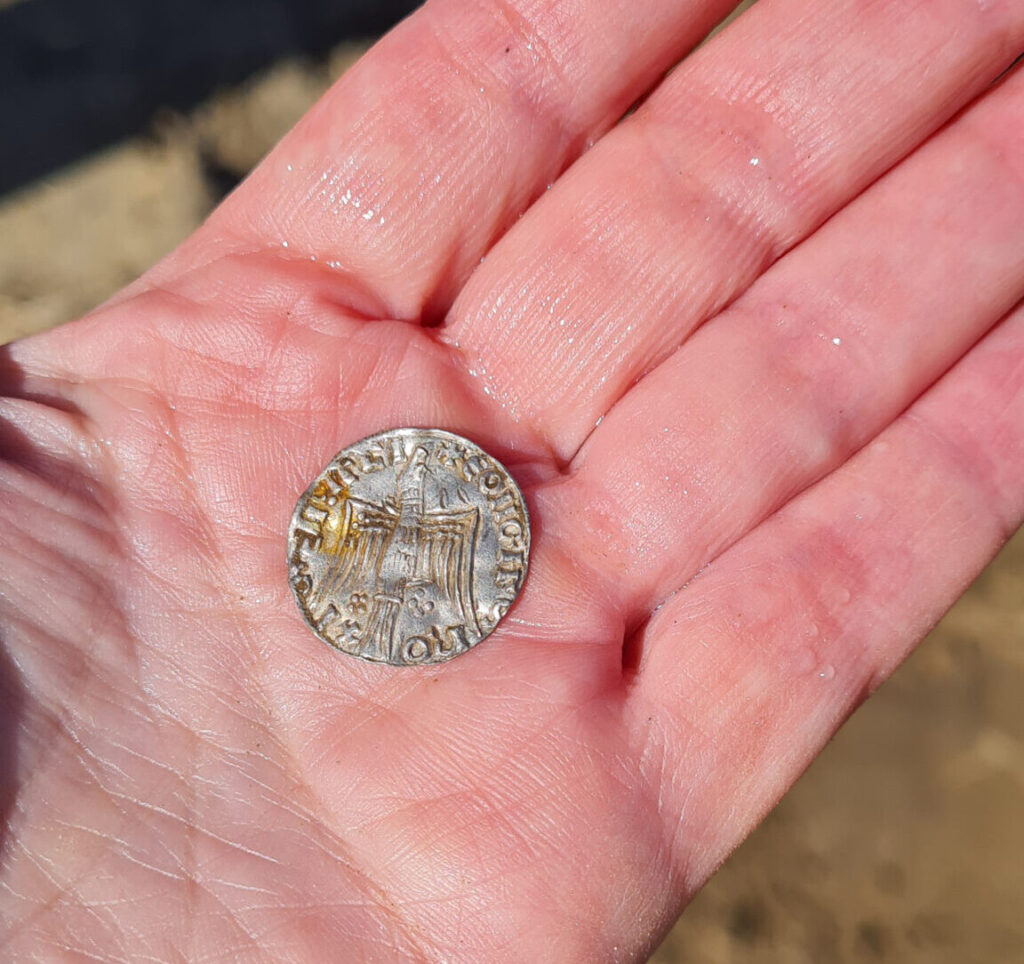
 Coin number 4000 is a Danish penny, from Harthacnut. It was probably minted in Lund in the period around 1030–1035, which was also the last years of the reign of his father Cnut. The snake motif is seen on the coins of Cnut, and it is often interpreted as a worm, snake or dragon. Photo: Cultural History Museum
Researchers believe the hoard may provide important new evidence about Norway’s role in long-distance trade during the late Viking Age.
“Over 95 per cent of the coins in this hoard come from kingdoms in what is now England and Germany. These were the most widespread currencies in international trade at the time, and thus link Østerdalen to an international trade network”, explained Professor Svein Gullbekk of the Museum of Cultural History.
Why such an enormous concentration of wealth appeared in Østerdalen has become one of the key questions surrounding the discovery. Archaeologists increasingly suspect that the answer lies in iron production.
“This may be the key to Østerdalen’s international trade network. We have long known that there was extensive iron production and export of iron to countries further south. But until now, we have not known what values came back in return for this trade. This hoard is a testimony to payment on a large scale. This smells like money – the coins are not clipped or damaged in any way”, said Gullbekk.
The condition of the coins is especially important. Viking Age silver hoards often contain clipped, hacked, or fragmented silver used primarily for its weight rather than as currency. In contrast, the Mørstad Hoard appears to contain intact coins, suggesting they circulated as money within broader commercial networks.
Kjetil Loftsgarden, Associate Professor at the Museum of Cultural History and project manager for the excavation, noted that iron was one of the most valuable resources in Viking Age Scandinavia. “Iron was fundamental to most aspects of Viking Age society – agriculture, seafaring, and warfare. Denmark, for example, had no iron production of its own in this period, but an enormous need for iron”, he explained.
Archaeological work carried out in Østerdalen and other parts of inland Norway has revealed extensive iron production sites dating to the Viking Age. Researchers now believe the region was producing iron on an industrial scale, creating a substantial surplus for export.
“The Mørstad Hoard provides a striking picture of the wealth that iron production created”, Loftsgarden added.
Dating the Hoard
Photo: Museum of Cultural History, University of Oslo
The coins may also help historians better understand a major turning point in Norwegian history. According to researchers studying the hoard, the newest coins appear to date from the earliest years of Harald Hardrada’s reign. Harald ruled Norway from 1046 to 1066 and is often regarded as the last great Viking king.
“The newest coins that have been found date from Harald Hardrada’s earliest years as king. A Danish coin in the hoard is from the same period. Based on our analysis of the coins so far, we assume that the hoard may have been buried sometime in 1046 or 1047, that is right at the end of the Viking Age and the transition to the Norwegian Middle Ages. But this may of course change if coins of a later date are discovered”, said Gullbekk.
This period marked an important shift in Norway’s monetary system. For much of the Viking Age, foreign coins — especially those from England and Germany — dominated circulation in Scandinavia. During Harald Hardrada’s reign, however, Norway began establishing a more organised national coinage system.
As a result, the Mørstad Hoard may offer a snapshot of Norway at the very moment it was transitioning from the Viking Age economy to a more centralised medieval kingdom.
Why Were Hoards Buried?
Photo: Museum of Cultural History, University of Oslo
Researchers are also trying to determine why the coins were buried in the first place. One interpretation sees Viking Age hoards as practical savings — wealth hidden for safekeeping during uncertain times. Another theory suggests that some hoards may have had ritual or religious significance, functioning as offerings or goods intended for the afterlife.
“We will also investigate whether there were threats or political conditions in this area that led to the hoard being buried. History shows that the more unrest a society experiences, the more hoards are deposited”, Gullbekk said.
So far, archaeologists have not found traces of a container or wooden structure associated with the hoard. During the excavation, the topsoil was removed carefully in grids, and both the loose soil and sandy subsoil were examined in detail in hopes of finding evidence about how the treasure had originally been deposited.
What Happens Next?
Photo: Museum of Cultural History, University of Oslo
The discovery has already attracted international attention, but the work surrounding the hoard is only beginning. Each coin will now undergo a lengthy process of identification, conservation, photography, and cataloguing. Researchers will record where each coin was minted, under which ruler it was issued, and when it entered circulation. Every coin will also be entered into the museum’s digital database and linked to its precise find location.
Conservators will clean and stabilise the coins to ensure their long-term preservation, while archaeologists continue studying what the hoard can reveal about trade, wealth, and political conditions in late Viking Age Scandinavia.
An exhibition dedicated to the hoard is already being planned at the Museum of Cultural History in Oslo, although museum officials say it will take time before the public can see the entire collection on display.
Under Norwegian cultural heritage law, all archaeological finds dating from before the Reformation in 1537 automatically belong to the state. The Mørstad Hoard will therefore become part of Norway’s national archaeological collection and a major resource for future research into the Viking Age and early medieval Scandinavia.