
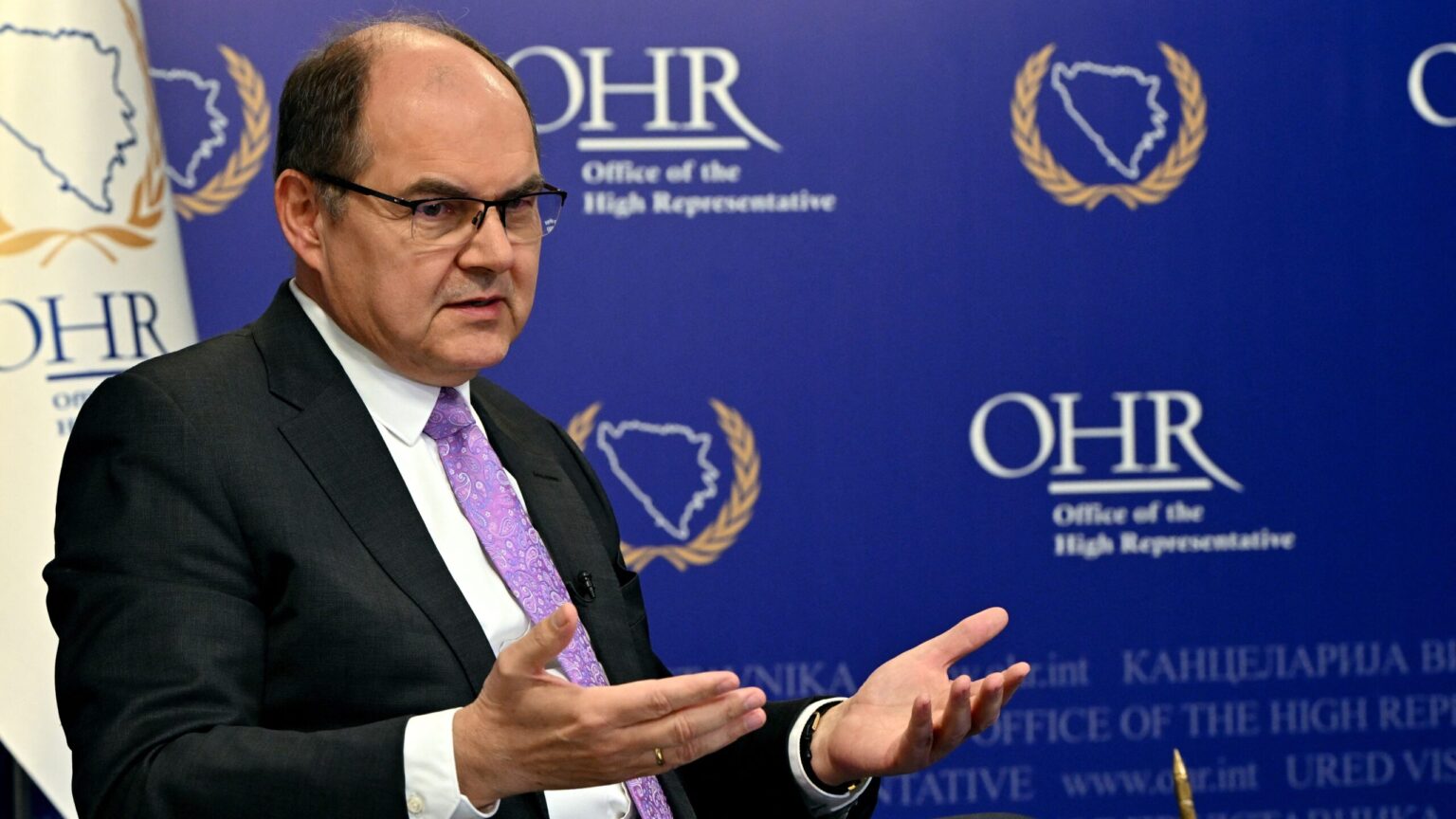
Christian Schmidt appeared before the UN Security Council on Tuesday amid deepening uncertainty over the future of Bosnia and Herzegovina’s postwar order. Hours later, he formally announced his resignation as High Representative, though he is expected to remain in office on an interim basis until a successor is appointed, ending one of the most controversial tenures in the history of the Office of the High Representative.
In many Western capitals, the resignation will be treated as a routine bureaucratic transition. It is something far more significant than that. It marks the deepest crisis yet for the system of international supervision imposed on Bosnia and Herzegovina after the Dayton Accords and raises a question Western policymakers have avoided for nearly three decades: whether the entire model has exhausted its political legitimacy.
His final appearance before the United Nations Security Council underscored just how fragile the post-Dayton order has become. In unusually stark terms, he warned that Bosnia and Herzegovina faced its most serious institutional crisis in years, accusing Republika Srpska’s leadership of systematically undermining the state’s constitutional framework.
Yet the more revealing development came not from Schmidt himself, but from Washington. American officials signalled that his successor would likely exercise a substantially narrower mandate, the clearest indication yet that the United States is reconsidering the expansive international supervision model it helped build after Dayton.
The resignation is a reckoning. It may well mark the beginning of the end of a political model that the United States and its European allies have spent nearly three decades constructing, defending, and refusing to question. Bosnia and Herzegovina is the only state in Europe where a foreign official appointed by outside powers holds the legal authority to write laws, dismiss elected governments, rewrite constitutions, and remove sitting politicians from office. This arrangement has been sold, for 30 years, as a peacekeeping necessity. It is worth asking, at this late hour, whether it was ever anything more than imperialism with a human rights gloss.
Those who built the postwar order in Bosnia believed, with the confidence characteristic of the 1990s, that the right institutions imposed from outside could transform a shattered country into a functioning democracy. They were wrong. The result was not democracy. It was dependency, a country frozen in a permanent state of supervised adolescence, unable to develop the political muscles that self-governance requires because every serious dispute could always be resolved by an outside authority.
‘The result was not democracy. It was dependency’
Dayton ended the killing but created an extraordinarily complex system of ethnic power-sharing between Bosniaks, Croats, and Serbs. Three presidents, 14 parliaments, and overlapping veto structures were meant to prevent domination by any one group. What they produced instead was political paralysis. Governments form only after months of negotiation, reforms stall, and major disputes are routinely resolved through outside intervention.
Originally conceived as a temporary institution, the Office of the High Representative became something else after the Bonn Powers of 1997: a shadow government with the authority to intervene directly in the politics of a sovereign country. A foreign official, accountable to no Bosnian voter, acquired powers no elected government in the democratic world would tolerate. 30 years later, the foreign supervision remains in place. At some point, a transitional arrangement becomes a permanent colonial administration.
That is precisely how it is understood in Republika Srpska, the Serb-majority entity that, along with the Bosniak–Croat Federation, makes up the Bosnian state. There, the OHR is not seen as a peacebuilding institution. It is seen as an occupying authority. The grievance has legal weight: Christian Schmidt was never confirmed by the United Nations Security Council. Russia and China refused to approve his appointment. Yet he continues to issue binding laws and reshape the political order of the country over the objections of its population. In Banja Luka, this is not perceived as the defence of democracy. It is perceived as its negation.
Before presenting his latest UN report, Schmidt escalated the confrontation with Republika Srpska, accusing it of systematically undermining Bosnia’s central institutions. Perhaps Schmidt is correct in his assessment of what Republika Srpska is doing. But correct analysis does not automatically justify the remedy. The deeper question is whether an unelected foreign official issuing warnings and decrees is the appropriate instrument for resolving what are, at bottom, political disputes between communities that must ultimately find a way to govern themselves. Washington has apparently concluded that it is not.
Washington’s recalibration began before Schmidt’s resignation. The shift reflects not only frustration with Bosnia’s paralysis, but a broader American retreat from the nation-building assumptions that shaped the post-Cold War era.
The lifting of sanctions against Milorad Dodik and his associates in 2025 signalled a shift away from isolation and toward engagement with Republika Srpska.
The Dodik case illustrates the central contradiction of the Bosnian system. Dodik was prosecuted and removed from office under a law imposed by Christian Schmidt through executive decree. A foreign official wrote the law. An elected politician was prosecuted for defying it.
In Republika Srpska, the case is viewed less as a defence of the rule of law than as proof that the OHR can weaponize the legal system against political opponents. For Bosnian Serbs, the episode confirmed a suspicion that has never fully gone away, the suspicion that Bosnia is not a state that emerged from the genuine consent of its peoples but a construction imposed by outside powers and maintained by outside force. That suspicion may be inconvenient for the architects of Dayton. It is not, on the evidence, entirely wrong.
From the Bosniak perspective, the OHR is not an imperial imposition but a lifeline. For many in Sarajevo, it remains a security guarantee against renewed secessionism. The rhetoric coming from Republika Srpska is not theoretical, nor is Dodik’s relationship with Moscow incidental. Those who fear that a premature Western withdrawal could unravel what little stability exists are not paranoid. They are people who have already watched their country collapse once.
Discontent with Dayton, however, is not confined to the Serb community. Many Bosnian Croats argue that the postwar system has steadily eroded their political voice. Because Croats and Bosniaks vote in the same constituency, larger Bosniak voting blocs have repeatedly determined the Croat member of the presidency. For many Croats, this violates Dayton’s original promise of political equality among the country’s constituent peoples. Bosnia today has the formal structures of democracy without broad agreement on their legitimacy. Institutions function, but their authority is contested, and major political disputes are routinely managed through foreign supervision rather than domestic compromise.
30 years of international oversight have confirmed a basic conservative critique of liberal internationalism: democracy cannot be imposed from outside, and political systems permanently managed by international bureaucrats never develop the capacity to govern themselves. Washington is not wrong to reassess. The question is whether it is doing so with adequate honesty about why the reassessment is necessary. The Clinton administration built Dayton and the system that followed it on the premise that American power, applied with sufficient commitment and institutional creativity, could transform the political culture of a shattered country. The George W Bush administration made essentially the same bet in Iraq and Afghanistan. Bosnia has simply been a slower, quieter version of the same failure.
‘Democracy cannot be imposed from outside’
Europe, for its part, is not reassessing. Germany in particular remains committed to the OHR model and continues to regard the office as an indispensable guarantor of Balkan stability. The Germans are not wrong that someone needs to worry about stability in southeastern Europe. They are wrong to conclude that the current arrangement produces it in any durable sense. What it produces is a managed stasis, a situation in which catastrophe is prevented but nothing is resolved, and in which the resolution of underlying conflicts is perpetually postponed because there is always a foreign official available to paper over them.
There is a particular irony in the fact that a German politician is the current face of Western trusteeship over Bosnia. Germany, which spent decades after the Second World War insisting on its own sovereignty and its right to build democratic institutions without external supervision, is now the principal European defender of an arrangement that denies those same rights to Bosnia. Berlin is upholding a model that Washington itself is quietly abandoning. That is not a sustainable position, and it will not be sustained indefinitely.
The Balkans are once again becoming contested terrain, and Washington has a legitimate interest in regional stability. But American interests are not served by an arrangement that generates resentment, paralysis, and permanent dependency. The European Union, meanwhile, sustains the EUFOR Althea military mission and continues to provide political backing for the High Representative’s authority. Brussels has also, in an act of optimism that strains credulity, classified Bosnia as an official EU candidate country. The combination is remarkable: a state that is supposed to be on a path to membership in a union of sovereign democracies is simultaneously being administered by an official with the authority to override its elected government at will. A country administered by foreign decree is being prepared for membership in a union of sovereign democracies.
‘A country administered by foreign decree is being prepared for membership in a union of sovereign democracies’
Wolfgang Petritsch, the Austrian diplomat who served as one of Schmidt’s predecessors, has drawn the logical conclusion. The remaining reforms that Bosnia needs to implement, he argues, could be handled within the EU accession process itself. There is no longer a political justification, more than three decades after the end of the war, for maintaining the OHR. This is not a fringe position. It is the position of a man who held the job and knows what it is and what it is not capable of producing.
Schmidt himself arrived in office hoping, by his own account, to be the last High Representative. He would close the office and hand Bosnia its full sovereignty. It did not work out that way. The country had not implemented the necessary reforms, he declared, and the office therefore remained essential. He is now leaving while making essentially the same argument: indispensable, unfinished, necessary. The man who wanted to end the OHR is departing as its defender. Institutions rarely declare their own mission complete.
The short-term stabilizing function of the OHR is real and should not be dismissed. Pull the external authority away suddenly, and bad things could happen. Republika Srpska’s leadership has given plenty of indications that it would exploit any vacuum aggressively. Sarajevo’s fears are not groundless. Even critics of the OHR generally accept that the continued EUFOR military presence remains an important deterrent against escalation.
But stabilization and resolution are different things, and the OHR has been delivering the former for 30 years while making the latter progressively less likely. A country whose political conflicts are permanently managed by an outside authority never develops the mechanisms for managing them internally. The muscle atrophies from disuse.
Dayton stopped the killing. That achievement is real and should not be forgotten or minimized. But the system Dayton produced did not, in the end, create the conditions for a self-governing, self-sustaining political community. What it created was a country in permanent receivership, whose ethnic divisions were institutionalized rather than transcended, whose sovereignty was nominal rather than real, and whose politics could never mature because maturity requires the possibility of genuine failure and genuine accountability.
Bosnia has become a 30-year case study in the limits of liberal internationalism and externally managed democracy. The tragedy is that the people who built the Dayton system and sustained the OHR through its various iterations never seriously entertained the possibility that they were wrong. They kept adjusting the model, adding powers here, extending mandates there, issuing new decrees and new warnings, and when none of it produced a self-sufficient democratic state, they concluded that the solution was more of the same.
Christian Schmidt’s resignation does not end that story. It does not dissolve the OHR or restore Bosnian sovereignty. It does not resolve any of the underlying disputes that have made Bosnia ungovernable for three decades. But it does something important. It signals, for the first time from within the system itself, that the model has exhausted its credibility even among those responsible for operating it.
If Bosnia is ever to become a genuinely sovereign country, the OHR will eventually have to close. Not tomorrow, and not without a serious reckoning with what comes next. But the case for closing it is stronger now than it has ever been, and the case for continuing it is weaker. The argument that outside supervision is indispensable has been made for 30 years. At some point, indispensable becomes indefinite, and indefinite becomes permanent, and permanent colonial administration, whatever name you give it, is not compatible with the self-governing democracy the West claims it is trying to build.
Peace, as the history of Bosnia shows, can be imposed from outside. The habits of self-government, the willingness to negotiate rather than to wait for a foreign official to resolve the impasse, the acceptance of political defeat as something other than an existential threat: these cannot be. They have to be grown from inside, through conflict and compromise and the accumulated experience of shared life. No amount of international supervision has ever produced them, and there is no reason to think it ever will. A political order that still requires foreign supervision after 30 years may have preserved peace, but it cannot honestly be called a successful democratic settlement.
Related articles: