
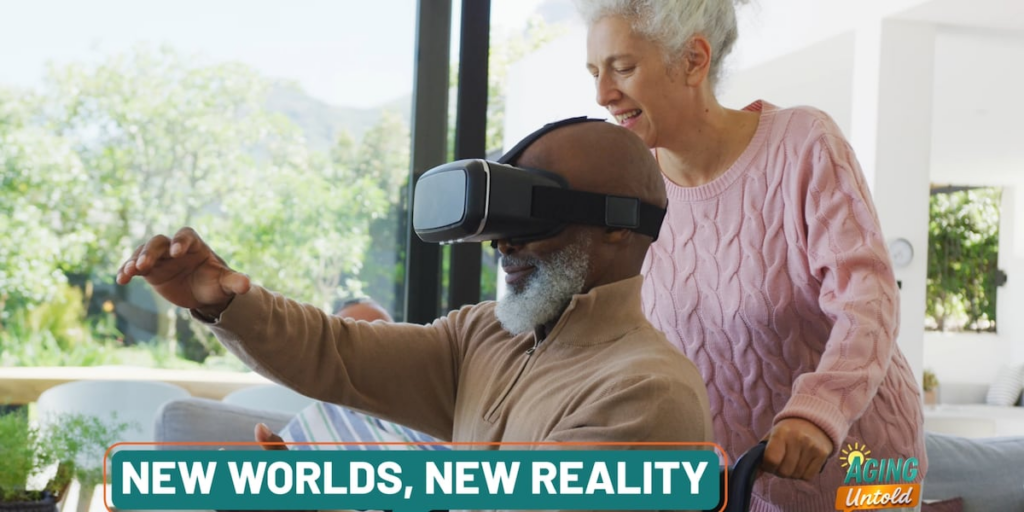
(Aging Untold) — Virtual reality (VR) is opening new worlds for seniors, allowing them to explore, travel and reconnect from home.
In a 2023 study of adults 65 and older, nearly 80% saw improved emotional well-being after trying VR headsets, and 60% said they felt less isolated after short sessions, according to the Associated Press.
Programs show promising results
The New York State Office for the Aging started a program that distributed artificial intelligence (AI) companions and found that 95% of users experienced less isolation and felt less lonely and more connected, Amy O’Rourke, an aging expert, said.
“There is a little bit of a creep factor like, oh, it’s not a real person, but it’s really been effective once they get used to it,” O’Rourke said.
The Department of Veterans Affairs has used virtual reality to help with pain relief, mental health issues and balance issues while decreasing the sense of isolation that older adults experience, O’Rourke said.
Benefits and precautions
Sam Cradduck, a gerontologist, said VR systems are opening up a whole new world, but they can cause vertigo and dizziness in some users.
“If you’re going to do this, you want to start slow,” Cradduck said. “You don’t want to just throw on a headset because your grandkids decided to put you in a game system, and take off because you could get dizzy and it could lead to falls.”
For people with dementia, there are concerns about added confusion, but there are real benefits to being able to go on a trip and never leave home, Cradduck said.
Dr. Rhea Rogers, a board-certified physician, said balance is key. Physical therapy programs are using VR for balance, support and mobility.
Some people can get overwhelmed and overstimulated, leading to more agitation. However, the ability to visit museums or other places without leaving home provides valuable interaction. It just should not substitute for real-life interaction.
“You also want them to have some direct interaction. It’s never going to replace it,” Rogers said. “I think everything is an enhancement.”
Creating connections
Katherine Ambrose, an aging-well coach, said VR can create laughter and engagement with family, serve as conversation starters with families or caregivers, and allow users to revisit meaningful places like beaches where they honeymooned or towns they were in years ago.
The technology provides emotional reconnection, memory stimulation and conversation catalysts. It can also be used for practical testing to establish a cognitive baseline and measure improvements, she said.
O’Rourke described one woman who had a secret she was too afraid to share. She talked to her AI companion about it, which became a catalyst for her to start talking to her children.
For older adults who need help setting up the technology, Cradduck suggested asking grandchildren to assist and then play games together.
Rogers recommended checking with local departments of aging to see what programs are available.
Four key takeaways
- VR can reduce isolation: In a 2023 study, 80% of adults over 65 saw improved emotional well-being after using VR headsets and 60% felt less isolated after short sessions
- Start slowly to avoid side effects: VR can cause vertigo and dizziness in some users, so it’s important to start with short sessions and have supervision to prevent falls
- Multiple applications: VR is being used for virtual travel, museum visits, pain relief, mental health support, balance training and physical therapy
- Enhancement, not replacement: VR should complement direct human interaction, not replace it, and can serve as a conversation starter and way to connect with family members
Copyright 2026 Gray Media Group, Inc. All Rights Reserved.