
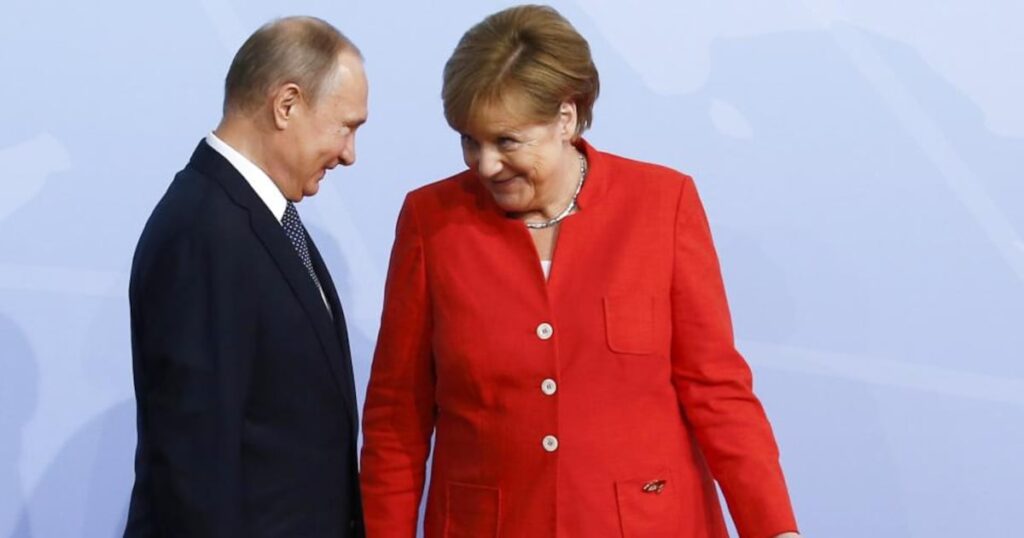
Angela Merkel sounds like she is enjoying retirement.
She has pared back her schedule to little more than “feel-good” engagements and thinned out her once‑familiar array of coloured blazers, though gardening has proved beyond her.
“Some things take off, others don’t. I console myself that it always depends on the nature of the soil,” she told a podcast from Germany’s Focus magazine.
Nearly five years after leaving office, the 71-year-old may soon be asked to retire her retirement – at least temporarily – to serve as EU envoy in any future peace talks between Russia and Ukraine.
Der Spiegel magazine was first to air the speculation, prompting a non-denial denial from Merkel’s office. There had been no official requests, a spokeswoman said, without saying whether she was ready to accept such a role in the future.
EU foreign ministers are set to discuss the envoy issue during an informal meeting in Cyprus from May 27th−28th. Not that Merkel would be Russian president Vladimir Putin’s first choice.
Last weekend he floated as a potential envoy Merkel’s predecessor as chancellor, Gerhard Schröder. Their close friendship, and Schröder’s stoic sympathy for Russian political perspectives, have proven a sticking point with EU leaders, along with his post-chancellery work as an adviser to Russian energy companies.
Enter Merkel, whose ongoing popularity in many western European countries is not shared among Germany’s eastern neighbours.
They will never forget how, in her four terms in office, she increased German dependency on Russian energy and backed undersea Russian gas pipelines, while blocking Ukraine’s Nato membership ambitions in 2008.
[ Latvian government collapses over Russia-bound Ukrainian dronesOpens in new window ]
Perceived appeasement of Merkel and other German politicians – as well as co-operation of German arms firms with the Russian army – have prompted angry outbursts from Ukrainian president Volodymyr Zelenskiy.
In April 2022 in Bucha, scene of one of the early war’s most infamous civilian massacres, Zelenskiy said: “I invite Ms Merkel … to visit Bucha to see to what the policy of 14 years of concessions to Russia has led.”
Poland and the Baltic countries are also cool on Merkel, particularly after she blamed them in part for the failure of her efforts back in 2021 to establish a way to allow the European Union to speak directly with Putin.
“That was not supported by some, primarily the Baltic states but Poland was also against it,” she said, “fearing that we did not have a coherent [European] policy towards Russia.”
A final delicate point is a Merkel nomination from her political frenemy, chancellor Friedrich Merz. He knocked back Putin’s Schröder suggestion on Thursday, saying “we Europeans decide for ourselves who speaks for us” – without naming any names.
But even Merkel-phobes have to admit she ticks many boxes: an experienced, unflappable, Russian-speaking, compromise-oriented leader with east and western European perspectives who is able to get inside Putin’s head.
[ Ukraine hit by second day of large-scale Russian missile and drone strikesOpens in new window ]
After another night of heavy Russian strikes in Ukraine, Merkel was not asked directly on Thursday about the envoy speculation.
Nor did she speak at length about the Russian-Ukraine conflict except to note, tantalisingly, that she “knows all the details”.
It was clear in an interview last year, however, that she has unfinished business on Ukraine-Russia, in particular that failed 2021 push for EU member states to “work on having a common policy” on Russia.
“In any case it didn’t come to fruition and yes, then I left office, and Putin’s aggression began,” she said then. “We will no longer be able to clarify today what might have been.”
While she waits for the phone to ring – or not – Merkel told the Focus podcast she was a woman of few regrets and fewer bad habits. Well, perhaps just one: “Liking a little too much fried potatoes at 10 in the evening.”