
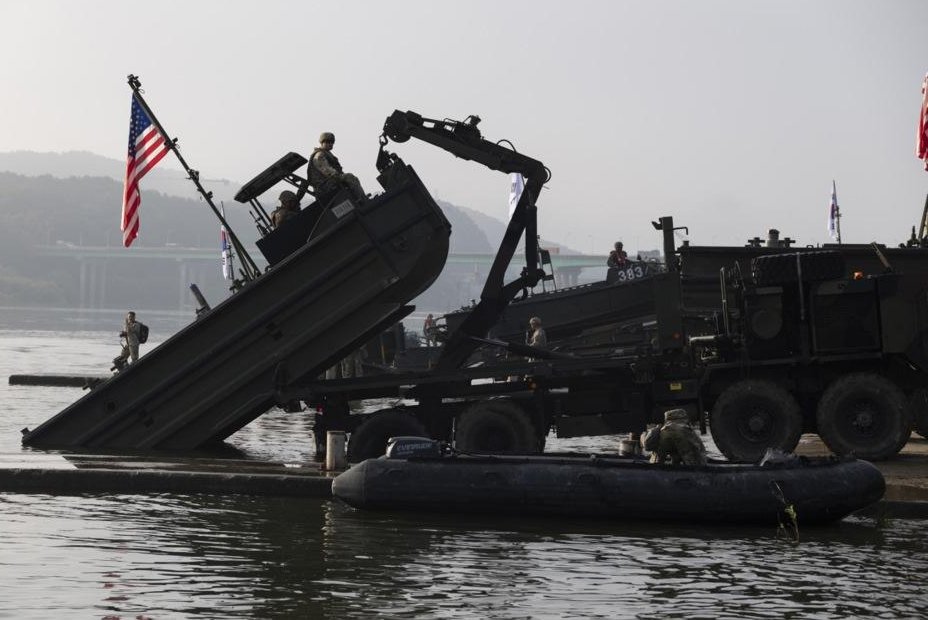
U.S. soldiers from the 11th Engineer Battalion with the 2nd Infantry Combined Division conduct a combined wet gap crossing exercise with the 7th Engineer Brigade, 7th Corps of the South Korean Army, as part of the Ulchi Freedom Shield 25 in Yeoju-gun, south of Seoul, in August 2025. File Photo by Jeon Heon-Kyun/EPA
May 15 (UPI) — The author prefers to use the lowercase “n” in north Korea to challenge the Kim family regime’s legitimacy.
The Republic of Korea and the United States have spent years debating wartime operational control transition as though it were the central strategic challenge facing the alliance. It is not.
The debate has become trapped in language, symbolism and domestic politics while the real military problem remains insufficiently addressed. The issue is not Operational Control, or OPCON, transition.
The issue, rather, is whether the alliance can design, build, resource and operate a Future Combined Forces Command, or CFC, capable of deterring war, controlling escalation, defeating aggression and securing the conditions for long-term regional stability.
The alliance should stop using the phrase “OPCON transition.” It obscures more than it clarifies. It reduces a comprehensive alliance modernization challenge into a narrow argument over authority and sovereignty. It implies the transfer itself is the strategic objective. It is not.
The right issue is not sovereignty. The right issue is whether a post-transition command arrangement strengthens deterrence, warfighting capability, escalation control, and alliance cohesion.
Question that should drive the alliance
The current debate often begins with the wrong question: Who commands? That question matters, but it is secondary. The primary question is this: What kind of combined command structure does the alliance require for future war in the Asia-Indo-Pacific?
That future war environment will not resemble the Korea of 1953, 1978 or even 2015 when the current conditions-based transition process was codified. The Korean Peninsula can no longer be viewed as a standalone theater.
Any future conflict involving north Korea will unfold in a broader regional operational environment shaped by China, Russia, cyber operations, space systems, artificial intelligence, information warfare, long-range precision strike systems and nuclear coercion.
The alliance therefore requires strategic agility, not merely strategic flexibility.
From strategic flexibility to strategic agility
The term “strategic flexibility” emerged during earlier debates over the regional role of U.S. Forces Korea. But flexibility is often reactive. Agility implies initiative, speed, adaptation and the ability to seize advantage before an adversary dictates conditions. That is what future deterrence requires. We need agility for both ROK and U.S. forces.
Why institutional maturity matters
The current combined defense structure was built for another era. It has performed remarkably well for decades. It deterred major war. It maintained alliance cohesion. It provided continuity and readiness during periods of extreme danger. But strategic maturity requires acknowledging when institutions designed for one era no longer fully fit another.
Hanbyeol Sohn correctly describes the Republic of Korea military as a mature force capable of leading future operations. He is correct that institutions must evolve as military capabilities evolve. And he is correct that the alliance command structure requires redesign to match modern operational realities.
But the alliance should avoid the mistake of treating OPCON transition as the solution. Transfer absent strategic clarity risks becoming a political milestone rather than a military improvement.
Kim Jong Un benefits most from any transition that creates ambiguity regarding command relationships, reinforcement timelines, nuclear consultation or U.S. commitment. Deterrence depends on eliminating ambiguity, not introducing new forms of it
New framework: Future Combined Forces Command
The alliance, therefore, needs a new framework. It should cease treating OPCON transition as the main effort and instead focus on the establishment of a Future Combined Forces Command.
Six foundational conditions
That effort should begin with six foundational conditions.
1. Mission and specified tasks
The alliance must review, revise where necessary and clearly restate the mission and specified tasks of the CFC through the military committee and security consultative meeting process.
The mission must reflect contemporary strategic realities, rather than inherited assumptions from the Cold War. The command must be prepared for conventional conflict, nuclear contingencies, cyber-attacks, gray zone coercion, instability in north Korea, regime collapse and regional crises that affect Korea and the broader “Pacific region.”
Most importantly, each contingency plan must define a clear political end state approved by both governments — for example, establishing a free and unified Korea or a United Republic of Korea, or U-ROK. Military success without political clarity invites strategic failure.
2. Combined Contingency and Campaign Planning
The alliance must develop a truly integrated combined campaign plan. The defense of the Republic of Korea can no longer be separated from broader regional security requirements. It must operationalize Articles II and III of the 1953 Mutual Defense Treaty.
Future conflict scenarios may involve simultaneous crises in Korea, the Taiwan Strait, the East China Sea or the broader Pacific. Campaign design must, therefore, integrate deterrence, escalation management, reinforcement, missile defense, cyber operations and post-conflict stabilization into one coherent framework.
3. AI-enabled command and control
The alliance should design and implement a fully AI-enabled command and control system for the Future CFC. This may become the decisive modernization effort of the next decade. Future warfare will reward the side capable of integrating information, making decisions rapidly, synchronizing across domains and exploiting data faster than adversaries.
The alliance should build a secure, interoperable system operated daily by ROK and U.S. personnel and fully integrated with United Nations Command member states. Such a system should provide real-time translation, integrated planning tools, automated workflows, resilient communications and targeting integration across the combined force. It must be able to exploit emerging AI capabilities.
4. New operational concepts, organizations
The alliance must develop new operational concepts and organizations suited for future war. Combined kill web architectures and combined multi-domain task forces should become central components of alliance modernization.
The Future CFC cannot simply inherit legacy command arrangements designed for a largely linear ground campaign north of the DMZ. Future operations will involve simultaneous contests in cyberspace, the electromagnetic spectrum, information environments, maritime domains and space. Operational concepts must reflect this reality.
5. Fully organized, resourced headquarters
The alliance must fully organize and resource the Future CFC as a functioning operational headquarters, rather than one only activated for exercises, contingencies or war. Assigned ROK and U.S. personnel must continuously man the command. Assigned and apportioned ROK and U.S. forces must routinely train together.
Readiness cannot exist only in plans and briefing slides. Future war will punish commands that have not trained together under realistic operational conditions.
6. Full-spectrum training
The alliance must train across the full spectrum of contingencies. Exercises should stress nuclear integration, escalation management, cyber disruption, regional spillover, north Korea internal instability and collapse operations, and combined political-military decision-making under crisis conditions. Tactical interoperability alone is insufficient. Strategic synchronization between Seoul and Washington will determine success or failure during crisis.
Korean command and political legitimacy
At the same time, one political and military reality should be acknowledged clearly and directly. Any military operations conducted in north Korea, whether during war, collapse or instability operations, must ultimately be led by a Korean commander. This is not simply a Korean political imperative. It is also an American strategic necessity.
The only acceptable end state for operations north of the DMZ is a free and unified Korea. That political objective requires Korean legitimacy. The United States cannot appear to occupy north Korea or impose unification through foreign military control. The perception of another Iraq or Afghanistan would undermine legitimacy from the outset.
The strategic question
This is where the debate should mature. The alliance should stop arguing about transfer dates and symbolic milestones. It should, instead, focus on designing the future command system necessary for deterrence and defense in the Asia-Indo-Pacific.
The question is no longer whether the Future Combined Forces Command should exist. The question is whether the alliance possesses the strategic discipline and political maturity to build it correctly.
David Maxwell, executive director of the Korea Regional Review, is a retired U.S. Army Special Forces colonel who has spent more than 30 years in the Asia-Indo-Pacific region. He specializes in Northeast Asian security affairs and irregular, unconventional and political warfare. He is vice president of the Center for Asia Pacific Strategy and a senior fellow at the Global Peace Foundation, where he works on a free and unified Korea. After he retired, he became associate director of the Security Studies Program at Georgetown University. He is on the board of directors of the Committee for Human Rights in North Korea and the OSS Society and is the editor at large for the Small Wars Journal.