
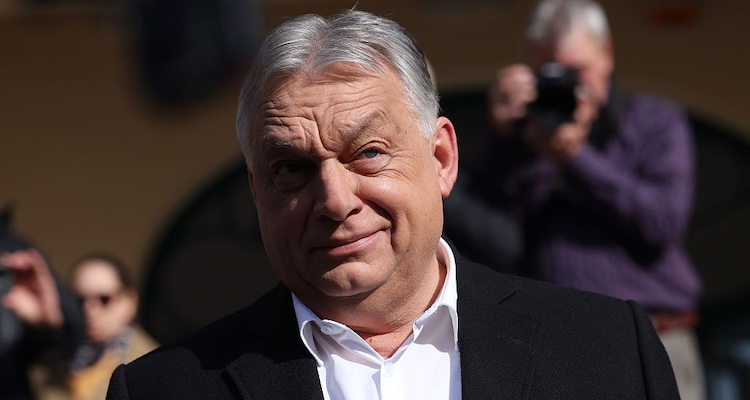
In April 2026, Viktor Orbán’s Fidesz party was voted out of power in Hungary, losing its parliamentary majority for the first time in over a decade. A sober assessment of Orbán’s Hungary, alongside other postliberal regimes, should finally put to rest the imagined utopia of postliberalism. We can now say plainly that real postliberalism has been tried, and the results were far from perfect.
I am here evoking the longstanding notion in Marxist circles that regimes aligned with Communist ideals have fallen short only because “real socialism hasn’t been tried yet.” The endurance of that idea has been vital for those who still believe in the overall Marxist ethos. In this view, socialism’s dark history is due only to the corruption and wickedness of people like Joseph Stalin or Mao Zedong, not to socialism or Communism itself. But 109 years after the formation of the Soviet Union and 36 years after the fall of the Berlin Wall, it is nearly impossible to argue with any honesty that the failures of socialism were not aberrations but features. Food shortages, economic stagnation, corruption, and repression are inherent to collective ownership and centralized social planning. The failure to grasp such basic cause and effect is due to the romanticization of Communist utopia and the demonization of democratic capitalism. In this imagined world of perfection where socialism can work, everything good from our current order can remain the same while we simply fix the inequality of capitalism by superimposing socialism on top of it.
The “hasn’t been tried yet” fantasy is an attempt to have your cake and eat it too, to avoid the atrocities of socialism by keeping the parts of society that are good while doing away with the unfairnesses. What socialists refuse to grasp is that oftentimes those very good things they value are by-products of the system they so loathe.
A similar problem plagues those who self-identify as postliberal and/or integralist. Postliberals, such as the political philosophy professor Patrick Deneen, and integralists, such as the law professor Adrian Vermeule, successfully identify genuine cultural problems—and then issue sweeping and sensationalist solutions. Seeing a world bereft of order and virtue—as evidenced by alternative forms of marriage, the collapse of the nuclear family, the abandonment of the factory-working everyman, the proliferation of drugs and pornography combined with weak communal and religious institutions—postliberals then turn and blame the problem on liberalism itself.
For Deneen, liberalism’s emphasis on autonomy and rights has deemphasized the necessities of obligation, tradition, and community. But instead of noting the difference and calling for a revival of the mediating structures that try to set individualism within the framework of communitarianism, Deneen and others throw out the baby with the bathwater. The only way to rectify such issues, they argue, is through “regime change,” which happens to be the title of Deneen’s second book on the topic. Deneen concludes it with a call to action: “It is time to abandon the ruins we have made, seek shelter, and then build anew.” But what postliberals get wrong is that they believe they can maintain the “good” parts of liberalism while abolishing the parts they contemn.
Just like the Marxists, the postliberals refuse to make a cost-benefit analysis that ignores perfection as a possible end; instead, they rely on a utopian conception of the way things ought to be, and from which we are currently separated, to make value judgements on the way things currently are. This failure to appreciate the successes of liberalism in the first place is why they fall into a fatal trap—the belief that historical novelties such as the rule of law and economic prosperity are simply inevitable. In other words, for the post-liberals, all that we prize in society can exist absent liberalism; while at the same time, liberalism is holding us back from the way in which things can be even better.
This is where the postliberals have their own form of the “hasn’t truly been tried” myth. Instead of admitting that centralized, religious autocracy inevitably leads to all sorts of intended and unintended consequences—of which there is adequate proof—postliberals seem to believe that real religious autocracy, or real postliberalism/integralism, hasn’t been tried yet. But the truth is it has been tried and the results left much to be desired.
Three contemporary examples show us how postliberalism greatly weakens economic stability, hollows out authentic religious adherence, and does little to help the family grow.
_____________
The first is António de Oliveira Salazar’s regime between 1932 and 1968 in Portugal. In the aftermath of the First Republic of Portugal, Salazar created the Estado Novo, the New State, which combined Catholic social doctrine, nationalism, and economic corporatism. Salazar’s Estado Novo has in recent years received praise in the pages of the American Conservative and First Things.
That praise was unearned. Salazar’s corporatist system produced stagnation and peasantry. In 1962, the New York Times referred to Portugal as an “impoverished, backward, feudal country… the poorest and worst administered nation of non-Communist Europe.” The report continued, “Dr. Salazar has managed to keep law and order, the two primary aims of all dictators. Little else can be said for the regime.” By rejecting both free market dynamism and genuine competition, the Estado Novo further entrenched a poor, agrarian working class that was kept deliberately isolated to preserve control. Industries were organized into state-supervised guilds that suppressed innovation and protected incumbent owners. Almost half of the population worked the fields in abject poverty. Despite moderate GDP growth, Portugal remained one of the poorest countries in Western Europe. The economic gains that did materialize, often cited by postliberals, were a product of capitulating to “globalization”: the benefits of the Marshall Plan, extractions from African colonies, joining the Organisation for Economic Co-operation and Development (OECD) and European Free Trade Association in 1960, and a trade agreement with the European Economic Community in 1972. While other European nations further industrialized rapidly after World War II, Portugal lagged.
The regime also failed in its professed commitment to the family. While Salazar championed traditional family structures, his economic policies made it difficult for families to thrive materially. Although Salazar rapidly expanded the number of schools, illiteracy rates remained among the highest in Europe. The combination of low wages and limited opportunity led to significant emigration to France. By 1969, more than 100,000 Portuguese citizens had fled there.
In addition to the economic consequences of corporatism, Salazar—as all authoritarians must in order to uphold control and “order”—relied on harsh censorship and domination. The PIDE, Portugal’s secret police, often engaged in extrajudicial torture and execution. The suppression of dissent created a culture of fear, not virtue.
Ultimately, Salazar was plagued by the same malady that tends to destroy all repressive uniparty regimes: Life is unpredictable, and no central authority—no matter how disciplined or well-intentioned—can anticipate every social, economic, or political contingency. When pressures arose in Portugal over its imperialist policies in Africa, the regime could not adapt without undermining its own foundations. Salazar was forced to respond by intensifying control, expanding the mandatory military draft, and diverting scarce resources to preserve order. The result was a precarious cycle in which each effort to suppress instability only deepened it, leaving Portugal poorer, more isolated, more unstable, and less capable of genuine renewal. The Estado Novo was upended by the Carnation Revolution in 1974 without a single shot being fired.
If Salazar’s Portugal was marked by economic stagnation and widespread peasantry, Francisco Franco’s Spain was far worse. Yet, American Reformer writer Josh Abbotoy once quipped that “basically, America is going to need a Protestant Franco”—later qualifying, but not fully retracting, the remark in First Things.
Franco came to power at the end of a bloody civil war and ruled from 1939 to 1975 over a regime that was both more authoritarian and more explicitly religious than Salazar’s. Franco’s autocracy was not subtle, and neither were its consequences. He vowed to root out what he called “Judeo-Masonic-Bolshevik” influence, and he styled himself El Caudillo por la gracia de Dios, leader by the grace of God. His Falange movement had been backed by Adolf Hitler and Benito Mussolini during the civil war, and absent Spain’s internal devastation, he may well have joined them in World War II. The civil war itself was catastrophic: More than 500,000 died, with roughly 200,000 victims of mob violence and torture. During the war, the Nationalists imprisoned hundreds of thousands in concentration camps. Upon taking control, Franco abolished all political opposition, centralized legislative power in his own hands, and executed more than 20,000 political enemies, ensuring that dissent would not reemerge.
Economically, Franco initially pursued autarky—an attempt at total economic self-sufficiency—and it proved disastrous. Famine spread, and civilians collapsed in the streets. Beggars reportedly lined the roads as Franco’s motorcade passed, hoping for scraps of bread. By some estimates, as many as 200,000 people died from starvation in the postwar years…in Spain. Like Salazar, Franco ultimately had to abandon his ideological commitments to preserve his regime. By 1950, Spain was taking loans from the United States, and the 1959 Plan de Estabilización opened the country to international capital, IMF assistance, and American military bases. Tourism surged, forcing the regime to tolerate cultural changes—including bikini-clad tourists on Mediterranean beaches—that sat uneasily with its professed Catholic moral order. By the 1960s, Spain had joined institutions like the OECD and integrated into global trade, effectively abandoning autarky. Yet even with foreign investment, Spain was the poor relation of its Western European neighbors. A regime that had promised economic independence and moral virtue ended up compromising both.
Beyond economics, Franco’s fusion of church and state did not strengthen Catholicism; it weakened the faith’s potency. By presenting himself as a divinely sanctioned ruler and suppressing any religious pluralism, the regime bound the fate of the church to its own repression. The association between church and state, combined with harsh repression, made way for an even stronger anti-Catholic backlash in the inevitable collapse of the Franco regime. Today, Spain is more secular than half of the countries in the European Union, ranking 16th out of 34 in religiosity, according to Pew Research. Only around 20 percent of Spaniards identify religion as “very important in their lives” and say they attend services at least monthly. Supposedly secular strongholds such as Poland, Ukraine, and Greece all rank higher than Spain.
This is no surprise. As Alexis de Tocqueville observed as early as 1835, the separation of church and state is not a boon for secularization but for religious authenticity and piety:
When a religion founds its empire upon the desire of immortality which lives in every human heart, it may aspire to universal dominion; but when it connects itself with a government, it must necessarily adopt maxims which are only applicable to certain nations. Thus, in forming an alliance with a political power, religion augments its authority over a few, and forfeits the hope of reigning over all.… The Church cannot share the temporal power of the State without being the object of a portion of that animosity which the latter excites.
According to Tocqueville, anticipating our current debate, by standing apart from the ephemeral and political state, the church strengthens true faith and virtue.
The same phenomenon is evident in Orbán’s Hungary. While touting itself as a postliberal Christian country, Hungary ranks even lower (20th) in religiosity than Spain. In the latest Hungarian census, 57 percent of Hungarians declined affiliation to any faith. Membership in the Catholic Church dropped by 30 percent—an estimated 1.1 million people—since 2011. Hungary’s Catholic demographic shrunk from 50 percent in 2001 to a lowly 28 percent today. This, despite the fact that large swaths of state funds have been poured into churches.
In addition to falling religious association, Hungary’s pro-natalist policies have done little to curb declining birth rates across Europe. Hungary’s birthrate (1.41) trails both France’s (1.61) and England’s (1.55).
_____________
And, just as Salazar and Franco were undone by economic trouble, the same is true of Orbán. Despite adopting free market policies between 1998 and 2002 during his second tenure as prime minister, Orbán later took a more corporatist stance, or what he deemed an “unorthodox economic policy.” He levied heavy taxes on banks, energy, and telecommunications, in addition to nationalizing private pensions. The Fidesz party took control of hundreds of corporations and businesses and invested greatly in Chinese lithium-ion batteries and electric-car plants. The investment did not pay off and left the economy in free fall. Orbán raised the minimum wage and put price caps on a number of products including gasoline, making the economic problem even worse. In 2025, Hungary’s growth in GDP was 0.4 percent, third to last among EU countries. As was the case with his postliberal predecessors, Orbán was forced to give in to his chief populist foe, the European Union. According to Johan Norberg, senior fellow at the Cato Institute, EU funds to Hungary “totaled up to 4%… similar to what East Germany received from West Germany after reunification.” An economic plight of Orbán’s own making, combined with pervasive corruption—rivaling that of countries like China and Cuba—helped sow the seeds of the regime’s demise.
What these case studies show us is that removing the pillars of the liberal democratic order doesn’t fix systemic inequality or stem the proliferation of pornography. It has a much more wide-ranging impact. Were we to follow these examples, as the benighted postliberal philosophical apologists for Orbán would have us do, we would risk upending the foundations of a prosperous society that allow us to have basic needs met in the first place. Autocratic regimes aren’t repressive because they have a depraved leader—although they oftentimes do—but because autocracy doesn’t govern by popular or republican consensus. Widespread poverty and a poor working class aren’t a coincidence but a consequence of corporatism, protectionism, and anti–free market policies. And the idea that they foment virtue is a proven absurdity. When you fuse church and state, you get a less authentic, more alienating religious order.
Instead of seeking utopia, postliberals, just like socialists, would be better served spending their time thinking about how liberalism has made our lives comparatively better than those of our predecessors while working on ways to fix whatever drawbacks come along with it. Winston Churchill said as much when he quipped, “Democracy is the worst form of government, except for all the others.” Maybe that’s why postliberals hate him so much.
Photo: Sean Gallup/Getty Images
We want to hear your thoughts about this article. Click here to send a letter to the editor.