
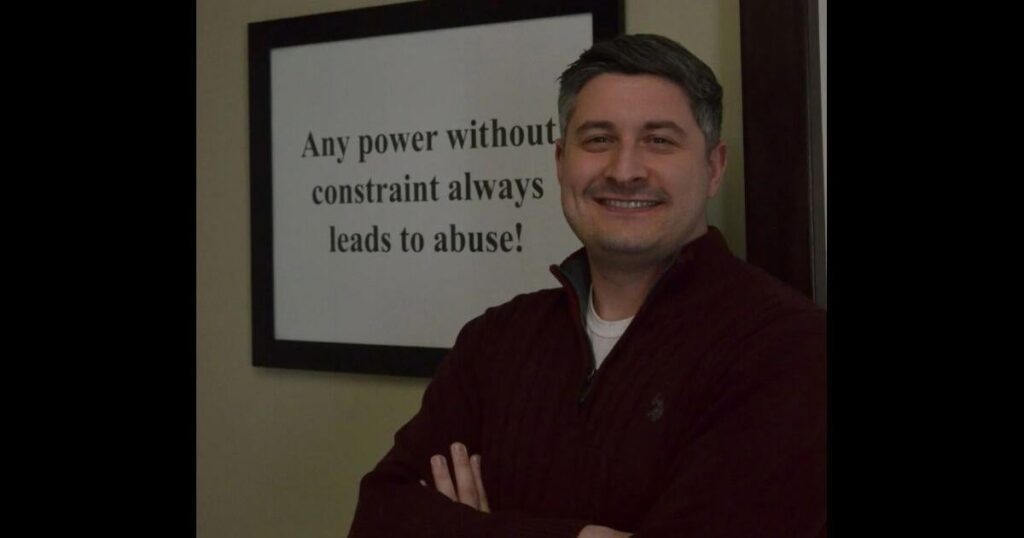
SARANAC LAKE — Village Manager Bachana Tsiklauri will be leaving the village government next month to study international diplomatic relations in Estonia with a focus on military conflict resolution.
A native of the country of Georgia, he saw what happens when diplomacy fails and devolves into conflict. As a teenager, he saw tanks roll through his hometown and heard bombs exploding as Russia invaded his country.
“I’m going to do everything in my power to prevent anything like that from happening to anywhere else,” Tsiklauri said.
He told the board of his coming departure in March, knowing that the position is loaded with a lot of work and wanting to give the village enough time to find a replacement.
The village is currently accepting letters of interest to fill the manager position.
Tsiklauri said he plans to stay through the end of June — the end of the fiscal year — to help the new manager ease into the job. The village went through a major turnover when he started as the treasurer in 2022. There was no one around to show him where things were. He wants to leave the next manager in a better position.
Mayor Kelly Brunette said Tsiklauri’s leaving is a “huge loss” for the village.
He is well-versed in village operations and knows much of the budget by heart.
In budget meetings, he can rattle off account codes for specific spending lines off the top of his head, as well as how much is budgeted for on that line. For example, within a few seconds, he can tell you that parks equipment is budgeted on line 001-7110-0200 and there is $10,000 in there this year.
Tsiklauri started as the village treasurer in 2022 and was appointed as the village manager in 2023, after the former manager resigned following a conflict with the then-mayor.
He has been accepted to a two-year master’s program in International Relations and Diplomacy at Tallinn University in the city of Tallinn, the capital of Estonia, which starts in August.
He’ll leave early to watch his partner, Almy Bartis, graduate with a master’s degree in a similar field from a college in the Netherlands in July. The two have been living long-distance for two years.
One of the things that attracted him to Tallinn University is that it pays respects to traditional diplomatic methods, but also looks to the contemporary methods in the modern world.
Tsiklauri said he would love to work for the U.S. Department of State, which handles foreign policy and relations, after graduating, but that’s a long way off.
“The United States is the key to progress of the human race, that’s my personal opinion, for many factors,” Tsiklauri said. “It’s actually doing something good for humanity as a whole.”
Diplomacy is a field that has always attracted Tsiklauri’s attention. It is basically just the practice of good communication through conflicts. He sees it as the foundation of what has allowed humans to build everything that they have, and a way to improve the world from where it stands today.
“Diplomacy is the tool for finding the solutions for the problems that all of us are dealing with, all the inhabitants of this planet,” Tsiklauri said.
It is something unique to humans. Without it, he said it is impossible to tell what others are thinking or trying to do. It’s how humans create peace, he said.
Instead of conflict, fighting and war, diplomacy settles differences through civil conversation, planning and cooperation, he said.
Though, globally, he said there are tough times for diplomacy right now, he is optimistic that there’s always a way out to a brighter future.
“Every generation is blessed with the ability to do that,” Tsiklauri said. “I don’t think our generation is an outlier.”
He wants to dedicate his life to peace and prosperity throughout the globe. He’s just one guy, but he knows there are people who think like him.
Dominos
Tsiklauri was 13 when Georgia, a former Soviet republic on the Black Sea, was invaded by Russia in 2008.
Though the war only lasted five days, the Human Rights Watch non-governmental organization has identified this as an ethnic cleansing and the European Court of Human Rights ruled that Russia had committed human rights abuses in Georgia. Russia still occupies around 20% of Georgian land to this day and around 192,000 Georgians were displaced by the war, according to the United Nations High Commissioner for Refugees.
Long processions of Russian tanks drove through his town toward the nation’s capital. He heard the sound of helicopters overhead and bombs exploding. He watched his country be invaded. His family sent him and his siblings to a church for several days while they stayed at the house. They did not want to stay, but were afraid of their home being robbed during the chaos.
Hearing helicopters flying and bombs falling, his faith in humanity took a hit, but it wasn’t crushed. He still believes in the good people can do, and that good diplomacy is the way to bring that about.
In 1991, as the Soviet Union dissolved, Georgia declared independence. Separatist movements in regions of the country, backed by Russia, wanted to further separate the regions of Abkhazia and South Ossetia from the country of Georgia. At the core of this conflict is oil, land, government structure and military alliances.
There was a ceasefire agreement signed in 1992, but it was fraught. Diplomatic regulations deteriorated into a crisis and separatist forces broke the ceasefire agreement, leading to The Five-Day War in 2008.
What’s going on now with the war in Ukraine is connected to what happened then, he said. It’s a “domino effect.” The human race is caught up in this cycle that comes and goes, he said.
Diplomacy attempts to remove dominos from that chain to prevent future collapses. This is something he wants to be a part of.
In 2022, soon after Russia invaded Ukraine, and before he was hired by the village, Tsiklauri and Bartis worked with the village to hang Ukrainian flags on Main Street as a show of support for the country.
Two years later, he moved to Saranac Lake at the age of 15, following his father.
Tsiklauri graduated from Saranac Lake High School, attended North Country Community College and earned a four-year degree at SUNY Plattsburgh. He worked in the financial field through his career before joining the village staff.
Local diplomacy
Diplomacy is a new field of study for Tsiklauri, but he said he’s already well-versed in it as a nonprofessional.
“We use diplomacy on a daily basis, right?” Tsiklauri said.
It’s an essential part of the job of a village manager, and he enjoys the challenge of communicating effectively.
If people in the village don’t communicate properly, if the proper channels and approaches are not carefully chosen, things are not going to work.
“If the right words and the right tone are not chosen, then the message that you are trying to relay might not get through,” Tsiklauri said.
The position is a “huge roundabout” — all roads lead into it.
“It doesn’t matter who is upset, everything comes to me,” Tsiklauri said with a laugh.
No one person can run the village themselves, he added. It takes a team, and that team needs good communication skills.
“The core of local government is teamwork,” Tsikauri said.
He will miss the work here. He said he’s enjoyed working for his community.
Tsiklauri said the hardest part of the job is when there is not enough time in the day and he cannot physically help everyone who is asking for help. He finds this frustrating.
“I never want to be someone that lets someone down,” he said.
He will not miss all the emails. Tsiklauri said he plans to recover from his “email PTSD.”
Though every day on the job brings a new challenge, he gets spiritual fulfillment from the satisfaction of knowing he helped someone out or resolved an issue.
“That is the biggest fulfillment that I have ever gotten from the job,” Tsikauri said.
Decisions and actions made on the local level are the most impactful to Saranac Lake residents, he said, and their impact is felt more immediately than state or federal actions.
One of his goals over the past four years has been to educate the board, department heads and the public on the finances of the village. Everyone should have an understanding of the budget, he said, since they are the ones who feed it and make it alive.
Budget talks can be dry and boring, but he said the budget is the most important financial document in the village.
Tsiklauri has advice for the next manager: be open-minded and stay within the rules. He said to take each complaint at face value.
An emotional reaction to criticism or complaints can prevent logical or rational decisions. He said it’s easy to let emotions mess with his head, but looking at the challenge or complaint with a “cold-headed” approach makes the job easier.
On the wall of his office hangs a large, framed quote: “Any power without constraint always leads to abuse!”
It’s a line from a documentary that he found to contain a core truth. He had it printed in a large front and framed on the wall so that he can see it every morning when he sits down at his desk. For Tsiklauri, it’s a reminder to stay neutral — to understand that everyone will have their biases and to avoid letting his get in the way — as well as a reminder that checks and balances are important to good government.
It’s a mentality he wants to bring to the global stage, tackling some of the world’s biggest issues.