
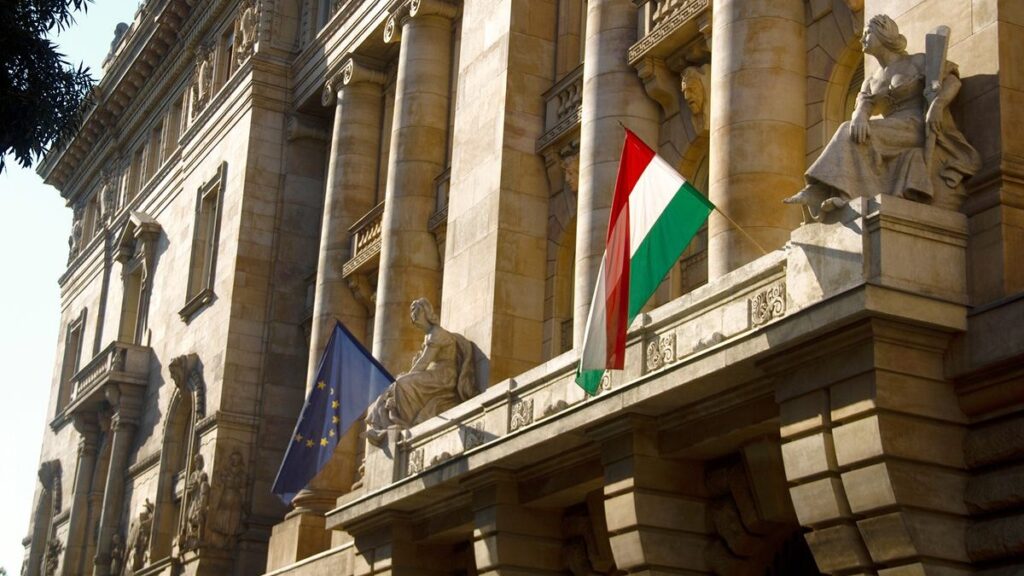
The following is an adapted version of an article written by Csaba Zalai, a university professor at the University of Public Service, originally published in Hungarian on the Five Minutes Europe blog of Ludovika.hu.
What Did Hungary Do Wrong During Its First Two Decades of EU Membership?
There is something symbolic about the fact that on 9 May 2026—Europe Day—the new National Assembly was formed and a new political cycle began in Hungary. This is not only a turning point in domestic politics, but also an opportunity to take stock after 22 years of EU membership and face the fact that the political, economic, and strategic convergence we rightly hoped for upon accession has not materialized, while the European Union itself is undergoing a historic transformation.
The decisions made in the coming years—on deepening integration, enlargement, the common budget, or defence policy—will determine Hungary’s room for manoeuvre for decades to come. It matters greatly with what credibility and from what position we participate in these debates.
Two years ago, on the 20th anniversary of accession, several assessments were conducted, but these were mostly incomplete and politically charged. Little was said about how public administration performed beyond EU subsidies and macroeconomic indicators, how well we were able to assert our interests, and what state the Hungarian European policy apparatus had reached.
At the same time, there was broad agreement that Hungary had not exploited the benefits of EU membership as successfully as several of the countries that joined alongside us. This is particularly painful because in 2004, many considered Hungary to be among the top performers: we started in the lead in terms of economic development, administrative preparedness, and legal harmonization.
The Loss of National Consensus
One of the conditions for our successful accession to the EU was the existence of a broad national consensus in Hungarian foreign policy following the regime change. The course set by the Antall Government—Euro-Atlantic integration, neighbourhood policy, and the protection of the rights of Hungarians living beyond the borders—remained in place thereafter. This provided the country with public support and international credibility.
However, the consensus gradually eroded after 2004, as foreign and European policy increasingly became a battleground for domestic politics, while cooperation on strategic issues declined. For a medium-sized member state with an open economy, predictability is one of the prerequisites for success within the EU.
Once again, we need at least a minimal consensus on our fundamental national interests. This does not mean a grand coalition, but rather that decisions on certain strategic issues—such as EU funds, enlargement, and security policy—should not be made based on the day-to-day logic of party politics.
This could include the meaningful involvement of opposition parties in shaping the main directions of foreign and European policy, as well as reviving the practice that existed during accession negotiations, when the National Assembly regularly debated Hungary’s European strategy. This would not be a political gesture, but a tool for democratic oversight and long-term predictability, which would also strengthen Hungary’s position in Brussels. The same applies to the European Parliament: more coordinated action by Hungarian MEPs on the most important national issues would increase our chances of asserting our interests.
‘We need at least a minimal consensus on our fundamental national interests’
At the same time, consensus-building must go beyond party politics. It must meaningfully involve economic actors, professional interest groups, Hungarian communities beyond the border, as well as the academic and expert communities. Although the European Studies Network was a good initiative, its insularity and narrow institutional base—relying on just three domestic universities—prevented it from fulfilling the role intended for it.
The Cost of Institutional Instability
One common feature of successful member states is that EU affairs are handled by a stable, professionally competent, and predictable institutional system. In Hungary, by contrast, the body responsible for EU coordination has constantly shifted from one ministry to another.
Over the past two decades, this system has been reorganized seven times—that is, on average every three years—with its tasks and responsibilities modified each time. This has not only undermined policy continuity but also diminished the weight and authority of EU coordination within the government.
Even more serious was the turnover of staff. With the departure of experienced EU affairs experts, institutional memory was lost time and again, even though networks, negotiation routines, and policy expertise are crucial in Brussels. Where there is no stable apparatus and accumulated knowledge, advocacy inevitably weakens.
It did not help that, starting in 2022, the position of the prime minister’s chief advisor on European policy (sherpa) was merged with the post of State Secretary for EU Affairs and later with that of Minister. This blurred the lines between strategic-political and technical-coordination roles, leading to an increased emphasis on short-term (party) political considerations and a weakening of professional oversight.
In addition, the previously well-functioning division of labour and mutually balancing roles among positions crucial to EU decision-making—the sherpa, the State Secretary for EU Affairs, and the Permanent Representative in Brussels—have been undermined, disrupting the institutional balance. Where there is no clear chain of command and no transparent decision-making process, the ability to advocate for interests is weakened again.
Foreign Policy and European Policy on Separate Tracks
One of the shortcomings of recent years has been that traditional foreign policy and European policy did not reinforce one another but often proceeded along separate tracks. There was a failure to consciously align bilateral, multilateral, and regional cooperation—particularly the Visegrad cooperation—with EU objectives.
Synergies between the network of embassies and the Permanent Representation in Brussels also remained untapped. Yet today, the two areas are inseparable: energy and supply security, defence policy, trade, and enlargement are simultaneously EU and foreign policy issues. Closer cooperation could also contribute to the mobility of staff and the long-term retention of professionals with the appropriate language skills and EU experience.
Meanwhile, Hungarian European policy has increasingly aligned itself with the conflict-driven logic of the European Parliament, as its key players have increasingly come from among politicians and assistants working in the EP. However, the vast majority of the EU’s actual decisions are made in the Council, through the coordination of member state interests and the forging of compromises. A member state may be vocal, but that does not necessarily make it effective.
What Went Well, and What’s Next?
The new government is inheriting a difficult legacy. Due to the conflicts and loss of trust of recent years, it must mend relations with EU institutions and a significant number of member states, as well as restore the regional partnerships that previously expanded Hungary’s natural sphere of influence. This is particularly true of the Visegrad cooperation, which, with the right degree of pragmatism, could remain an important framework.
One of the most urgent tasks is to secure the return of frozen or stalled EU funds. Together with the SAFE programme, this amounts to more than 32 billion euros, nearly half of which is non-repayable aid, while the remainder is available as loans under favourable terms. Tight deadlines are in place, so every month lost represents a direct economic loss. This is not merely a budgetary issue, as the functioning of local governments, the competitiveness of businesses, and economic growth all depend on it.
The initial phase will inevitably be a ‘rush job’, requiring quick political and technical solutions. It is important, however, that this forced ‘firefighting’ does not become the norm. In parallel with the drawdown of funds, the professional structure of Hungary’s European policy must be placed on new and lasting foundations, avoiding the recurring mistakes of the past two decades:
• a stable institutional system, rather than constant reorganizations;
• a well-prepared team of experts, with professional expertise rather than political loyalty;
• closer coordination between foreign policy and the EU;
• the rebuilding of regional alliances, particularly in Central Europe;
• more predictable relations with EU institutions and partners.
‘The professional structure of Hungary’s European policy must be placed on new and lasting foundations’
It is in Hungary’s interest not to engage in one-off crisis management, but to build a European policy apparatus that is viable in the long term. This requires a clear division of responsibilities: the prime minister (through his chief advisor, or ‘sherpa’) sets the strategic and political direction, while the State Secretariat for EU Affairs ensures professional coordination within the government and, together with the permanent representation in Brussels, is responsible for representing Hungary’s positions.
The use of EU funds does not fall strictly under EU coordination, so it is not practical to merge the two tasks into a single organizational unit. At the same time, closer cooperation with the Ministry of Foreign Affairs is needed, so it would be worthwhile to reestablish the network of EU attachés at Hungarian embassies in member states. This is because our bilateral relations are now largely shaped by EU affairs; moreover, in this era of European strategic autonomy, EU policy and traditional foreign policy areas are becoming increasingly inseparable.
The Next 20 Years Will Be Decided in Budapest
The first 22 years of Hungary’s EU membership offer a twofold lesson. On the one hand, EU membership alone is no guarantee of catching up: without appropriate governance, strategic thinking, and strong public institutions, there can be no lasting success.
On the other hand, Hungary’s situation is by no means hopeless. Our geographical location, economic integration, and knowledge base continue to offer a significant opportunity for us to become one of the region’s most successful member states once again.
To achieve this, however, we must break with improvisation, the predominance of domestic political logic, and institutional instability. The success of Hungary’s EU membership over the next two decades will ultimately be decided not in Brussels, but in Budapest.
The views expressed by the author do not necessarily represent the views of Hungarian Conservative.
Read more:
Click here to read the original article.