
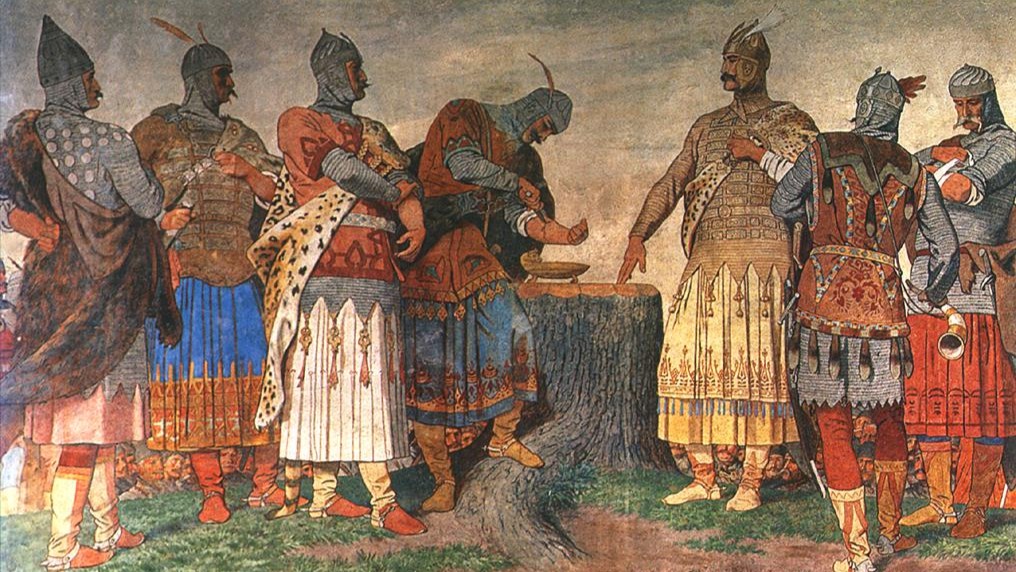
Mihály Hidasnémeti Ferdinandy (1912–1993) is one of the most exciting, yet never truly discovered, unprocessed, and perhaps even misunderstood figures of 20th-century Hungarian intellectual history. The promising young historian—who published his monumental work, We Hungarians (Mi magyarok), at the age of just 29—did not return to Hungary after the communist takeover.1
Marxist, and later post-materialist historiography immediately placed him outside the canon. The labels ‘witty dilettante’ or the even more unjust ‘second-rate epigon’, which are still attached to him today, are severe ideological and methodological judgments that are untenable given the author’s body of work, yet they prevent the historical profession from taking Ferdinandy ‘seriously’.2
His series of major works—We Hungarians (Mi magyarok), The Seekers of God (Az Istenkeresők), Italy and the Northern Man (Itália és az északi ember), Myths of the House of Árpád (Az Árpád-ház mítoszai)—are not merely excellent, highly readable historical treatises, but also grandiose, metaphysically demanding attempts to uncover the inner mainsprings of the Hungarian fate and the European spirit. Ferdinandy—although primarily a historian with brilliant intuition rather than a philosopher par excellence—did more than almost anyone else among Hungarian historians to experience and depict history not as a series of data or a mass of economic and social facts, but as a living, organic drama of fate.
In Ferdinandy’s perspective, mere facts represent only the surface of existence, the veil beneath which the forces of ‘inner history’ operate. According to him, the historian must reconstruct from the shattered shards of the past not primarily the physical form of the vessel, but the taste of the content it once held. He formulated this methodological credo, which proclaims the necessity of cognition beyond rationalism, programmatically in the opening lines of The Seekers of God:
‘I seek the mysteries, the arc, the contents, and the possibilities of human fate in this book. I ask the reader, nonetheless, not to search the following pages for the sentence that would answer his question: what is fate, essentially?…I do not wish to define fate, for fate is more than us and would burst even the most carefully devised definition. Yet, even if it cannot be defined, it can certainly be depicted. This book is an attempt to depict human fate.’3
History, therefore, according to him, is not a closed process, but a temporally unfolding variation of existence interpreted as drama. The nation, too, must be interpreted not as a statistical unit, a physical or at most psychological aggregate, but as a spiritual organism, indeed, as a true ‘personality’. Thus, Hungarian history—the primary subject of Ferdinandy’s works—stands before us not as a collection of isolated events, but as a single coherent life-destiny of grand and tragic arc.
As he emphasized in the lines quoted from the pages of We Hungarians: the nation must be conceived as an individuality just like the individual man, possessing its own birth, youth, and passing, and it must develop that peculiar language in which it can speak with its God.4
In Ferdinandy, the historian essentially becomes a seer. He is the one who ‘descends into the well on the dangerous rope of his thoughts, to reach Álmos and the ancestors, who live their timeless—because already passed—lives in unattainable depths’;5 he sees through the dust of centuries to glimpse the archetype, the Platonic idea of the nation, which must remain identical to itself despite every historical change, Mongol storm, Ottoman occupation, and war of independence.
‘Adopting a visionary attitude does not at all mean ignoring sources or indulging in subjective arbitrariness’
Ferdinandy, however, is not an irrationalist. Adopting a visionary attitude does not at all mean ignoring sources or indulging in subjective arbitrariness. This is the factor that radically distinguishes Ferdinandy’s historiography from, for example, the explicitly irrational, feverish explanations of ‘prehistorical dilettantes’ devoid of source criticism. Quite the contrary. He too started from the sources, applying source criticism similar to—or even stricter than—the positivists, but he uncovers their deepest, mythical layers lying beyond rationality.
While Gyula Szekfű analysed the ruin of the ‘three generations’ fundamentally on a moral–political basis, Ferdinandy expanded the horizon in the direction of fate analysis (Lipót Szondi) and cultural morphology (Oswald Spengler). His ‘new cultural science’ method views history not as the mechanical result of external impacts, but as an organism building from within, where biological, psychological, and metaphysical factors form an inseparable unity.
This organic–cyclical perspective allows him to interpret the past as a single coherent life path, a drama of fate possessing its own internal logic. In this system, the key figures of Hungarian history—St Stephen, St Ladislaus, Louis the Great, Matthias—are not merely contingent political leaders, but the embodiments of archetypes, formulating the answers of the national-individuality to the eternal fundamental questions of existence.
The Fate-Mission of the Hungarians
The central category of Ferdinandy’s philosophy of history is fate. Fate, however, is not some blind, deterministic doom, but a necessity springing equally from the national character and the geographical–cultural position. The concept of inner history for him designates how the spiritual makeup of the nation answers the challenges of the outside world.
This answer is not always rational, and indeed is often tragic, but it is always deeply characteristic of the subject that is the nation. In Ferdinandy’s analyses, the encounter of Northern and Southern (Mediterranean) cultures is not merely a geographical question, but a psychological drama similar to Prohászka’s dialectic of the Wanderer and the Hider.
Ferdinandy sees the fundamental problem of the Hungarian fate in the ‘double bind’, the perpetual oscillation between East and West. The House of Árpád, this family of saints and heroes, is not simply a ruling dynasty, but the biological and sacral bearer of this duality. In the members of the dynasty, blood (the nomadic, Eastern heritage) and spirit (the Western Christian mission) wage their battle. This struggle is not only political but existential: the command of fate.
‘I chose a family as the subject of my inquiry because the family is not only a historical but also a biological unit. Since I am Hungarian, I sought a Hungarian family for myself. It followed from the nature of my interest that my attention was drawn toward a family that reached into world history with a shaping hand. And there is only one such Hungarian family: the House of Árpád.’6
‘The decision of Géza and St Stephen, which bound the Hungarians to Western Christianity, is not merely a pragmatic political step, but an ontological leap’
The most dramatic manifestation of this fatefulness is the moment of the ‘primordial choice’. The decision of Géza and St Stephen—at once necessary and causing dramatic tragedies for a part of the nation—which bound the Hungarians to Western Christianity, is not merely a pragmatic political step, but an ontological leap.
With this decision, the Hungarians stepped out of the timelessness of the Eastern nomadic fate and entered the time of Western history, which separates two world-realities from each other. Yet this entry came with a massive sacrifice: the constant tension of internal division, of ‘two self-consciousnesses’, which has not reached a full point of rest in the Hungarians ever since.
‘In general, the entire fate of equestrian nomads, the entire history of equestrian nomads, shows that they always attempted to break out of the spell of the steppes. This undoubtedly succeeded best for the Hungarians and their ruling house. We have seen, however, that if the vault they built for themselves from Christianity and Western culture allowed a breach above them, then in every single case they escaped back through this breach into the ancient steppe.’7
The House of Árpád is the lineage of saints through which the Hungarians established contact with God: uniquely in Europe, it united the pre-Christian cult of the sacral–charismatic leader with Christian sanctity. This dual legitimation made it possible for the Hungarian king not merely to be one among many, but a true Apostolic King, who could negotiate with both the Papacy and the Empire as an equal.
The Kingdom of Hungary—Ferdinandy emphasizes—was not an ethnic state in its modern sense, but a Hungarian Empire (Archiregnum Hungaricum)8 capable of integrating Slavic, German, Pecheneg, Cuman, and Romanian ethnic elements under the idea of the Holy Crown. The true fate-mission of the Hungarians is to be a synthesis of East and West in the heart of Europe. The paradigmatic ruling figure, the powerful Hungarian tradition laying a millennial foundation, culminates not even in St Stephen, but rather in the figure of St Ladislaus.
‘In St Ladislaus, tradition and Christianity reconcile for the first time on Hungarian soil. He is the first whose Christianity does not suppress his Hungarian character, and whose Hungarianness does not exclude his Christian nature…His example provided the opportunity for the Hungarians to feel not tension, but unity between their undoubtedly existing Christian conduct and their undoubtedly remaining Hungarian sense of life and worldview.’9
He considers the reign of Louis the Great to be the zenith of Hungarian history. Here too, as with St Ladislaus, it is about the synthesis of West and East, but now in a more fulfilled, mature form. It is no coincidence either that the reign of Louis the Great coincides with the greatest territorial extent of the country.
‘This king, enthroned above Westerners and Easterners, Western by his forefathers but Eastern by his foremothers, is just as much a synthesis of West and East as the country he rules…In the figure of Louis we see the ideal manifestation of the Hungarian king, the guardian and lord of the ‘Eurasian synthesis,’ the sovereign of the European Centre.’10
The Struggle with Chaos and Retardatio Asiatica
In his work Mistress of Countries (Országok úrnője), Ferdinandy describes the era after the extinction of the House of Árpád, particularly the reign of Charles Robert (Charles I), not simply as an era of consolidation, but—similar to the Árpád era—as a titanic struggle in which the Western-style state-building will clashes with dragging, anarchic forces. The concept of retardatio asiatica (Asian delay/backwardness) here means the ‘re-primitivization’ of society.
‘Huns, Avars, Cumans, Pechenegs are telling examples of this—all-encompassing—re-primitivization…Just as it operated for about two hundred years in the case of the Mongols, the centre and social order created by Géza and his great son functioned essentially all the way up to the era of Stephen V—even if already threatened by the dangers of an epochal shift. But then it loosens. The history-turning work of the Árpáds, however, cannot be undone. Nevertheless, the society gradually losing its leaders—in accordance with its ancient nature—re-primitivizes.’11
Ferdinandy here projects the internal dynamics of nomadic societies onto late 13th-century Hungary. According to his theory, the social structure of steppe peoples is fundamentally loose and tribal, which only a charismatic ruler (like Attila or St Stephen) is capable of temporarily trans-hierarchizing, that is, forcing into a higher, imperial order.
As soon as this central force (the centre of power) ceases or weakens, society falls back into its original, more primitive state through the momentum of inertia. The era of the petty kings (oligarchs) is exactly this re-primitivization: the nation disintegrates into a loose, squabbling system of tribal–chieftain domains. This retardatio means not only political, but economic regression as well: the dominance of in-kind economy and robber economy as opposed to modern monetary economy.
Standing against this natural gravity, this ancient instinct pulling toward chaos, is the figure of Charles Robert, who in Ferdinandy’s interpretation is the archetype of the conscious, rational, Western statesman. As Ferdinandy formulates it:
‘What Charles fought for himself from fate: the summary of his life showing so many great and epochal results concludes with the essential lesson that the purposeful and resolute individual against a whole world: despite circumstances and intentions opposing him hostilely in everything, is capable of curbing every opponent, every unfavourable circumstance “with great power and a mighty arm”, bending them to the yoke of his own will.’12
Charles Robert’s historical role, according to Ferdinandy, is that he stopped the re-primitivization. ‘With great power and a mighty arm’ (a biblical allusion), he forced his will upon the anarchy. He is, therefore, not the continuator of the nomadic tradition, but the naturalizer of modern (contemporary) economic policy (the gold florin, mining reforms) and Western diplomacy (the royal summit of Visegrád).
The fight against the petty kings was civilization’s fight against barbarism. Charles recognized that the robber economy of the landowning oligarchy was destroying the cities and bourgeois development, so he rebuilt royal power relying on the cities and monetary economy.
His work, the Archiregnum (Mistress of Countries), was not the result of organic development, but the personal construct of a brilliant individual, which, however, was vulnerable precisely for this reason: its survival depended on the continuity of the royal will.
In Ferdinandy’s view of history, however, not even the greatest monarchs are exempt from the blows of Fate. Doom, the intrusion of the irrational element into history, appears even during Charles Robert’s life, most dramatically in the assassination attempt by Felicián Zách and the catastrophe of the Wallachian campaign.
‘The “mountains” (the landscape) and “betrayal” (the human factor) always lurk beneath the surface of rationality’
In his description of the Battle of Posada (1330), Ferdinandy analyses the miniatures of the Illuminated Chronicle, highlighting the visual representation of the tragic. The image of the chivalric army trapped in the narrow mountain pass symbolizes the impotence of technical superiority against ancient warfare utilizing natural terrain conditions. Charles Robert, the organizing genius, stands impotent here against Fate; the transfer of royal majesty (the coat-of-arms armour) and the flight show the limits of personal heroism and the fragility of human fate. This event is a warning: not even the empire-building will can overcome every obstacle; the ‘mountains’ (the landscape) and ‘betrayal’ (the human factor) always lurk beneath the surface of rationality.
The Wanderer and the Sovereign
As we saw earlier, according to Lajos Prohászka, the Hungarian hiding (bujdosó) soul cannot truly form an organic unity, it can only ‘scatter’. Ferdinandy, however, sees this problem differently. The foundational experience of the Hungarian soul, besides ruling, is precisely wandering—that is, in Ferdinandy’s interpretation, the Hungarian is also originally a ‘wanderer’—which, however, often distorts into hiding as time passes.
In his work Italy and the Northern Man, Ferdinandy grasps the ‘Northern man’ in his nostalgia for the South (classical harmony, the Sun, Rome). Wandering is not merely geographical movement, but a metaphysical search: the search for lost totality, the Golden Age. The great paradox of Hungarian history is that the wandering people find a homeland, but guard the memory of the infinity of the steppes in their souls to the very end.
Ferdinandy saw the fundamental problem of the Hungarian fate in the ‘double bind’ between East and West and in the perpetual oscillation, which took body in the dynastic and sacral mission of the House of Árpád. The cause of the tragedy, according to Ferdinandy, was not even the weakness or passivity of the Hungarian nation itself, but the lack of a true leader after the era of Matthias and the Hunyadis.
The nation is a Body that, left without a Head, weakened because the holy king was not only a political leader but a sacral mediator between God and the people. When this mediator ceased to exist, the nation was left alone in the ‘struggle with God’. After Mohács, legitimacy was lost definitively. The ascension of John Zápolya and the Habsburgs to the throne was merely a surrogate action, an unsuccessful attempt to fill the sacral void. Ferdinandy, with the title of Chapter VIII of We Hungarians—‘German poison, Turkish opium’ (Német maszlag, török áfium)—quotes Zrínyi to refer to the trap into which the nation, having lost its leader, fell.
‘Wandering is not merely geographical movement, but a metaphysical search: the search for lost totality, the Golden Age’
Even if the dynasty physically died out, Ferdinandy’s entire body of work suggests: the holy royal tradition and the imperial formula can be spiritually rehabilitated and restored—if not currently in politics, then in the consciousness and spirit of individual Hungarians. The mode of existence for Hungarians is not seclusion behind the spiritual and/or physical marchland, but to remind itself of its earlier, more elevated existence. Embracing tragic knowledge for him means proudly accepting the great destiny of wrestling with God. This ‘great and new perspective’, which he promises in the preface of We Hungarians, is exactly this spiritual dimension that points beyond the physical loss caused by Mohács or Trianon.
In his interpretation, the essence of the Hungarian Archiregnum Hungaricum is qualitative existence and sovereignty. The Sovereign, even if currently dethroned, remains a king, because true kingship is not external power, but the spiritual step of sovereign inner bearing. According to Ferdinandy, the modern Hungarian nation must find its vocation not in power expansion, but in a qualitative existence—in the sense of László Németh. Embracing fate is what makes the nation noble; the tragic is not failure, but the highest-order justification of existence.
‘The dawn sparkled in the East. The spell was broken. The steppe began to live and we turned back again from the ancient landscape…And we raised our heads and looked out between the narrow confines of the street to the eternal stars. And without fear and with an ordered soul we Hungarians set out on our own path, softly humming the brave verse of the poet: Be an island and await the sun from the swamp!’13
19th-century and early 20th-century historiography—from the influence of which neither Prohászka nor Ferdinandy could completely extract themselves—still tended to depict the conquering Hungarians as a tribal-level, unorganized, instinct-driven horde that could only rise to the level of true statehood in the wake of interaction with the West. Contrary to this simplistic, evolutionist view, modern Hungarian medieval studies (György Györffy, György Szabados) and international research (Walter Pohl) both prove that a coherent steppe imperial model exists, which is not the embodiment of chaos, but of an extremely sophisticated state organization with its own peculiar logic.14
The state-building techniques of the Hunnic, Turkic, Avar, and Khazar empires—the spiritual–cultural models of the conquering Hungarians—which the Hungarians also brought with them into the Carpathian Basin, actually show the picture of advanced, centralized power exercise. Such was, for example, the division of sacral (kende/kündü) and actual executive (gyula) power, which was not a sign of weakness, but a guarantee of stability. This structure separated cultic legitimation from everyday governance, preventing a power vacuum in the event of the death of a leader.
St Stephen’s Christian foundation of the state—as Ferdinandy also emphasizes—was actually not a radical break with the past, but rather a brilliant transformation, a ‘salvaging’ of this steppe tradition.15 Contrary to the pessimistic reading of Prohászka’s The Wanderer and the Hider, György Szabados and modern research also prove that Stephen’s state was a hybrid construction in which the Western (Frankish–Bavarian) model and the Eastern (steppe) heritage formed an organic unity.16
‘Stephen’s state was a hybrid construction in which the Western (Frankish–Bavarian) model and the Eastern (steppe) heritage formed an organic unity’
St Stephen’s royal character becomes truly unique at this point: he was not a primus inter pares with restricted maneuvering room in the sense of Western feudalism, whose power was bound by private-law bargains. Although he legally remained the first man of the nation in the spirit of the Blood Oath, in the technique of power exercise he enforced the Attilan (tracing back to the Hunnic sacral kings) legitimation. Thus a peculiar synthesis was created: a sovereign of Christian form but Eastern content with absolute power, whose centralized strength stood much closer to the efficiency of steppe empires than to that of contemporary Western kings struggling with feudal anarchy.
The Ferdinandy-esque Sovereign-ruler, therefore, actually did not deny the Eastern heritage, but poured it into a Christian form, thereby creating Central Europe’s most stable, centralized state, the paradigmatic medieval Kingdom of Hungary. In light of this historical fact, finitism, that is, the closure of the Hungarian state, is not impotence, but the result of successful adaptation, exceptional imperial organizing skill, and organizational potential. Thus the Hungarians—at least in the first, ascendant phase of their history—did not hide (bujdosott) in the Carpathian Basin, but actively and sovereignly arranged the space using the spiritual and political knowledge brought from the East.
The ‘ideal’ Hungary, in the sense of Ferdinandy’s positive vision, is not just one state among many in the Carpathian Basin, but a geopolitical fortress and a natural stabilizing centre. Its task is not conquest, but the protection of the region’s integrity, maintaining the delicate balance between East and West, and preserving its peculiar culture—Eastern in roots, but Western in form—against homogenizing global currents.
Archaic Myth and Modern Psychologism
Mihály Ferdinandy’s position as a historian was unique in 20th-century Hungarian intellectual history; for positivists, Marxists, and even certain trends of intellectual history, it was so radical, myth-centric, and metaphysical that—as Tibor Joó’s critique quoted above highlights—his work was often dismissed even by intellectual historians themselves as ‘novelistic history’. Ferdinandy’s interpretation of history was considered too irrational, or as one that reached too deep into the world of legends and collective imagination.
Although Ferdinandy’s ‘novelistic’ historiography is in reality the work of a brilliant diagnostician possessing immense background knowledge, his perspective is interwoven with a few spiritual symptoms stemming from the worldview foundations of modernity, which may nuance the overall picture.
Ferdinandy’s greatest merit is that he stepped beyond mere economic and political historiography and brilliantly recognized the universal patterns underlying forms: such is, for example, the sacral kingship fulfilling the role of the Axis Mundi (World Axis) in the Christian Middle Ages (Rex quasi sacerdos) and in the steppe-equestrian nomadic worldview (Almus id est sanctus), the solstice significance of the miraculous stag myth, or the universal yearning for the return of the Golden Age in the legend cycles of Hungarian and other peoples.
Ferdinandy, emphatically following C G Jung, derived these sacral archetypes from the ‘collective unconscious’, reducing them to psychological archetypes, primal instincts, and personality types—such as in the case of Hunor and Magor, or Béla and Ladislaus, the extroverted/introverted dichotomy. Premodern man, however, did not create his myths from the obscurity of subconscious instincts, but experienced them as direct revelation received in a state of ‘intellectual intuition’, still posited, for example, by medieval Christian philosophical and theological thought.17
In Ferdinandy’s works, the Platonic idea is thus often degraded to biology and at most depth psychology: the entire historical tableau is permeated by this ‘psychologizing’ view of history, which rears its head over and over again. According to one such explanation, the 13th-century ‘revival’ of the Attila myth among the Hungarians is a simple self-defence reaction to the trauma of the Mongol invasion. In Ferdinandy’s reading, the fear caused by the Mongol invasion triggered the ‘Scourge of God’ complex from the collective unconscious as a kind of psychological immune reaction against the Mongols. The Hungarians simultaneously wanted to show that they too had a ‘Scourge of God’ figure; moreover, this manifests in the form of an ancient king standing at the foundation of the entire national tradition.
It is obvious that the dread of the Tatars did not ‘produce’ the consciousness of Hun–Hungarian continuity, since Attila as an ancestral figure already appears in Anonymus, even before the Mongol invasion. The fact that the Hun legend comes more to the fore in Kézai, writing after the Mongol invasion, can also be explained by the fact that during the extreme peril, or the Mongol invasion interpreted as cosmic darkness, the sacral memory of the nation simply amplified.
According to one of his most debated explanations—while he brilliantly grasps that the medieval world is ‘much smaller, but precisely for this reason much greater’ than the modern one18—medieval man turns toward eternity (and the church) because he is terrified of death, change, and earthly turmoil, and ‘vehemently yearns for permanence.’19 St Augustine’s Civitas Dei (City of God) seems, in the author’s eyes, to be nothing but the ‘gigantic compensation’ for earthly suffering.
This is one of the greatest errors of modern psychology and sociology. Although elsewhere—for example, in interpreting Prohászka’s Holy Crown myth, or when speaking of the search for God as the deepest meaning of history—Ferdinandy firmly stands by the positing of sacrality, the transcendent dimension, and vertical character, in such passages he seems nonetheless to yield to the materialist and positivist spirit of the age. Feuerbach, one of the prophets of the materialist wave preceding Marx, also proclaimed that God is merely the projection of human fears, and since Ferdinandy does not balance these passages with the assertion of the existence of transcendence, they can easily cause confusion in the reader.
Knowing ancient and medieval metaphysical and theological literature, it can be stated with peace of mind that premodern man did not turn toward eternity out of fear, but because his intellect (his spiritual vision) was still open to the supernatural—unlike the modern, who becomes modern precisely by viewing everything in immanence, severed from spiritual roots. The demand to connect to God, or to the idea of eternity consubstantial with Him, is not a compensation, but the sole realistic and objective basis of existence prior to modernity, which every civilization—regardless of the specific form of religion—felt deeply.
Furthermore, Ferdinandy sees revelry and the ascetic fear of death (the vision of the rotting corpse) as two sides of the same coin, a ‘quasi-neurotic’ contradiction. If, however, we cast a glance at the true idea of the medieval Christian Memento mori and the Ars moriendi (the art of dying well), then we must see that medieval man did not at all evaluate this consciousness of death as an ‘icy sadness’. His image of death did not merely consist of a neurotic dread of biological annihilation.
As the French historian Philippe Ariès pointed out,20 in the eras preceding modernity, ‘tamed death’ (la mort apprivoisée) dominated: death belonged to the cosmic order of everyday life; it was a natural, communal, and ritual event. The shocking vision of the rotting corpse (macabre depictions and the dance of death) was not a symptom of existential despair, but a conscious, didactic, and ascetic tool (contemptus mundi—the contempt for earthly vanities). Its purpose was for the individual to detach from transient illusions and for his soul to prepare for the true, final spiritual struggle deciding eternal life. Medieval man did not dread non-existence—like the man of the modern age—but the unprepared, sudden death without repentance and sacraments (‘mors subita’). His anxiety was therefore not biological, but strictly metaphysical and theological in nature.
Ferdinandy could not completely rid himself of the rationalist prejudice that history is fundamentally a maturation process in which we progress from the primitive, ‘zoomorphic’21 phase to rational adulthood. He considers catching up with Western-style, settled civilization as the sole norm, mistakenly identifying it with Christianity.
Everything that deviates from this he frequently brands as internal discord or, worse, degradation or a subconscious reaction. He celebrates King Andrew’s sober, compromise-ready Realpolitik against Levente’s discordant paganism; and he condemns the petty kings because they prevented the development of Western-style commodity production and an agrarian bourgeoisie. In connection with the Hungarians remembering the Eastern past, he quotes Vörösmarty’s ‘sand of Shiva’; he sees the old steppe and the old nomadic reflexes as a ‘stubborn daimonion,’ the spirit of destruction (‘Ruin’), which drags the Hungarians into depravity if they do not cling tightly to the ‘blue landscapes’ of the West, that is, the Latin world of forms.
In this respect, Ferdinandy shows a great deal of similarity to the conception of Lajos Prohászka, whom he highlighted multiple times. As we quoted in detail earlier, for Prohászka, Eastern behaviour is ‘duckweed’ (Slavic melancholia and Turkish fatalism), from which the Hungarian can only be saved by the rationally acting Western spirit. Although they both rejected the French Enlightenment, the philosophy of history of German Idealism and Romanticism affected them with elemental force. While the anti-Eastern bias of Western rationalism is present in Ferdinandy only in a highly sublimated, latent form, the Eastern roots and origin tradition of the Hungarians were in certain cases interpreted as a deficit by him as well.
Ferdinandy used the intellectual historical concept of retardatio asiatica to contrast the Eastern, history-less existence falling back into the steppe with the more developed West. The question is whether the West can be fully equated with Christianity, if we also consider Byzantium and Russian Christianity. It is a fact that the West created banks and colonies sooner, but is this proof of its deeper Christianity?
If we were to ask a Russian or Greek thinker, he would argue that it was precisely the Orthodox East that preserved a purer Christianity and normal, traditional human modes of existence for the longest time.22
In light of myth research, a better understanding of Eastern religions and shamanistic traditions, and the revaluation of the concept of steppe civilization, the concept of retardatio asiatica is also difficult to maintain today: that is, the idea of the primitiveness of equestrian nomadic man and the equestrian nomadic empire.23
‘The life of the ancient Hungarians…was a serene existence respecting life and forming an organic unity with nature’
We know from the work of Gyula László and others that Ferdinandy’s cultural-anthropological premises—especially his theories adopted from András Alföldi concerning the zoomorphic, rationally backward phase of nomads—do not hold up at all. In that era, the young Gyula László, for instance, pointing to the majestic harmony of grave finds, hair-braid discs, and sabretache plates, proved: the life of the ancient Hungarians did not consist of apathetic fear of death and a demonic desire for destruction, but was a serene existence respecting life and forming an organic unity with nature. They were not Christians, but this does not mean they were primitive, demonic, or materialistic.
Related articles: