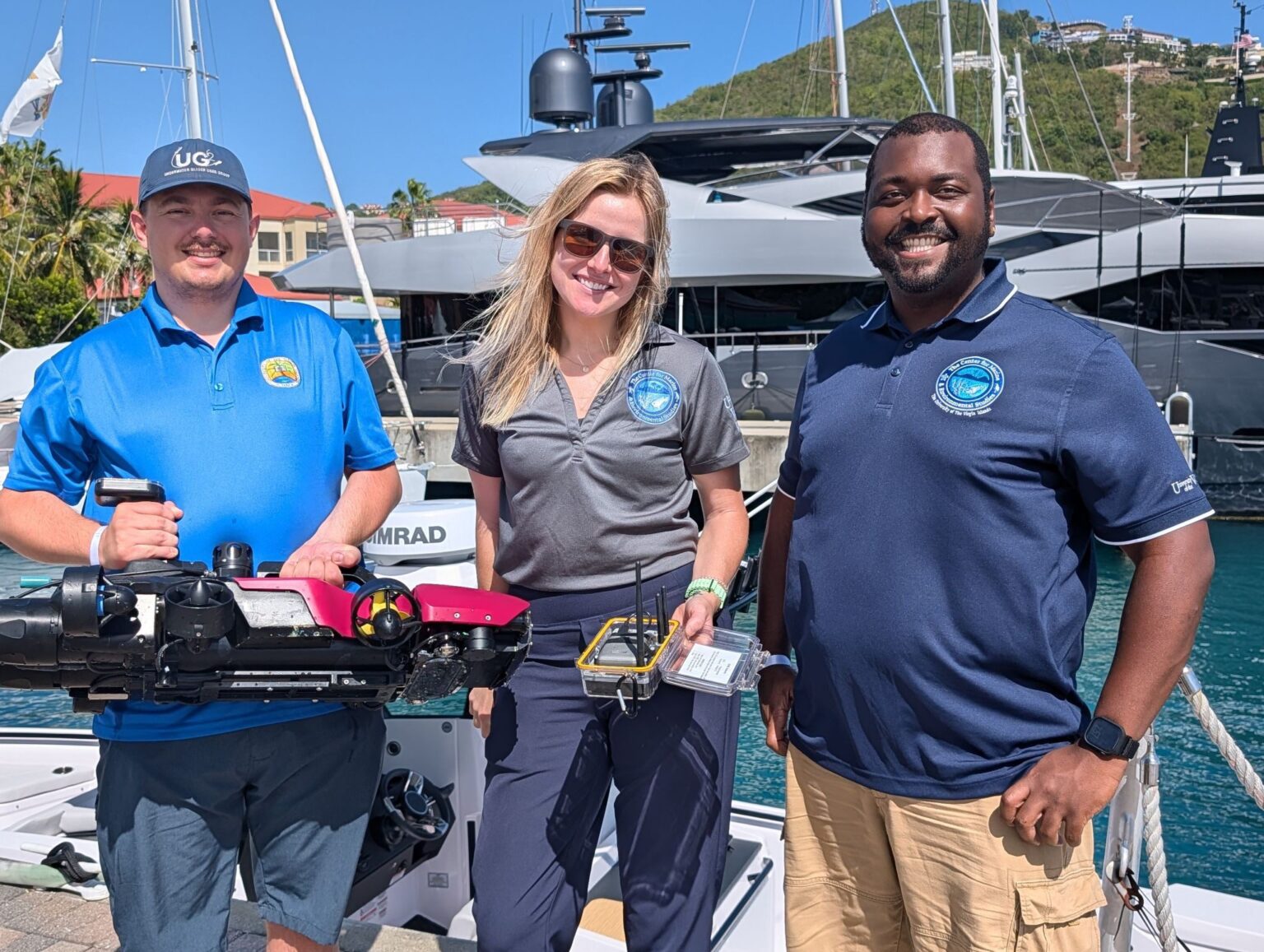
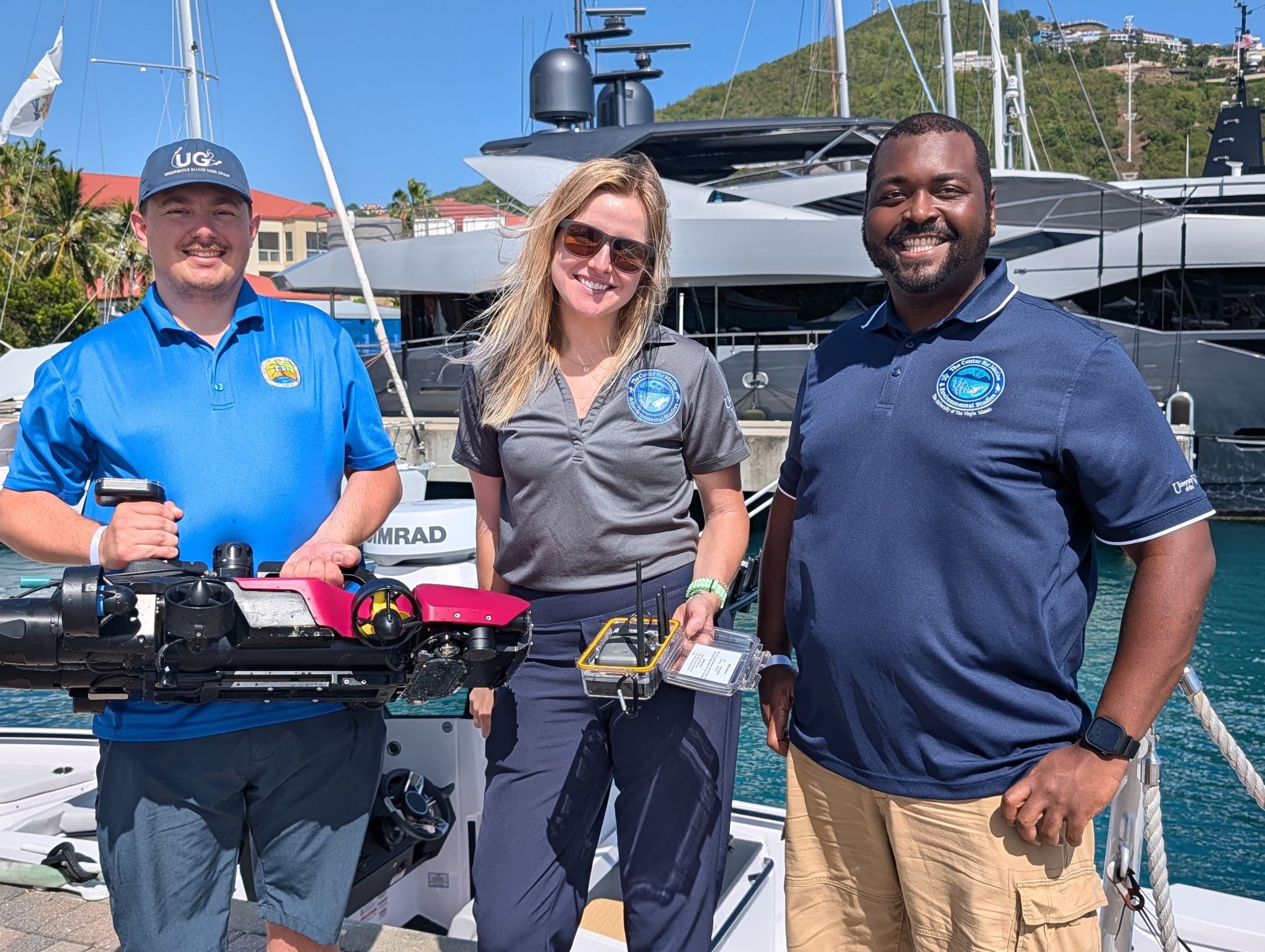
 From left, Cole Sheeley, Lauren Ollinger and Samuel Gittins Jr. pose with one of VICAR’s Ranger bots during the boat expo at IGY’s Yacht Haven Grande Marina on May 16. (Source photo by Finn Sharpless)
On Saturday, at the third annual Virgin Islands Boating Expo, held at IGY’s Yacht Haven Grande Marina in St. Thomas, researchers from the University of the Virgin Islands showcased cutting-edge technology during a Virgin Islands Center for Autonomous Research demonstration.
At the VICAR outreach event, researchers from the University of the Virgin Islands’ Virgin Islands Reef Response and VICAR also showcased live coral, virtual reality headsets, and underwater robots to help residents, especially children, better understand what is happening beneath the surface of local waters.
Lauren Ollinger, a research assistant professor at UVI’s Center for Marine and Environmental Studies and head of VICAR, said the work builds on years of diver-based coral reef surveys.
“The history of the Center for Autonomous Research is we have for a long time been doing manual diver-based surveys of coral reefs, specifically. Here in the Virgin Islands, we have 34 sites that we monitor annually, so divers go out every year to the same sites. These systems are changing and dying faster than we can keep up with using these traditional ways of surveying them.”
She said advances in artificial intelligence, autonomous vehicles, sensors, and batteries are now reshaping how that work is done.
“With this explosion in artificial intelligence and this revolution in autonomous vehicles and sensors, even batteries, there’s really a lot of these kinds of devices coming online. We set out early on to see how we could use these kinds of technologies to incorporate them into this program, and it was a strategic approach to develop methods specifically for the monitoring program.”
Ollinger said the team is already using the robots on real missions.
“We are actually deploying these technologies out on the coral reefs, and we pre-program these missions so they run by themselves. They can behave intelligently, they have obstacle avoidance, and they collect images at a really efficient rate compared to humans. That’s one of the reasons we’re motivated to use them, because they help us collect higher-resolution data.”
Samuel Gittins Jr., a coral research fellow and professional science master’s student at the University of the Virgin Islands, said the technology is being developed to identify “diseases and other different stressors in the coral space” underwater.
Gittins also said the hands-on experience helps spark student interest in marine science and robotics.
“It really helps spark their excitement,” he said. “Honestly, in the world of science, I bet they didn’t know that something like this existed, that you could actually control it yourself.”
Ollinger said children quickly adapted to the robot controls. She added that VICAR works with many different groups within the Center for Marine Science at UVI.
Nicholas Durgadeen, coral restoration technician with the Virgin Islands Reef Response program at UVI, said the technology helps students better understand an underwater world many have never experienced firsthand.
“Technology just provides that extra avenue in which we can teach them and really get them to understand what it’s like to be in that world,” Durgadeen said. “For kids who may not have had the experience to be in the water or scuba dive before, they get to see what it’s like and decide if this is a path they want to go down in life.”
Durgadeen said the reef restoration work often runs alongside the autonomous research group at UVI, which takes a different approach to accomplishing the same goals.
“They have a lot of autonomous and remotely operated vehicles that they try to go out and survey and monitor coral reefs. Instead of what our lab does, where we’ll go down to these sites and assess them with manpower people actually there, this lab is trying a different approach using remotely operated vehicles or autonomous operating vehicles.”
Ollinger said VICAR is a core group within the university working to develop new technologies and apply them across multiple research labs.
“We are the VICAR Lab, so we are a core group of people working to develop these technologies and then plug them into different labs,” she said. “A big part of that is the data infrastructure that we’re building. Behind the scenes of all this snazzy robots is actually a lot of coding that we’re doing day to day, and the purpose of that is to make these approaches usable for our entire department, not only for our single project and our single lab, but to eventually be used for mangrove surveys or coral restoration.”
She said the hands-on learning component is also important for students.
“Learning these kinds of skills, learning about engineering, learning about how things work, how it looks versus how it functions. I think it’s important,” she said.