
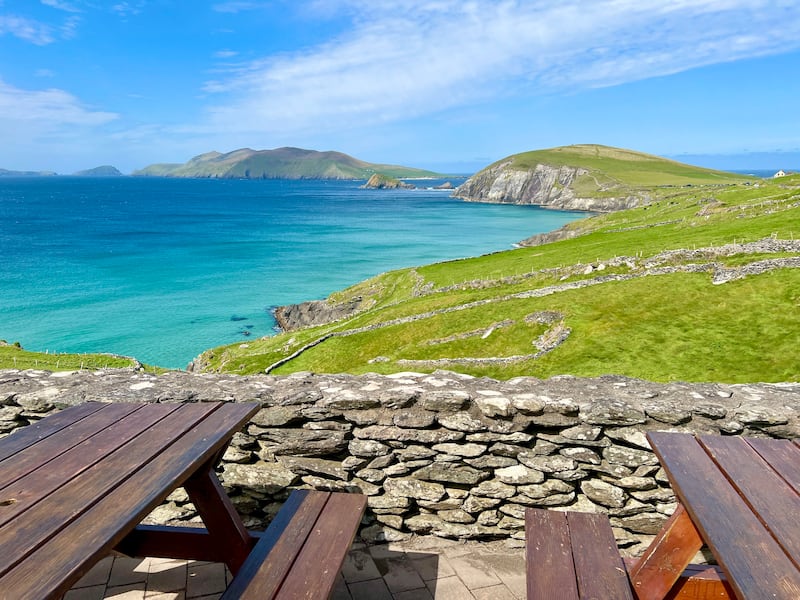
 A brunch stop at Caifé na Trá near Dingle on a scenic drive. (Photo by Scott McMurren)
Are you part of the Irish diaspora? There are about 70 million people throughout the world who can claim Irish heritage.
During the Irish famine between 1845 and 1852, more than a million people died of starvation. But more than twice as many left the island. Many sailed for the U.S. In any gift shop in Ireland, you can spot souvenirs with familiar Irish surnames: Murphy, Kelly, O’Sullivan, O’Brien, O’Connor and a hundred others.
My own family tree has roots in Ireland and Scotland.
When visiting Ireland, there are many resources to help you chart your ancestors, including The Irish Emigration Museum in downtown Dublin. Other members of my family have traced the McMurren heritage to Ulster in Northern Ireland.
Many visitors to Ireland are doing just that: Visiting their ancestral lands, even if their distant cousins no longer live there.
My trip to Ireland was not to find my ancestors. Rather, it was to visit to a family friend, Sister Anne Campbell. Sister Anne is a member of the Congregation of the Sisters of Mercy in Kilbeggan. For decades, Sister Anne taught at Catholic schools in the southern U.S., where she taught with my mother-in-law and became a dear family friend.
The Sisters of Mercy operate two schools in Kilbeggan. We saw them from across the parking lot. But Sister Anne took us right to a local landmark: the oldest licensed whiskey distillery in Ireland, the Kilbeggan Whiskey Distillery. The tour of the distillery offers an inside look at the process of making and distributing whiskey, as well as a taste of several varieties.
Whether it’s a quest to learn more about your ancestors or to witness Ireland’s incredible beauty, there are other surprises waiting for you on the Emerald Isle. America and Ireland are closely intertwined and you cannot help but feel connected, whether by faith, by family or some thread of culture or history. That doesn’t count the music, which is a universal connector!
It’s easy to explore Ireland, since almost everyone speaks English.
It’s good to have some of your arrangements completed in advance. But leave some wiggle room in your itinerary for thing you discover at random — like the whiskey tour in Kilbeggan!
I stand by my claim that Doolin, a small town on Ireland’s west coast, is the heart of Ireland’s traditional music scene. But Doolin’s not the only place you’ll hear this distinctive music.
Coming back from the Dingle Peninsula, we made a couple of stops to break up our journey back to Dublin. One was at the Blossom Hill B&B in Killaloe. As soon as we checked in, our host recommended we walk downtown, cross the River Shannon into the community of Ballina and find the Washerwoman Pub on Main Street, where he insisted we would enjoy the best Irish music around.
He was not wrong. The pub is small — less than 40 people can squeeze in. But each Sunday evening a group of a half-dozen or more musicians takes over the middle of the room. Musicians add three Irish flutes, an Irish harp, a banjo, a fiddle, a guitar and stir it up to keep everyone tapping their feet well into the evening.
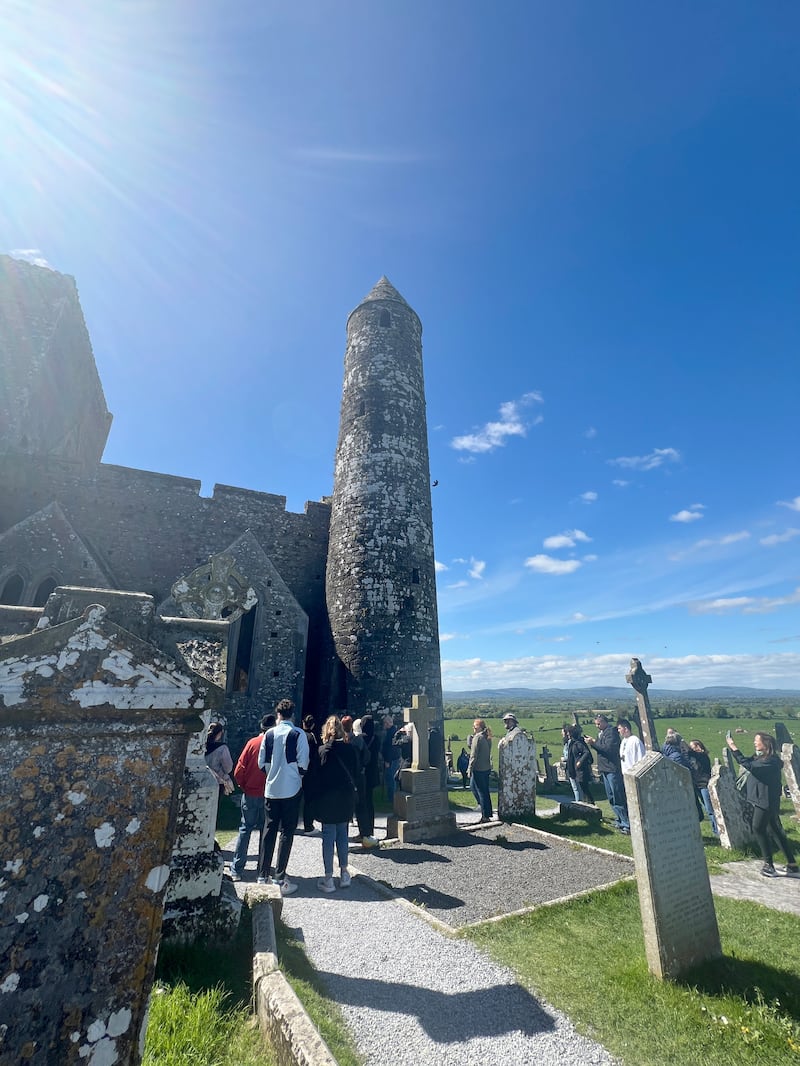 A giant 13th-century tower in the Rock of Cashel structure in County Tipperary. (Photo by Scott McMurren)
Before that, we made a planned stop to visit the Rock of Cashel, in Tipperary County. Set high atop the town and surrounding countryside, the church and castle are part of a UNESCO World Heritage site. None of the wooden structures remain from the original encampments in the 5th century CE. Most of the current structures were built in the 12th and 13th centuries.
The site once was the home to the High King of Ireland, but was gifted to the Catholic Church in 1101 CE. The stories of political intrigue between kings and bishops through the ages gives visitors more context to appreciate the struggles of the Irish people. This includes the cruel conquest of the fortress by Oliver Cromwell in the 17th century, who burned the cathedral with hundreds of townspeople inside seeking sanctuary.
The best seafood on our trip was in a restaurant in Dingle called The Fish Box. Dingle faces south on the Dingle Peninsula and boasts a robust fishing fleet.
The Fish Box is owned by the Flannery family, which has fished the waters for many years. Patrick Flannery works the family boat, the Cú Na Mara, and brings the catch home to Michael Flannery who manages the restaurant. Their sister, Emer Flannery, works the front of the house and tells the family story to diners who fill the restaurant each evening.
“We serve whatever we caught that day,” said Emer Flannery.
I’d never had monkfish, but it was the best fish-and-chips dish I’d ever had. The restaurant doesn’t take reservations, so it’s best to come early.
The Dingle Peninsula boasts incredible views and spectacular country. There’s a 50-mile scenic drive called Slea Head Drive with lots of pull-outs to stop and take in the views, or hike up a hill for a better look. We opted for brunch at Caifé na Trá, which is about 20 miles from town, tucked into a cliff with incredible views of the green hills, blue skies and the wild ocean.
Speaking of the wild ocean, there’s a scenic route that starts in the north in Donegal and snakes along the coast all the way to Cork on the south coast. It’s called the Wild Atlantic Way and it actually strings together several existing routes. That means it’s mostly narrow and slow-going. But it’s beautiful.
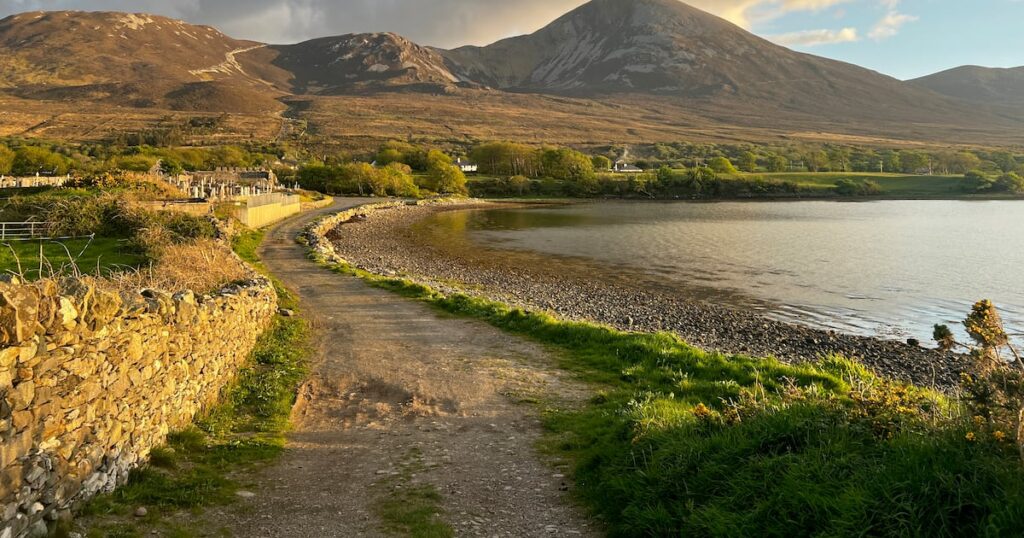
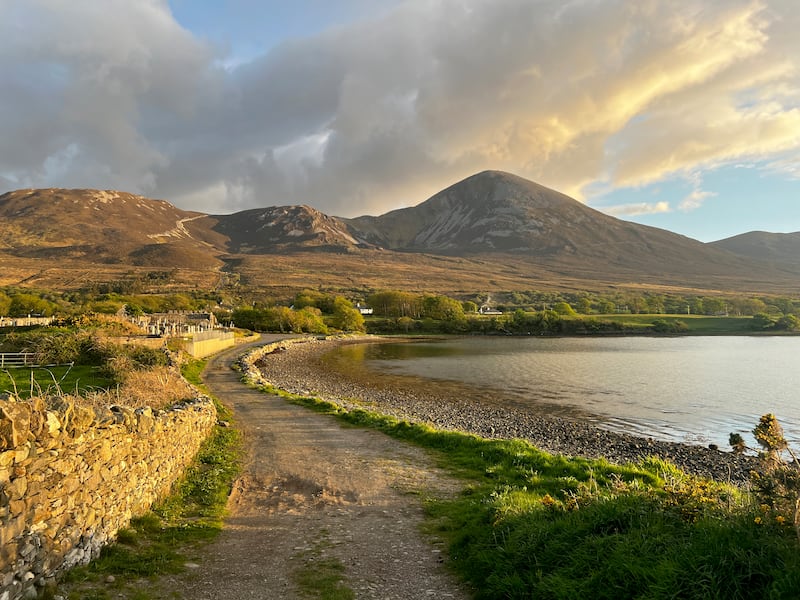 A view of Croagh Patrick from the beach at Murrisk, along the coast near Westport. This mountain is where St. Patrick prayed and fasted for 40 days. It’s a popular pilgrimage site. (Photo by Scott McMurren)
Near the town of Westport farther north on the west coast, we booked the Achill View B&B, just across a sheep pasture from the ocean. We didn’t know if was in the shadow of Croagh Patrick or St. Patrick’s Mountain. This is a revered pilgrimage site, visiting the mountain where St. Patrick fasted and prayed for 40 days. It’s a spectacular setting, although we opted to do our fasting and praying at sea level. Faithful followers erected a small church on top of the mountain.
There are several pilgrimage sites in Ireland, including the town of Knock. Here, in August of 1879, 15 residents of all ages witnessed a sighting of Mary, Joseph and John the Baptist which lasted two hours. After much investigation, the site was dedicated as a shrine and has welcomed millions of visitors and pilgrims since then.
Visitors can spend plenty of time in Dublin exploring the ancient sites and enjoying the pubs and restaurants in Ireland’s capital city. We caught a bus tour from there up to Northern Ireland, including Belfast and the Giant’s Causeway — a huge basalt outcropping on the north coast.
Even though Northern Ireland is part of the United Kingdom, there’s no passport stop or document check of any kind. But all the purchases are in pounds, where those in Ireland are in euros.
Finn McCool Tours offers a one-day tour, with an optional stop at the Titanic Museum in Belfast, an extra 20 pounds. The causeway is spectacular, with basalt columns jutting up from the sea. Quiggs, our guide, offered plenty of time to hike down and explore the site, which is operated by the National Historic Trust.
One of the highlights of the tour was Quiggs’ historic narrative of “the troubles,” which was essentially a 30-year civil war contesting British rule of Ireland’s northern counties. It’s a complex story of a long struggle, which echoes the Irish struggle for independence from Britain’s colonial rule in 1922.
Our brief tour only touches on a few places in this fabulous country. Maybe it’s time to make some discoveries of your own in Ireland.