
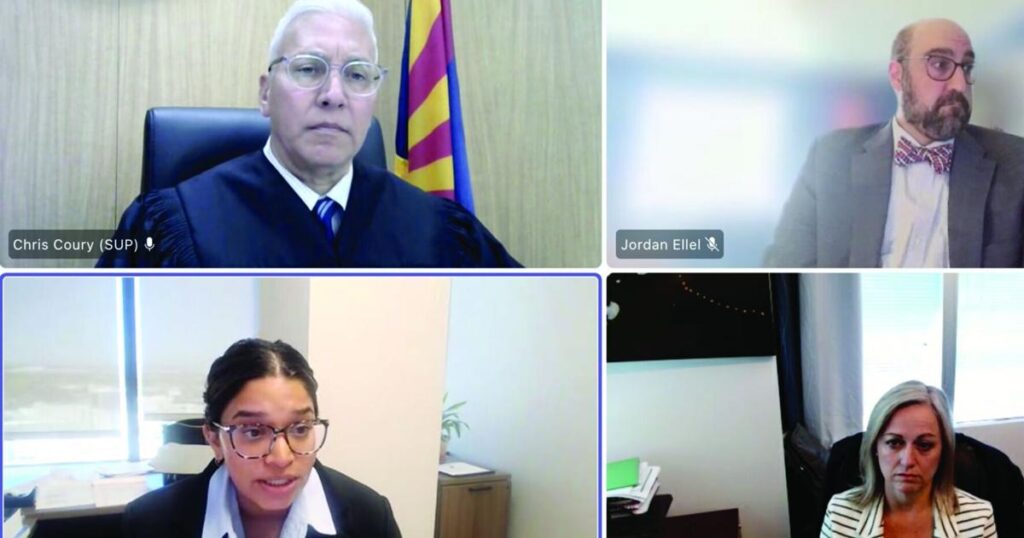
A Maricopa County Superior Court judge last week handed both the East Valley Institute of Technology and nine member school districts a partial victory in a closely watched lawsuit over millions of dollars in career-technical education funding while also signaling the legal and political battle is far from over.
The nine districts immediately declared the ruling a major win and accused EVIT of trying to retain increasing amounts of student-generated funding without sufficient accountability or transparency.
“This ruling validates what districts have said from the beginning: student-generated funding cannot simply be absorbed into EVIT’s rapidly growing administrative structure without accountability,” Tempe Union Superintendent Dr. Stacia Wilson said in a joint statement issued by the districts.
On the other hand, EVIT Superintendent Dr. Chad Wilson (no relation) said in an interview the judge “confirmed what I’ve been saying all along.
“We absolutely agree with what the ruling says, that EVIT can’t fund beyond what the programs cost.”
He also said, “I don’t know that this is a victory for anybody.”
Maricopa County Superior Court Judge Christopher Coury agreed with the districts on one major point: EVIT cannot keep career-tech money generated by district satellite programs unless the money is actually being used to provide related services.
But Coury also rejected the districts’ broader effort to force EVIT into specific intergovernmental agreements (IGAs) and declined to determine whether EVIT improperly retained money in past years because the factual record remains incomplete.
The ruling came in a lawsuit filed by nine EVIT member districts — Apache Junction, Cave Creek, Chandler, Fountain Hills, Gilbert, Higley, J.O. Combs, Tempe Union and Queen Creek — against EVIT, one of 14 CTE Districts in the state, each serving a group of school districts.
At the heart of the dispute is how tens of millions of dollars generated by EVIT satellite programs should be divided between EVIT and the districts that host many of those programs on their own campuses.
The IGAs include EVIT’s funding and supervision of satellite CTE programs serving over 26,000 juniors and seniors on the nine districts’ high school campuses.
Those districts also send about 8,000 high school juniors and seniors who attend EVIT’s two Mesa campuses for other CTE programs for half their school day throughout the year.
Three other districts belonging to EVIT – Scottsdale Unified, Mesa Public Schools and American Leadership Academy – long ago reached new IGAs.
The case could have major financial and operational implications because the funding involved exceeds $36 million annually.
Coury’s latest ruling noted, “At the time of the filing of the Complaint, it was alleged that negotiations had ceased and the parties were at an impasse. Since that time, it is undisputed that the parties agreed to a distribution of 96% of the funds for the 2025 fiscal year: 85% to the Districts and 11% to EVIT.
“The remaining 4% of the funds are being held in a restricted account, pending further negotiations.”
Under Arizona law, the state sends funding to EVIT based on student enrollment in those programs. Historically, EVIT then passed most of the satellite-program money back to the districts through intergovernmental agreements known as IGAs.
The districts argued EVIT was attempting to retain too much of that money while failing to clearly explain how retained dollars were being spent.
According to the ruling, the districts alleged EVIT at one point proposed keeping as much as 30% of satellite-program funding from at least one district.
The districts also claimed EVIT withheld nearly $8 million owed to member districts during the current school year and only recently released those payments. District officials further alleged some payments were inaccurate by amounts approaching $1 million.
District leaders portrayed the dispute as a dramatic departure from EVIT’s traditional relationship with member districts.
“For decades, EVIT operated as a collaborative partnership with its member districts,” Chandler Unified Superintendent Frank Narducci said in the joint release. “That changed when the very districts that created EVIT were increasingly treated as a funding source for administrative growth rather than as educational partners serving students.”
The districts asked the court to declare that EVIT cannot retain money beyond the actual cost of services provided, that it provide itemized accounting of what it pays for, and agree to new IGAs.
But Coury ruled state law limits both EVIT and districts, stating it limits how both EVIT and the districts can use the money.
“The Court agrees that this applies to EVIT,” Coury wrote regarding a statute stating payments for services cannot exceed actual costs.
But the judge said the restrictions apply to districts as well.
“In other words, both a district and EVIT are prohibited under Arizona law from entering an IGA that allows either party to retain any portion of the funding generated by enrollment in that district’s satellite CTE that is not used” to support career-tech programs or provide related services, Coury wrote.
The ruling also backed the districts’ demand for detailed financial documentation.
However, the judge stopped short of ruling whether EVIT actually violated the law in prior years.
“The Court declines at this juncture to surmise that a surplus exists,” Coury wrote, saying more factual development is needed before determining whether excess money was improperly retained.
Coury rejected the districts’ request for a declaration forcing EVIT to enter specific IGAs, noting Arizona law clearly gives both sides shared authority to negotiate those agreements.
“Any IGA / written agreement entered must specify (i) that payment for services shall not exceed the cost of the services provided, and (ii) a listing (itemized) of other goods and services that EVIT is providing to the District in connection with Satellite CTE programming that will be paid for by EVIT’s retention of funding,” he wrote.
“The Court is without authority, however, to direct a District and EVIT to execute an IGA. Nor does the Court have the authority to mandate the terms of the IGA.”
EVIT also filed new motions seeking to block the districts from spending more than $30 million currently sitting in special “Fund 596” accounts used for career-tech money.
EVIT argues those funds are legally restricted and can only be used for EVIT-related career-tech purposes and not programs the district creates without its approval and jurisdiction.
The districts disagree and contend the money is not restricted in the way EVIT claims.
The judge did not address that issue.
In a brief virtual hearing before Coury last week, attorneys on both sides acknowledged there currently is no agreement in place for the 2026-27 school year and that EVIT has not approved any satellite program for next year on those nine districts’ campuses.
That means districts could begin operating their own independent CTE programs outside EVIT’s authority – although EVIT argues in that case, it doesn’t have to pay for them.
The districts said they remain willing to work toward a collaborative solution but are evaluating how to continue offering career-tech courses without EVIT if no agreement is reached.
“Our priority remains exactly where it has always been,” Narducci said. “Protecting student opportunity, protecting graduation credit, and ensuring resources stay connected to the classrooms and programs serving students every day.”
During the hearing last week, Coury repeatedly suggested the dispute may ultimately boil down to a relatively straightforward legal interpretation of Arizona statutes governing career-tech funding.
He described the central issue as involving “the nature of the Fund 596 account” and whether those monies are legally restricted.
The next major hearing is expected in late June, shortly before the July 1 start of the next fiscal year.
The lawsuit carries enormous implications for career-technical education across the East Valley.
The districts argue they provide much of the staffing, facilities and operational support for satellite programs and therefore deserve most of the funding generated by their students.
EVIT argues state law created career-technical education districts specifically to expand and oversee specialized workforce-training programs and that the money cannot simply become unrestricted district revenue.
It does not appear as if the districts will enter joint negotiations before the hearing.
Asked whether any joint talks were likely, Chad Wilson said, “I have repeatedly asked to sit down with the districts individually.”