
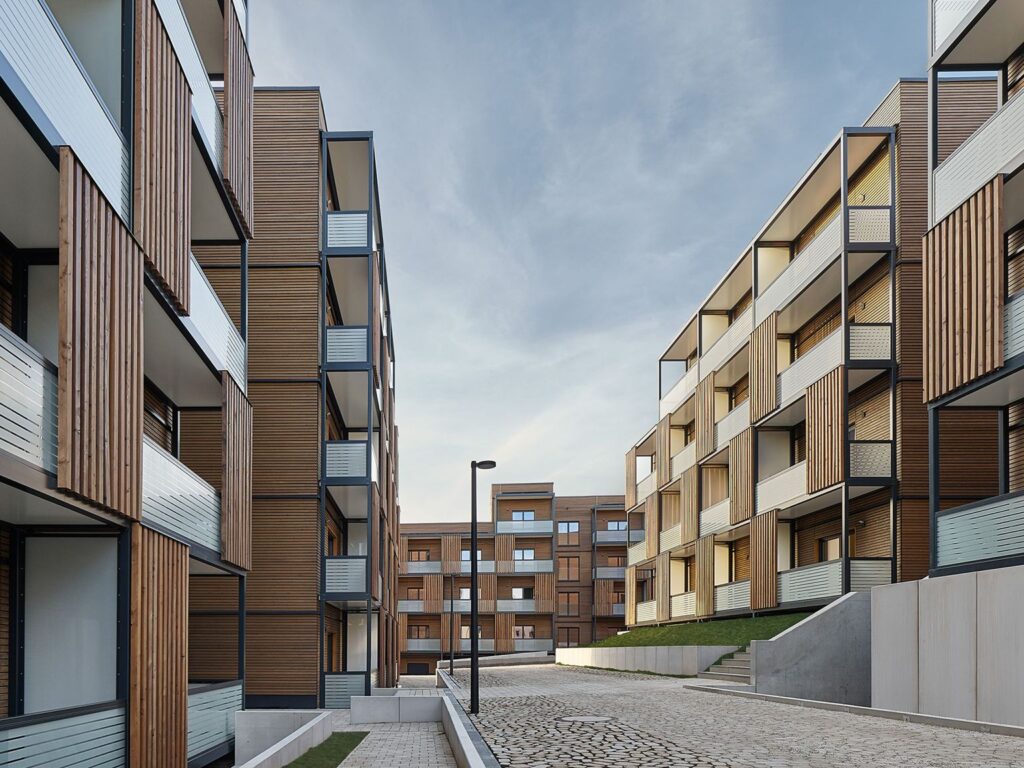
In a context in which it is estimated that there will be a need to build around 180 thousand houses in the next decade, any initiative that increases the sector’s responsiveness gains relevance. It is in this scenario that the partnership between the Portuguese BOND Systems and the European Unihouse arises, which promises to accelerate industrialised construction in the country and bring scale to a still limited market.
Currently, Portugal produces about 20 thousand new homes per year, a number clearly insufficient compared to demand. Industrialised construction emerges as one of the most efficient responses to this imbalance. The model, already consolidated in countries such as Germany, Sweden or the United Kingdom, is based on the production of modules in the factory that are then assembled on site, reducing construction times by up to 50% and significantly reducing material waste.
The partnership now announced seeks precisely to combine this international industrial capacity with local execution. While Unihouse provides technology, experience and production capacity, BOND Systems assumes integration in the Portuguese market, coordinating projects and articulating with national companies. The goal is clear: to create a faster and more efficient response for larger projects, without alienating local operators.
But despite the evident potential, the reality of the sector in Portugal shows that the problem is not only in the lack of technology or solutions. The industrialisation of construction is no longer a novelty. It exists, it is tested, and it works. The real challenge lies in its implementation at scale.
And here come the structural blockages that continue to hold back the sector. Lengthy licensing processes, lack of predictability, excessive bureaucracy and still limited coordination between public and private entities mean that many projects do not move forward at the necessary speed. Construction can be industrialised, but the system that frames it remains, in many cases, analogue.
Another critical point is the adaptation of the different actors in the sector. Industrialisation requires a different approach from the beginning: projects designed for factory production, greater integration between architects, engineers, and builders, and a cultural change in the way construction is viewed. Without this adaptation, the potential of these solutions is inevitably limited.
Still, there are positive signs. The entry of new players, international partnerships, and increased pressure to solve the housing crisis are accelerating change. Industrialised construction is beginning to gain space and to be seen not as an alternative, but as a necessity.
Portugal has the conditions to make this leap. It has capable companies, technical talent and a market that urgently needs faster and more efficient solutions. What is missing, once again, is not ideas or technology.
It is necessary to simplify processes, align entities and create an environment where these solutions can grow at scale.
Because in the end, building more is important.
But building better, faster and with a system that works is what can really change the market.