
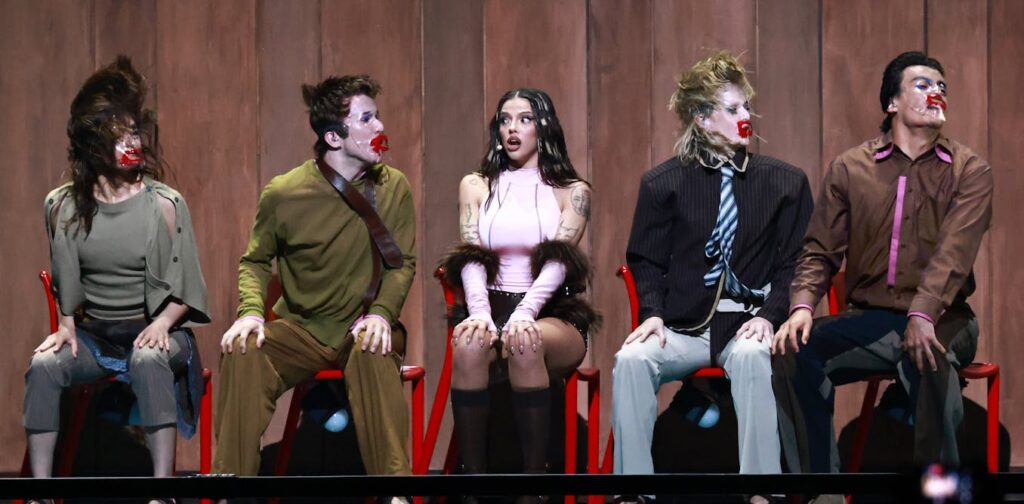
In a surprising turn of events, Bulgaria have taken home the crystal microphone trophy for the Eurovision Song Contest 2026 with Dara’s infectious dance hit Bangaranga.
It is Bulgaria’s first-ever win and all the more poignant given this year marked the country’s return to the contest after a three-year hiatus as its public broadcaster, BNT, has grappled with financial contraints.
Hosting Eurovision in 2027, while expensive, is expected to provide a welcome tourism economic boost.
Bulgaria’s win is the first time since 2017 the jury and public sentiments have been aligned. One tense moment during the voting saw Israel rise to first place thanks to the public vote, resulting in audible booing in the arena. However, Dara soared to the top of the board with 312 public votes to add to their 204 jury votes.
Bulgaria’s total of 516 points put it 173 points ahead of runner-up Israel, in the largest gap between first and second place in the contest’s history.
The bookmakers’ odds tipped Finland to win with Linda Lampenius x Pete Parkonnen’s duet of vocals and live violin, Liekinheitin. The fan favourites instead landed in sixth place.
Live instruments are not usually permitted on the Eurovision stage unless a case can be made that they are integral to the song’s artistry: it was argued successfully the violin was Lampenius’ “voice”.
Romania’s Choke Me by Alexandra Căpitănescu was another surprise favourite. Although she only gained 64 jury points, she came second in the popular vote (262 points) and third overall. It is the best outcome for a female-led rock act in the contest’s history.
In the lead-up to the contest, the song attracted some controversy, alleged to be “glamourising sexual strangulation”. In response, Căpitănescu stated, “The lyrics are about taking back control over anxiety and emotions that are choking you.”
Total eclipse of the heart
Australia’s entry was hyped by many as a potential winner. Even notorious Australia sceptic Graham Norton named Delta Goodrem’s Eclipse the one to beat.
Goodrem dazzled with Australia’s most ambitious staging since Kate Miller-Heidke’s 2019 performance. Dressed in a gown adorned with 7,000 Swarovski crystals, Australia’s golden girl was literally placed on a pedestal that ascended from a golden piano as she reached her vocal crescendo.
Australia placed second in the jury votes and ninth in the public votes to land fourth place. It is Australia’s second-best result, after Dami Im’s astounding second place in 2016.
Goodrem’s participation was partly funded by an Australian federal grant for international cultural diplomacy. Other recipients in the recent round include BlakDance Australia’s tour of the United Kingdom and Creative Australia’s support for Khaled Sabsabi’s Venice Biennale exhibit.
Goodrem’s funding underscores Eurovision’s usefulness for Australia’s cultural diplomacy and projection of “soft power”.
The inaugural edition of Eurovision Asia will be held in Thailand in November. Australia is not participating – the rules prohibit participating in both contests.
It remains to be seen whether Australia will stay in the original Eurovision or whether it will transition to Eurovision Asia in pursuit of regional diplomatic interests.
Broadcasters boycott
This year, Eurovision celebrated its 70th anniversary. But rather than uniting Europe (and Australia) through music, the absence of five regular participants indicated disunity.
Public broadcasters for Slovenia, Iceland, Ireland, Spain and the Netherlands withdrew from competition in protest of the humanitarian situation in Gaza and the European Broadcasting Union’s failure to have an open discussion and vote on Israel’s continued participation. While the contest claims to be non-political, critics point to the exclusion of Russia in 2022 after its invasion of Ukraine as a precedent.
Their absence is a blow to the European Broadcasting Union, financially and symbolically. Spain is usually one of the so-called “Big Five” – the five largest financial contributors to Eurovision. The Netherlands is also a large financial contributor but, more importantly, had been in the contest since the beginning in 1956.
The Dutch public broadcaster stated “participation cannot be reconciled with the public values that are fundamental to our organisation”. They cited humanity, press freedom and political interference as key reasons for their withdrawal.
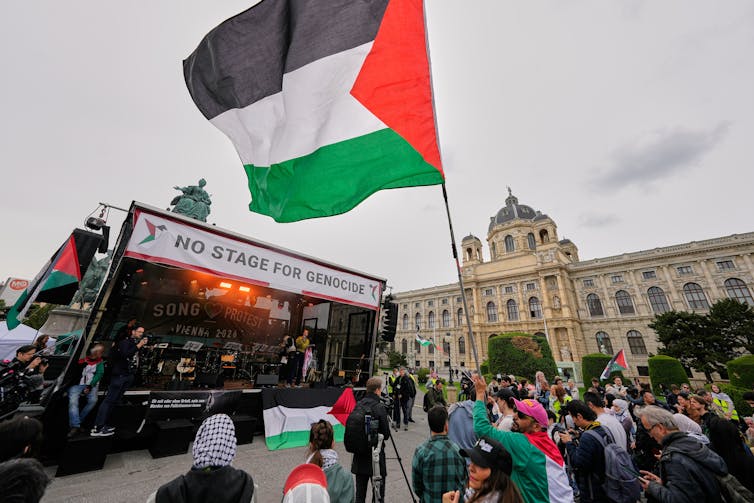
A song protest concert against Israel in Vienna, Austria, during the 70th Eurovision Song Contest week.
AP Photo/Martin Meissner
Broadcasters have also expressed concerns that Israel had attempted to manipulate public voting in other countries over the past two years. Slovenia led the call for a detailed report on the 2024 and 2025 voting results, but member broadcasters received only a summary of its findings.
Eurovision’s Executive Supervisor Martin Green stated the contest organisers were confident the 2025 contest yielded a “valid and robust result”.
Despite this claim, before the 2026 contest broadcasters voted on a rule change seeking to mitigate third-party campaigning and interference in the voting process. As reported by the New York Times, the disparity between the statements of the executives and the resulting vote from the broadcasters raised much scepticism.
A reckoning in 2027?
Just before the 2026 grand final, Belgium’s Flemish broadcaster VRT released a statement they would be unlikely to participate in 2027 without “a clear framework for participation, an open debate, and a direct vote among [union] members”.
The European Broadcasting Union must take broadcasters’ concerns more seriously or risk losing more participants and reputational damage. Its members are seeing a gap between their values as public broadcasters and those expressed by the EBU through its actions and decisions.
Without change, this global phenomenon may also risk not seeing its next milestone anniversary.