
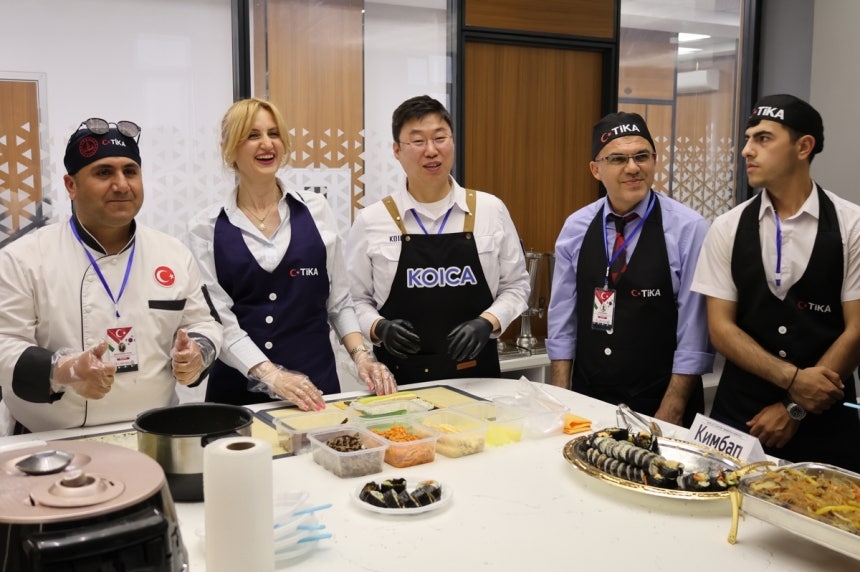
 Participants take part in a Korean cooking class during a joint training program hosted by the Korea International Cooperation Agency and the Turkish Cooperation and Coordination Agency at the State University of Tourism and Entrepreneurship of Tajikistan in Dushanbe on May 15. (KOICA)
 South Korea’s official development assistance agency and Turkish Cooperation and Coordination Agency jointly held a tourism education training program in Tajikistan last week, sharing their experience as major tourism destinations to help foster tourism professionals in the Central Asian country.
According to the Korea International Cooperation Agency on Monday, the program was held from May 12 to Saturday at the State University of Tourism and Entrepreneurship of Tajikistan in Dushanbe under the theme “Modern Approaches to Tourism Education.”
The initiative marked a rare example of two advanced official development assistance donor countries jointly carrying out a development cooperation project for a third developing nation.
Drawing on rich historical and cultural heritage, both South Korea and Turkey have established competitive tourism industries. According to 2024 statistics from the UN Tourism, Turkey attracted 60.6 million international tourists last year, while South Korea received 16.4 million. Tajikistan, by comparison, welcomed around 1.4 million foreign visitors, accounting for roughly 0.1 percent of global tourism.
Still, Tajikistan — sometimes dubbed the “Switzerland of Central Asia” — has increasingly drawn attention as an emerging travel destination thanks to its vast mountainous landscapes, which cover 93 percent of the country, including the Pamir Plateau, often referred to as the “Roof of the World.”
KOICA said the training program was designed to help Tajikistan build the foundation needed to develop its tourism sector into a sustainable industry with growth potential.
During the program, KOICA introduced South Korea’s tourism growth experience, industry trends and tourism education models. A hands-on Korean cooking class led by a chef from the South Korean Embassy in Tajikistan was also held as part of the training.
TIKA shared Turkey’s experience in developing its tourism industry and vocational education system, drawing on its own rise as a global tourism destination.
The program brought together 86 participants, including professors from Tajikistan’s national tourism university, instructors from tourism and hospitality vocational training centers under the Labor Ministry, and tourism industry workers.
Participants learned about global trends in tourism education, curriculum development methods and the economic and employment effects of the tourism industry, while also exploring tourism education models suited to Tajikistan’s conditions.
They also compared tourism development cases from South Korea and Turkey to discuss how tailored tourism education programs could be designed for Tajikistan.
KOICA said ideas discussed during the training could later be incorporated into broader economic development and job creation projects, while also exploring opportunities for South Korean companies to expand overseas in the tourism sector.
South Korean Ambassador to Tajikistan Jeon Sung-sik said the program was meaningful in that it created “a new model of cultural ODA cooperation” by sharing the experiences of South Korea and Turkey in culture-based industries.
“We hope this program will contribute to the development of Tajikistan’s tourism sector and help expand job opportunities for young people,” he said.
mkjung@heraldcorp.com