
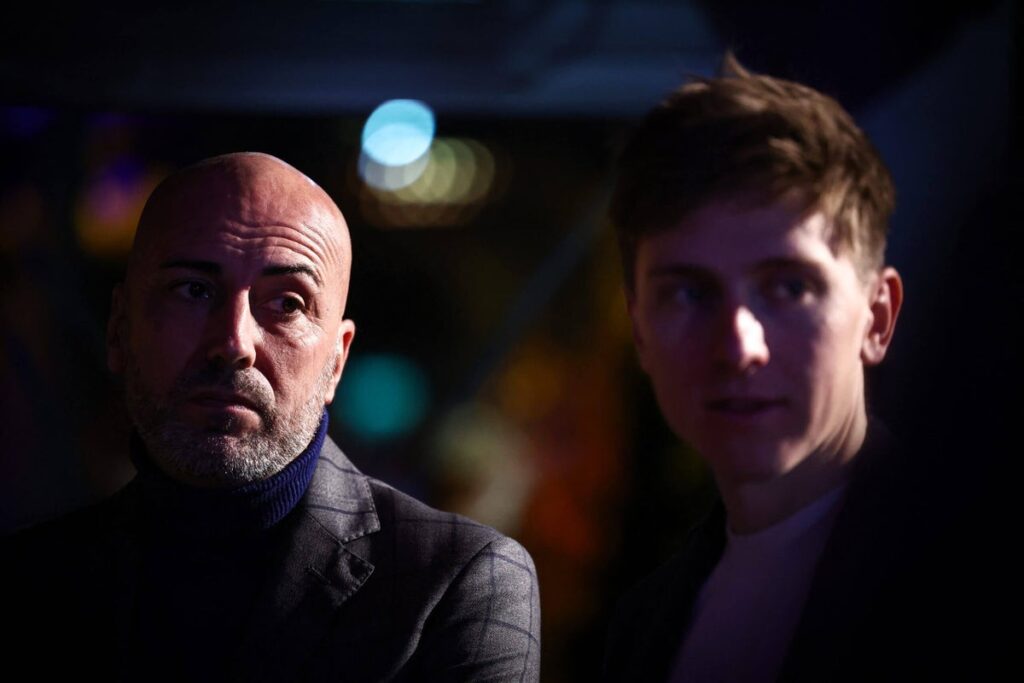
It’s a rest day at the Giro d’Italia today. While race leader Afonso Eulálio and the rest of the riders still left in the race sleep in before eventually going for a gentle two-hour recovery spin, those in suits meeting in hotel bars are getting down to business. Some riders need new homes; others need improved contracts. Plenty of deals need to be made.
“I’ve only got half an hour. After our call, I’ve got four video calls with four different teams,” Alex Carera, cycling’s premier agent, told The Athletic on the race’s first rest day last week, as the peloton and its huge convoy made its way from the start in Bulgaria back to the race’s homeland of Italy.
Previously, rest days at the Tour de France — held in July — were where hands got shaken and pens were put to paper. But around a decade ago, with teams eager to secure rosters before the summer, that shifted to the Giro. Nowadays, transfers and contracts are signed throughout the year, even if UCI rules state that they can’t be announced until after August 1. Nonetheless, the Giro is still abuzz with transfer talk.
“It’s true it’s a busy time of year right now, and the Giro, especially its rest days, are very important,” Carera, 50, explained. “But if you’re smart, you can find an opportunity to sign a good contract at any time of the year.”
Carera should know.
Since launching the A&J All Sports agency with his older brother Johnny in 1997, he has grown into the sport’s biggest, most powerful and most successful agent. The company represents more than 100 riders, including Tadej Pogačar, Jasper Philipsen, Isaac del Toro and Giro podium contender Giulio Pellizzari. In his near 30 years in the sport, Carera’s riders have won six Tours, six Giros, 44 world titles and 25 Monuments.
Of the 103 registered UCI agents, Carera is also the richest, pocketing five per cent of every rider’s contract and 10 per cent of additional sponsorship deals. When considering Pogačar’s €8.4 million (£7.3m/$9.8m at current rates) annual salary, plus his various private sponsors, Carera takes home around half-a-million euros a year from his star rider. It’s not quite the sums that his soccer counterparts walk away with, but Carera is undoubtedly cycling’s answer to the football super agents.
“If you want to be a good agent, you have to work 24 hours a day, seven days a week,” Carera says. “There is no Christmas, no first day or last day of the week. We have great responsibilities. And anyway, if you work with passion, every day you are on holiday.”
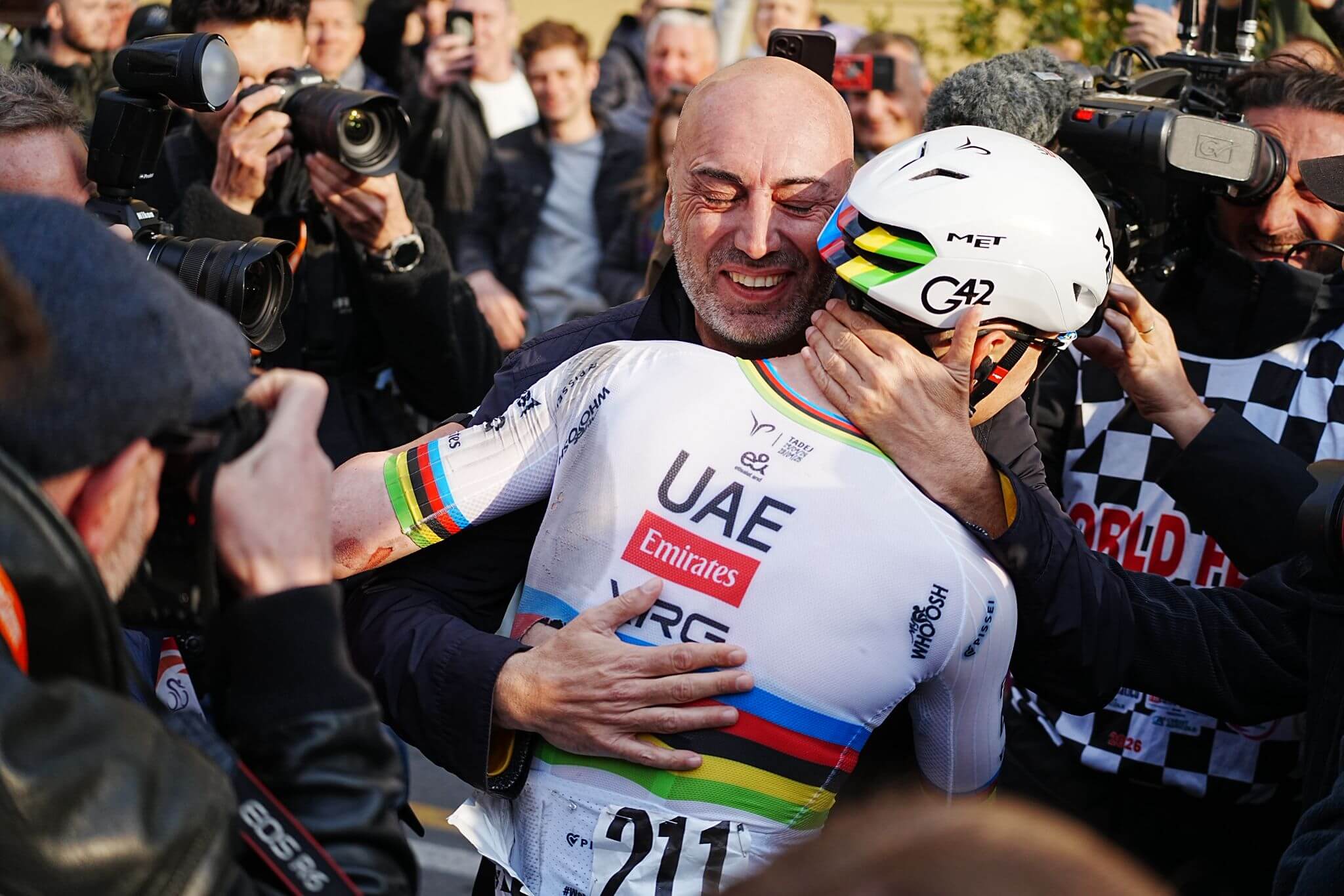
Alex Carera congratulates his most prestigious client after a victory. (A&J All Sports)
Whenever Pogačar crosses the line first, Carera is often among the first people to congratulate the Slovenian superstar on his latest victory. The photographers and TV cameras can’t avoid him. And believe it: the photobombing is intentional.
Carera is an efficient operator, trusted with dozens of multi-million euro contracts, but he’s also a brand, a character. Just check his Instagram out — his near-12,000 followers regularly heap praise on his judgement and successes and some even reply to his posts asking when he’s next visiting their country. He’s cycling’s only celebrity agent. “Of course I have a big ego,” the Italian says. “Otherwise I wouldn’t work 24 hours a day. My ego is my energy to stay at the top.”
It was at the age of 22 that Carera, inspired by the film Jerry Maguire in which Tom Cruise plays the role of an influential sports agent, transitioned from selling insurance to athletes to representing them. At the time, only around a handful of cyclists had agents. Today it’s commonplace, although not completely universal — Remco Evenepoel and Demi Vollering are represented by family members.
As well as cyclists, Carera dabbled with athletes from winter sports, swimming, athletics and motorcycling, but cycling was his passion, forte and expertise. “I understood it was better to stay in cycling and get to the top,” he says.
For a brief period, between 2016 and 2019, he was business and marketing manager at what is now known as Bahrain Victorious, having helped found the team. But the call of being an agent was too strong.
Today, he is the sport’s kingmaker, moving numerous pieces around the cycling puzzle, dictating the transfer policies of teams and having an oversized influence on the wider market. He has largely been responsible for the modernizing shift of handing out four-plus year contracts to the best cyclists, and for helping wantaway riders to seek pastures new mid-contract — something previously considered almost blasphemous in cycling.
His power and stature is best illustrated by a 2015 contract negotiation involving Fabio Aru, just months after he’d won the Vuelta a España. Discussions with Astana’s manager had reached an impasse but, outside the hotel where he was staying, Carera bumped into the team’s owner who invited him to a nearby nightclub.
“We spoke for three hours, through his translator, and around 3am, after three hours of negotiating, I picked up a serviette (napkin) and wrote down what we had agreed. ‘This is the document’, I told him. ‘We’ve found a deal’.
“We both signed it, we took a picture of it, and I sent it to Vinokourov in the middle of the night. At 8am, Vinokourov woke up and called me straight away. ‘But, f**k, this is the signature of the boss!’, he said to me. Yes, I replied, we found a deal in the nightclub, €1.5 million a year for the next three years. ‘OK, well, if the boss says OK, we sign it’.”
Today, a million-euro salary is the minimum expectation for cycling’s elite with around 70 pros in the men’s peloton thought to command one. UCI figures seen by The Athletic lists the median annual salary in the WorldTour at €350,000, with the big contracts pushing the average wage up to €654,000.
Pogačar, understandably, earns the most. Carera was first introduced to the Slovenian just weeks before his 18th birthday — it turned out to be the smartest recruitment of Carera’s long career. “We don’t always agree, and Tadej shares his opinion like I do, but he’s happy that his agent stays close to him not only when he’s winning,” Carera says.
Just this past weekend he was in Spain’s Sierra Nevada visiting Pogačar during a pre-Tour de France altitude camp. “It’s important to be with the rider as much as possible,” he says.
Spotting up-and-coming talent and future superstars is Carera’s most valuable strength. The latest rider he’s plucked from obscurity and who is now on everyone’s lips is the recently-crowned Vuelta a España Femenina winner Paula Blasi.
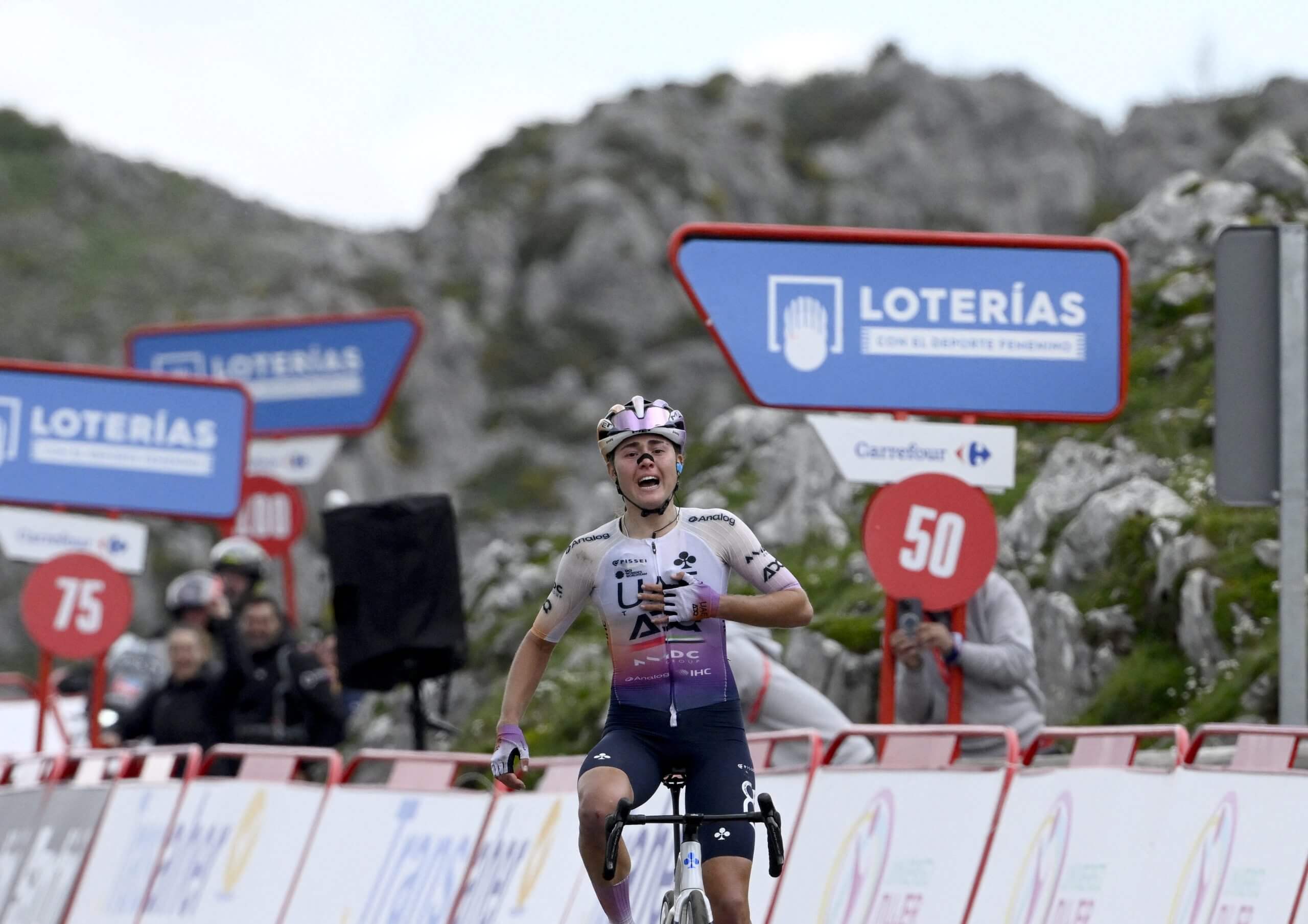
Paula Blasi won the Vuelta España Femenina earlier this month. (Miguel Riopa / AFP via Getty Images)
The 23-year-old Spaniard only turned professional with UAE Team ADQ 360 days before she won one of women’s cycling’s most prestigious races. Carera is now promising to make Blasi the first female rider to earn a million-euro salary. “That’s my goal because she is the future star of cycling.”
Finding prodigies is made easier today by Carera’s agency having 13 other agents in 10 countries working on their behalf, each tasked with dominating a specific country and market. Before that expansion, Carera relied on his cycling intuition.
“My father and brother were amateur racers, and from the age of three I was watching cycling,” he says. “From age three to 22, I watched 100 races a year. In 20 years, that’s 2,000 races.
“When you’ve been watching bike racing from the beginning of your life, you understand tactics. You also learn how to look beyond the race result and see with your own eyes a rider’s margin for improvement. If you know cycling, you can know in advance what will happen, and if you know what will happen you can move the game.”
Everyone in cycling, from the UCI’s powerbrokers to race organizers, and from brand managers to team directors, admires and respects Carera — but not everyone is friends with him.
He admitted that, at first, “team managers hated me because I was fighting to protect the career of athletes.” The landscape is different today: agents are woven into the fabric of cycling, and many teams need and rely on Carera. Other managers admit they put up with him.
His relationship with his peers is mixed. “With some agents I have a good relationship, a very respectful one,” he says. “Other agents not so.”
Last July, Carera left WARA, the association of riders’ agents, underlying his split with some of his colleagues.
“When you’re in the position I am in, every competitor wants to take your seat — that’s normal,” he says. “One day, one guy will take my place. But I want to work as hard as possible to keep it.”
At the end of every year, Carera hosts a party and padel tournament in northern Italy for his riders and the media. It’s the glitz and glamour he feeds off. He’s the only rider representative who cycling fans might be expected to recognise.
And when he speaks, people take note.
Recently, he caused minor uproar for suggesting that a Visma-Lease a Bike team car crashed into Pogačar on stage 18 of last year’s Tour de France, despite Pogačar stating he suffered a knee injury before the apparent incident. Carera also slammed efforts to monitor riders’ power files in an attempt to detect cheating, stating that “we do not have a doping problem”.
“Sometimes people like my opinion, sometimes they don’t,” he says. “Sometimes people don’t have the balls to say it. For this reason, journalists call and ask me. I only have one face.”
Probably the biggest change in working practices in the past decade has been cycling’s youth revolution, with young teenagers now being coveted by professional teams and agents recruiting riders at junior races. Cycling has belatedly caught up to how soccer, rugby, and American sports have been operating for decades, but it’s led to accusations of exploitation.
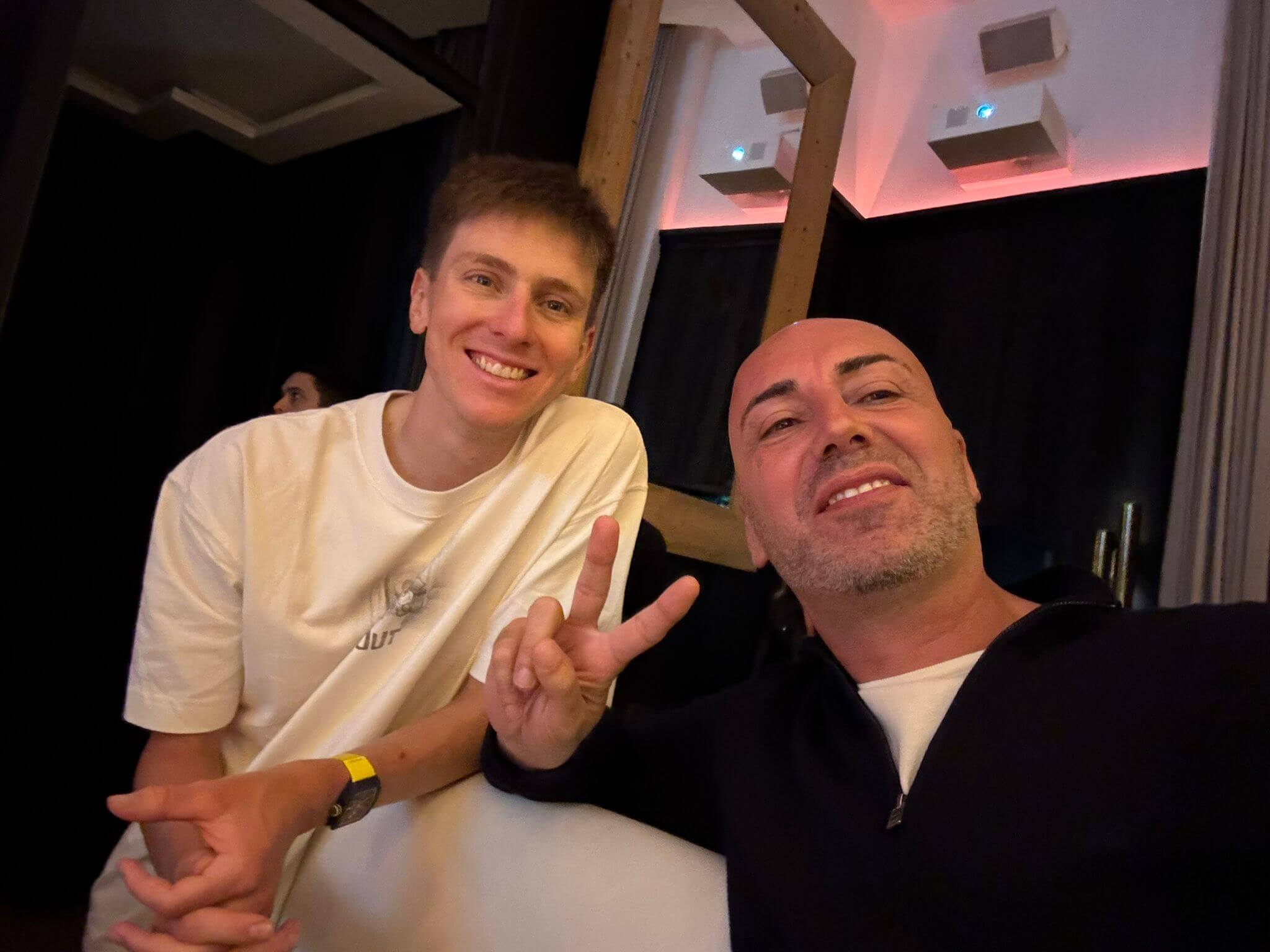
Alex Carera has helped modernize cycling’s contractual practices, including longer deals for the biggest names (A&J All Sports)
“We don’t sign riders until they become a pro,” Carera says. “We don’t take any money from them — we invest our time and our money into them and give our service for free. Ninety-nine per cent of parents understand and approve. The goal isn’t to make money but to help them achieve their dream.”
He used Eritrean star Biniam Girmay, who won three stages and the points jersey at the 2024 Tour de France, as an example. “The first time I saw Biniam, he was racing (for small French team) Delko. He had nothing. Now he has a big house in Spain with his family, and he’s inspired the next generation. That’s the work of a good agent.”
Recent success stories include Guillermo Thomas Silva, who won stage two of the Giro — Uruguay’s first ever Grand Tour stage win — and wore the leader’s pink jersey for two stages. “I first saw him when he was a neo-pro at Caja Rural and now he’s won a stage and been in pink — his life has changed completely. It’s a crazy story.”
The other stories Carera wants to help write in the coming years is winning the Tour de France with a fifth different rider. “Vincenzo Nibali, Chris Froome and Tadej have all won it, and I am sure in the next 10 years more athletes from A&J will win it,” he confidently predicted.
With our call now five minutes past the intended half-an-hour, Carera was in a rush to leave.
He had meetings to attend with key figures in the sport, contracts to sign. He told me one transfer he’s pushing to get across the line.
“Call me on next Monday’s rest day,” were his parting words, “and I’ll tell you if we have a deal or not.”