
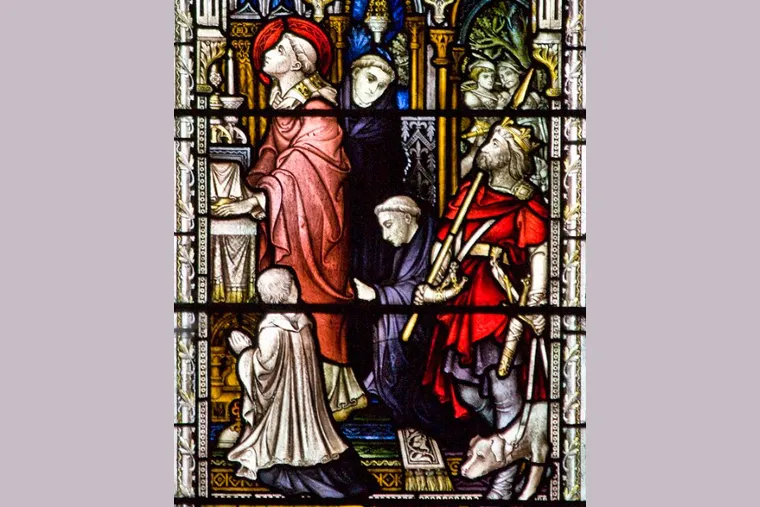
St Dunstan, archbishop and reformer, revitalised English monastic life and served four kings. Canonised 40 years after his death, his legacy includes the English coronation rite and enduring devotion throughout the centuries.
By Sam Linley, May 18, 2026 – EWTN Great Britain
Tomorrow is the feast of St Dunstan. He died at Canterbury on 19 May, 988, after nearly thirty years as archbishop. For most of the Middle Ages, he was reckoned the greatest of England’s saints, a place he held until the murder of Thomas Becket in the same cathedral, two centuries later.
St Dunstan was born around the year 909 near Glastonbury, into a family with ties to the West Saxon court. He was educated at the old abbey there, served a stint at the court of King Athelstan, and returned to Glastonbury as a monk. In 940, King Edmund appointed him abbot. From that abbey, almost single-handedly at first, he set about the reform of English Benedictine life.
In the previous centuries, England’s monasteries had decayed and discipline had loosened. Many houses had been hollowed out by Viking raids and royal indifference. With his fellow reformers, Æthelwold of Winchester and Oswald of Worcester, St Dunstan rebuilt the monastic structure of the kingdom from the ground up. The Regularis Concordia, drawn up at the Council of Winchester around 973, gave the English Church its first unified rule of monastic observance. The Benedictine houses we still pray in today, at Belmont, Buckfast, Worth, and Pluscarden are the direct result of St Dunstan’s work.
He served four kings: Edmund, Edred, Edgar, and Edward the Martyr, and lived to see the troubled accession of Æthelred the Unready. As Archbishop of Canterbury under Edgar, St Dunstan crowned the king at Bath in 973 with a rite which still forms the heart of the English coronation service. King Charles followed essentially the same liturgy at Westminster Abbey in 2023.
St Dunstan is the saint who, according to tradition, seized the devil by the nose with a pair of red-hot tongs as Satan tried to tempt him at his forge. He worked metal, drew, illuminated manuscripts, and played the harp. He was both a man of intellect and a man who knew how to work with his hands.
After his death, a cult of devotion to him began almost immediately. Just 40 years after his death, at the Synod of Winchester, he was canonised, and it was ordered that his feast should be kept on the 19th of May. His shrine at Canterbury became one of the great places of English pilgrimage until his relics were scattered at the Reformation, though both Canterbury and Glastonbury have since claimed them. His relics were scattered, but the inheritance was not. His rite still crowns our kings, his rule still orders our abbeys, and we still keep his feast day.
St Dunstan, pray for us.

Sam Linley is a staff writer and content creator for EWTN Great Britain.
Get EWTN Great Britain
in your inbox.
Post Views: 31