
Remoras are small suckerfish that cling to sharks, whales, turtles, and manta rays using a built-in suction disc on their heads. This allows them to basically hitch free rides across the ocean while feeding on scraps and parasites found on the surface of the marine animals.
Scientists have always treated the relationship between remoras and their free rides as harmless — perhaps even helpful in some cases. However, a new study suggests these underwater passengers may sometimes behave less like janitors and more like invasive squatters.
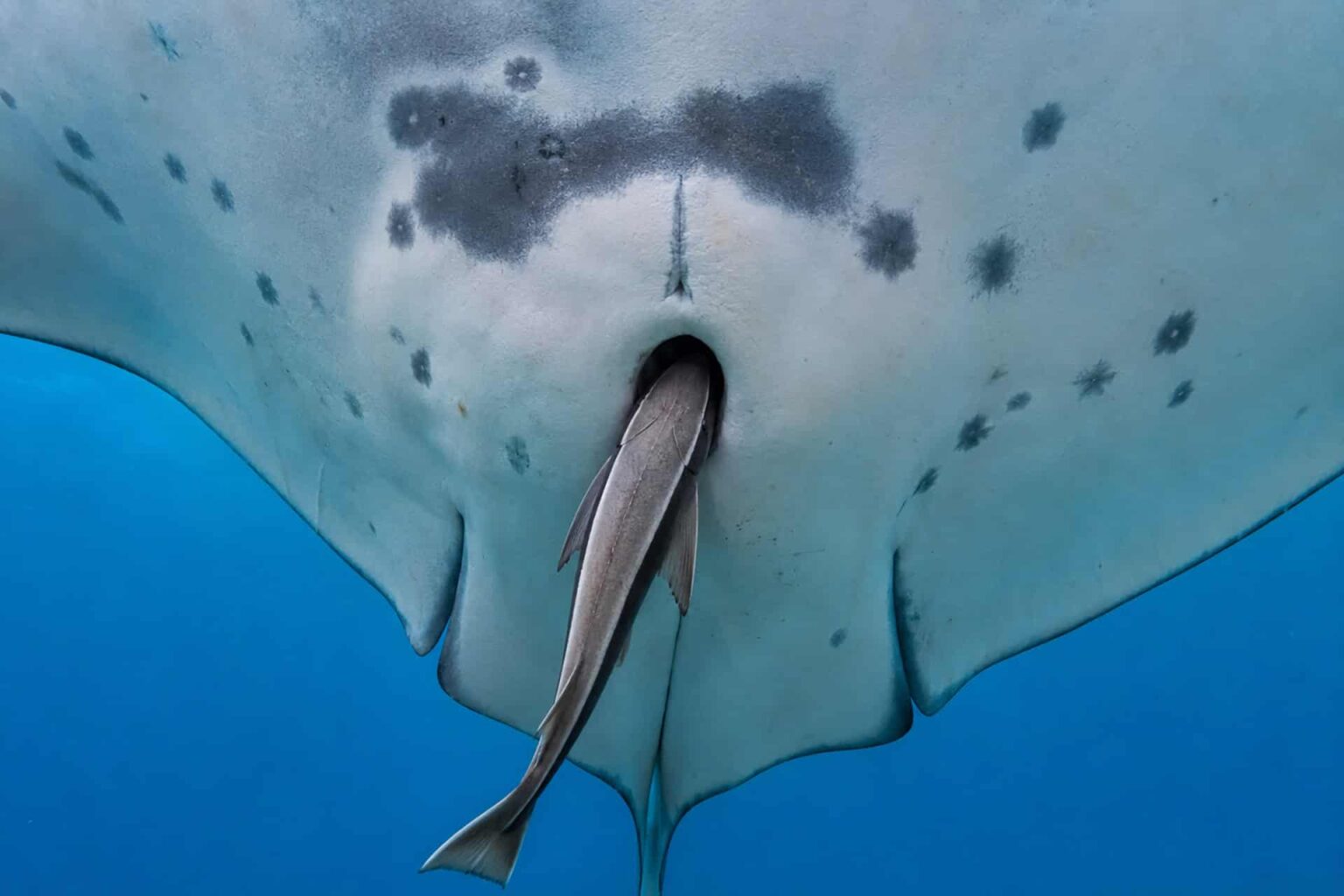
The study authors documented remoras slipping inside the cloacal openings and gill chambers of manta rays, exposing a hidden behavior that scientists almost never get to see in the wild. In one striking encounter recorded off Florida, a remora appeared startled by a nearby diver and suddenly vanished into the rear opening of a manta ray’
“In response to this intrusion, the manta ray briefly shuddered before continuing to swim away with the remora still inside of its cloacal opening,” the study authors note.
The discovery raises uncomfortable questions about whether remoras can sometimes harm the very animals they ride.
Remoras and manta rays are especially difficult to study in detail because both are highly mobile, and many of their interactions happen underneath or inside the body, where divers rarely get a clear view.
 Photos showing a remora entering a manta ray’s cloacal opening. Image credits: Emily A. Yeager et al./Ecology and Evolution (2026)
By combining 15 years of underwater footage and photographs gathered across multiple oceans, the researchers were finally able to uncover evidence of a behavior that had mostly escaped scientific attention.
To do that, the team analyzed manta ray survey records collected between 2010 and 2025 in the Maldives, Mozambique, and Florida. During these long-term monitoring programs, scientists used drones, scuba diving, freediving, and underwater photography to identify individual rays through their spot patterns, checking their health, and tracking population behavior.
However, buried inside thousands of encounters were a handful of strange images showing remora tails sticking out of manta rays’ cloacal openings or gill slits.
In total, the researchers identified seven cases of “cloacal diving” and one case of a remora lodged inside a manta ray’s gill structure.
Though that represented less than one percent of all surveys, the scientists believe the behavior may actually be more common than records suggest because the fish can remain almost completely hidden inside the animal. For instance, in many images, only the tip of the remora’s tail was visible.
Moreover, the behavior appeared in all three recognized manta ray species: Atlantic manta ray, Oceanic manta ray, and Reef manta ray.
“As these observations occurred in adult and juvenile hosts, in both the Atlantic and Indian Oceans, and across all three currently described species of manta ray, they highlight that remora cloacal diving behavior in manta rays appears demographically, geographically, and taxonomically widespread,” the study authors note.
From harmless passengers to possible parasites
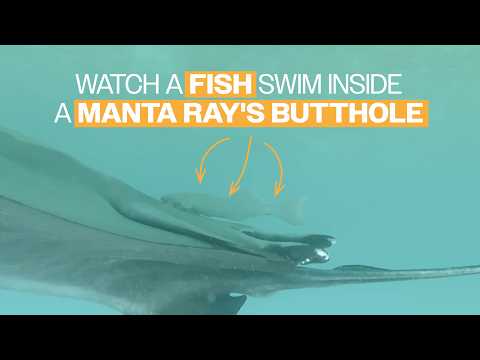
One video from July 2023 provided the clearest clue yet about why remoras may be doing this. A freediver approached an adult Atlantic manta ray from behind while a medium-sized remora hovered near the animal’s pelvic fins.
As the diver moved closer, the fish abruptly darted into the manta ray’s cloacal opening. The researchers suspect the remora may have been trying to hide from a perceived threat.
This discovery matters because scientists have long believed that remoras benefited, while the host was either unaffected or rewarded in return through parasite cleaning. However, this picture has become increasingly complicated in recent years.
Earlier research has shown that large numbers of remoras can increase drag in the water and force hosts to spend more energy while swimming. Other studies found that remoras preferentially attach to areas on giant marine animals where water resistance is lower, helping them conserve energy during long rides.
The cloaca is a highly sensitive opening used for mating, waste removal, and, in females, giving birth. Researchers warn that “the presence of a moderately-sized remora in a manta ray’s cloacal opening could impede mating behavior, live birth, or defecation if the cloacal diving behavior occurs for extensive periods of time.”
The study authors also documented a remora embedded deep inside the gill slit of an injured manta ray in the Maldives. Other rays showed scars and damage around the gills that may have been caused by previous remora attachment.
This possibility worries scientists because manta rays rely on delicate filter-like structures inside their gills to trap plankton from seawater while feeding. Damage to those systems could affect breathing and feeding efficiency.
Researchers also noted that manta rays appear to actively try to remove remoras. Previous observations have documented rays scraping themselves against sandy bottoms, breaching from the water, and flicking their fins in apparent attempts to shake the fish loose.
“This symbiosis is dynamic and likely exists on a continuum between mutualism and parasitism,” the study authors note.
Not all questions are answered
The research does not suggest remoras are always harmful. In many cases, the fish likely feed on parasites or leftover food without seriously affecting their hosts.
However, the findings are based on the largest dataset yet showing remoras entering manta ray cloacas and gill structures across multiple oceans. Together, the observations reveal that this famous marine partnership is far more complicated than scientists once believed.
The study authors still do not know how often this behavior occurs or whether it causes lasting damage. Hopefully, further research will provide answers to these questions.
The study is published in the journal Ecology and Evolution.