
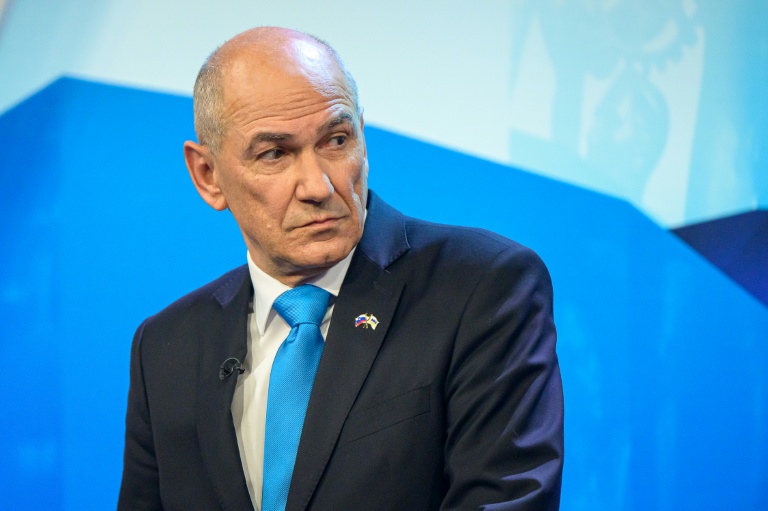
Slovenian conservative Janez Jansa, an admirer of US President Donald Trump, announced Monday he had reached a coalition deal to form a government, which could see the EU country retake an illiberal turn.
Jansa, a three-time premier who had frequent run-ins with the European Union during his last stint, sped up coalition talks after outgoing liberal Prime Minister Robert Golob announced last month that he had failed to form a government.
Golob’s party secured a razor-thin victory in March parliamentary elections over Jansa’s conservatives.
Jansa, 67, said his Slovenian Democratic Party (SDS) had reached a coalition deal with two centre-right parties — Christian democratic party Nova Slovenija and his former close ally Anze Logar’s Democrats — giving them 43 out of 90 seats in parliament.
He also has the support of five lawmakers from the anti-establishment party Resnica, which managed to enter parliament in the March vote, to reach a parliamentary majority.
“The conditions have been met for presenting the (prime minister’s) candidature. That will be done tomorrow,” Jansa told journalists on Monday after SDS leaders backed the coalition agreement.
The coalition programme includes among its priorities reducing taxes and forging a more efficient state through decentralisation and slashing bureaucracy.
“We will ensure a cheaper state but with better quality,” Jansa told journalists earlier this month.
Jansa has repeatedly criticised spending by Golob’s centre-left coalition government, while pledging to restore “Slovenian values”, such as the “traditional family”, and “close the (state money) pipe” to NGOs deemed political parties.
He also strongly criticised Slovenia’s recognition of a Palestinian state in 2024 and has defended the Israeli operation in Gaza, which the outgoing government has described as “genocide”.
A change in Slovenia’s foreign policy, in particular towards Israel, might be one of the first steps of the new government, according to political commentator Aljaz Bitenc Pengov.
“A shift in priorities regarding Israel and Palestine does not require any major (institutional) changes, it’s the easiest and quickest thing,” Bitenc Pengov told AFP.
Resnica leader Zoran Stevanovic said last week his party would “support Jansa’s candidature to become prime minister”, though it would not join the coalition, remaining “a fierce opposition party watching them closely”.
– ‘Won’t be stable’ –
Stevanovic was appointed parliamentary speaker last month with the backing of Jansa and his allies.
Bitenc Pengov said the compromises Jansa made to secure a majority in parliament do not promise a stable government.
“In terms of a parliamentary majority, they won’t be stable, and internally they won’t be stable either, primarily because of Resnica… and Logar,” Bitenc Pengov said.
Golob’s Freedom Movement (GS) has slammed Jansa’s coalition deal.
“We are getting a government voters did not vote for. It is the result of cheating, broken promises and manipulation,” the head of the GS parliamentary group, Borut Sajovic, said earlier this month, referring to pre-electoral promises by Stevanovic and Logar that they would not join a Jansa-led government.
The last days of campaigning ahead of the March 22 vote were overshadowed by claims of foreign interference, with authorities probing whether Israeli company Black Cube was behind secretly recorded videos alleging graft in Golob’s government.
Jansa — who faced accusations his party was linked to the videos — has admitted to having met a Black Cube official, but denied being behind the videos.
During his third mandate as prime minister until 2022, Jansa drew protests at home, with critics accusing him of attacking media freedom and the judiciary and undermining the rule of law.
bk/jza/jhb