
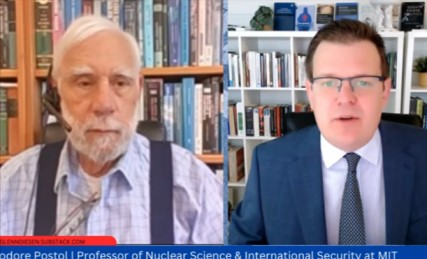
The internal domestic debates are complicated. Totally unpredictable. And it’s hard to know when and if the people who would like to proceed to build nuclear weapons will prevail in the internal debate. It could happen anytime. So we just don’t know.
But the point of importance is to ask ourselves what the alternative world would look like if we don’t take the effort to reach a negotiated understanding with the Iranians, who I want to underscore again, want to do this.
So the first point I’d like to make is just to point out a few — can you see that slide?
GLENN DIESEN: Yes, it’s up now.
Iran’s Capacity to Build 10 to 20 Nuclear Weapons
THEODORE POSTOL: Slide is up now, okay. There are a couple of basic points that I’ve already touched on but are worth emphasizing. And the first is that Iran can produce really 10 or 20 atomic weapons. This is a different statement than is commonly said today.
The general wisdom is Iran can produce rapidly — we’re talking about rapidly — from the 440 kilograms of uranium hexafluoride that is 60% enriched. The common wisdom is 10 nuclear weapons, but there’s an underlying assumption in those estimates that the atomic weapons that Iran would produce would take 25 kilograms of highly enriched weapons-grade uranium. But they don’t need 25 kilograms of highly enriched weapons-grade uranium to build an atomic bomb. They only need 14 or 15. It has to do with the design of the weapon.
That’s because it’s possible — in fact, when you look at the situation from a technical point of view, it seems almost certain — that if you were Iranian and contemplating rapidly producing nuclear weapons, you would not produce a weapon of the kind that’s being talked about. You would produce a weapon with a surrounding sphere, a hollow sphere of uranium-238 surrounding the 15-kilogram core of weapons-grade uranium.
The reason you would do this is this external sphere of uranium-238 has two beneficiary effects from the point of view of a weapon. First of all, it reflects neutrons back into the core of the weapon, which allows you to use a smaller amount of uranium-235 to build a weapon. So you only need a smaller critical mass. And if you have a smaller critical mass, that means you have more uranium-235 to build weapons with. So that’s point one.
The other point is that the uranium reflector is very massive. It’s quite heavy. And because it’s so massive, when an atomic bomb built in this way is undergoing rapid development, rapid energy release as it goes supercritical, if you can delay the expansion of the weapon by several hundredths of millionths of seconds — in other words, to slow up the expansion by a very small amount of time — you can get a considerably higher yield, because more of the critical mass will undergo fission before the weapons-grade uranium disassembles.
So you get two benefits. The cost is a higher weight, but as I’ll show, the higher weight is such that you could easily build and fly this weapon. The weapon that you would build would have dimensions and a weight that could easily be flown on an existing tested long-range missile that has typically been used to deliver conventional explosives to Israel.
So you not only have the weapon if you choose to move forward, but you have a delivery system that could deliver this warhead by ballistic missile. Now, the only thing you would have is the question of reliability of the ballistic missiles, and they seem highly reliable. Because the ballistic missile defense in Israel is near useless.
I should probably — I won’t be presumptuous — but there’s another talk I should be giving perhaps in a week or two that shows that the Patriot system has been absolutely unable to intercept Iranian ballistic missiles, just near zero capability. So it’s a very reliable delivery system in terms of a ballistic missile attack. And I have data to show this. I want to underscore this — the data I’ve collected.
The IR-6 Centrifuge and Iran’s Growing Enrichment Capacity
In addition, it turns out that information released by the International Atomic Energy Agency, when analyzed properly, leads to the conclusion that the efficiency of the IR-6 centrifuge is 2 or 3 times higher than what people have been generally assuming, including me, because I have not analyzed — it’s a very complex job analyzing exactly how much one of these centrifuges can produce in the way of enrichment.
But it’s a very important conclusion, because it means, for example, that Iran could potentially — could actually quite easily — produce 1 or 2 atomic bombs or more per year from natural uranium after they weaponize to, let’s say, 17, 18, or 19 weapons rapidly with the 60% enriched uranium. So we’re looking at a major, major nuclear weapons state, if something cannot be done to encourage them to not do this.
Now, this situation should not be alarming, because if you’re reasonable, you will understand, as I’ve already explained, that the Iranians want to negotiate. They don’t want to put themselves in a position where they’re surrounded by potentially hostile nuclear-armed weapon states. It’s not only Israel that’s their concern.
So you have a situation where they’re extremely interested in negotiation. They’ve demonstrated, by joining the Joint Comprehensive Plan of Action in 2015, that they will take very severe restrictions on their enrichment program and work within them. So we have all of the ingredients for a solution here.
No Choice But to Negotiate
And basically, my policy point is very simple. You have no choice but to negotiate. If you don’t negotiate, you’re going to have a very powerful nuclear weapons state at some point. That’s your choice. Try anything more military, or keep up the military pressure, you’re eventually going to drive the Iranians to a point where they make a decision to build nuclear weapons — and they have the capacity to build a boatload of these things and continue to increase their arsenal. So this is not a difficult choice in my view, if you’re being in any way rational.
So what has changed in my assessment? Why am I even more negative than the last time I gave this negative assessment? Well, the fact is that the gas centrifuges that are key to the technology that Iran needs to building atomic weapons are likely to be more numerous and more capable than people have been believing.
So for example, here is a table from the Institute for Science and International Security, and they have outlined the number of centrifuges produced over a few months at a time, up until the June 22 “Midnight Hammer” attack, which did so much damage to the Iranian program. Not fatal damage, but did significant damage. Up until that time, the Iranians were producing 450 centrifuges per month.
Now, a 174-centrifuge cascade is the baseline that the Iranians are using. They can couple a couple of these centrifuges together and build a combined centrifuge of 348 centrifuges, and they have demonstrated the capability to do this, as I’ll show you. The International Atomic Energy Agency reported this. I discovered this quite by accident when I was reviewing one of their reports. Perhaps if I were smarter, I would have seen it earlier.
But the point here is that this is not speculation. This is a capability that is clearly demonstrated by the production that is reported by the International Atomic Energy Agency, and I’ll explain that shortly.
So the amount of uranium you need to build a bomb — you can see the cursor, right?
GLENN DIESEN: Yes.
Iran’s Nuclear Weapons Capability: Technical Analysis
THEODORE POSTOL: Yeah, okay, good. The amount of uranium to build a bomb might be as much as 55 kilograms. That’s if you just have nuclear material and you just put together a ball of uranium metal that’s 90% enriched. You would need a bare sphere of uranium metal. You would need about 55 kilograms of this metal to build a weapon.
Incidentally, if you had 83.7% enriched, I’ll explain what that means. You would maybe need 60 kilograms or 65 kilograms. 83.6 is the number that traces of uranium-235 enrichments to 83.6% or 7% were found in the Fordow facility. So there were traces, very small traces, but it certainly indicates that the demonstrated capacity to come very close to weapons grade without having demonstrated 90%. People assume 90% usually.
Now, if you go down to what’s called a 10-centimeter reflector of uranium, you’re down to maybe 20 kilograms. So it’s my— actually, I should say I made a mistake here. It’s really 20 kilograms as I’m talking about. You can do better with a beryllium, a 10-centimeter beryllium sphere, but you have to be able to work with beryllium. There’s good evidence that the Iranians do know how to work with beryllium and that they have beryllium, but I’ll focus on these two possibilities: 20.5 kilograms of 90% enriched or 14.1 kilograms.
Gun Assembly vs. Implosion Weapon Design
So if we just look at how you would go about doing this, well, you would take these materials and you would put together a bomb. In this case, this is a diagram from the Encyclopedia Americana. And you’re not trying to compress this material. If you have a spherical explosion to compress the material, you could use less uranium metal to build a bomb. But the implosion mechanism is complex, and even with all the modern technology that’s available, you would want to test this weapon.
In the case of using a weapon design that uses more uranium, but you still have enough to use it, what’s called gun assembly — in this case, you have a uranium sphere, it’s got a borehole in it, and you have these two sections of cores of uranium, weapons-grade uranium, and you just explosively put them together. This would be a working weapon. And assembling it would not be a complicated task. It would not be a complicated task. The timing of the explosives is not demanding, unlike the case with the spherical explosion. And none of the technologies you wouldn’t have already in hand if you’re Iranian. I mean, this is as straightforward as you get.
And if you’re under threat, all these arguments that people make about implosion weapons, things of that type — this is silly. You’re under threat. You have this resource. Best is the enemy of good enough. What you’re going to build is a simple weapon.
Criticism of the Bulletin of the Atomic Scientists
You know, some of these statements from like the Bulletin of the Atomic Scientists, which is the big organization for misinformation on this — they may just put out a little thing saying, “Oh, they can’t build a weapon.” I don’t know where they got this from. It’s hard to believe how this organization continues to publish misinformation the way it does. It is a club. It is a social club. They have really almost no expertise in this organization and they don’t do anything about it.
I had a long discussion with the CEO and president and she showed no interest in understanding what I was talking about. None at all. It was really quite amazing.
Dimensions and Weight of a Gun-Assembly Weapon
Anyway, let me just give you a sense of what the dimensions and weights of — you know, these are obviously conceptual drawings — but if you wanted to build a uranium weapon, here’s the 55-kilogram core. It’s maybe 25 or 30 centimeters in diameter. I should have put the numbers in there. And if the core gets somewhat smaller, it goes down to 20.5 kilograms rather than 55, and the surrounding uranium-238 weighs quite a bit. It’s like 350 kilograms if it’s a 10-centimeter reflector.
Now, this is not necessarily a bad thing because the overall weight of components is under 350 kilograms. So if you needed another 100 kilograms of equipment — fusing devices, electronics, packages to hold things in place — you could easily build a weapon that weighed 450 kilograms, which is well within the range of any of your long-range missiles to carry.
This has the advantage that if you know how to work with uranium metal, which you have to be able to do already if you’re making uranium cores, then you know how to work with uranium-238. U-238 is the same thing as U-235 from the point of view of the mechanical properties and dealing with it. So you have all of the technology in hand. There’s nothing exotic about these technologies.
Beryllium Reflector as an Alternative
If you want instead to go to a lighter weapon with a 10-centimeter or more beryllium reflector, you could do that, but you have to work with beryllium, which incidentally does not mean it’s not a capability that the Iranians don’t already have. They could well have this capability. The advantage would be you would have a much lighter weapon because the reflector is not this fantastically heavy material. It’s a very light material, beryllium.
But why do you need all this lightweight — if you’re going to put it on a ballistic missile and you can carry it, why not go the way of uranium? At least this is my speculation, because the uranium is a massive material that delays the expansion of the critical mass when it goes supercritical, and you’ll get more yield on the weapon. So anyway, this is just my guess.
The W33 Artillery Shell: A Real-World Example
But if you want to see an example of a nuclear weapon, it’s useful to see — I found this diagram. I should say that it is almost certainly secret restricted data according to the U.S. Atomic Energy Act. Somebody stole this, copied this classified design. I don’t know who they were, but it’s out in the open. And this is the W33 artillery shell, which has a yield between 1 and 40 kilotons, depending on what you choose for the yield.
Now, how does it work? Well, first of all, it has a little gas bottle in it. So this is not something the Iranians could do at this time, because the gas bottle would contain deuterium and tritium gas mixture. And obtaining the tritium is a big industrial effort, and the quantities needed are almost certainly not available to Iran. I could be wrong on that. If that’s the case, then you’re in worse trouble.
But what you do is you control the burst of neutrons that go into the assembled critical mass by putting different amounts of deuterium and tritium gas into this bottle. So if I want a low yield, I don’t put any deuterium and tritium gas in there. If I want a very high yield, I put in a lot.
How the W33 Achieves Variable Yield
And what happens is when the artillery shell is fired, there’s a ring of uranium metal, weapons-grade metal, and there’s a slug, an annular slug of weapons-grade material that by the deceleration — this is, remember, an artillery shell — it undergoes a very large acceleration initially, and then as it flies, it undergoes a very large deceleration from the aerodynamic drag. And so what happens is this annular metal ring falls into place creating a critical mass that’s just short of what’s needed to get a nuclear yield.
But then you have this slug that, when the time is right, you’re going to have an explosive charge that drives it into this cavity here. And as it goes into the cavity, it’s going to crush up this container of deuterium and tritium gas. The temperature is going to rise very rapidly as the critical mass neutrons are given off. Eventually the temperature reaches tens of millions of degrees Kelvin. The deuterium plus tritium gas ignites in the thermonuclear reaction, and deuterium and tritium fuse into helium-4.
And when they fuse into helium-4, they give off neutrons, and the neutrons are very energetic. These are not — a typical neutron given off from a uranium nucleus is maybe a million electron volts. These neutrons are 14 million electron volts, and so when these enter the critical mass of uranium around them, they just smash uranium atoms. They don’t just undergo — they just get splated, they get splashed, and you get a tremendous growth in the number of neutrons. And that, of course, tremendously increases the yield. And it looks like this design is capable of 40 kilotons, which is quite a good yield.
Conclusion: Iran’s Demonstrated Capability
So if you just want to see the dimensions of the weapon that I just showed you, the uranium weapon, you can see it’s 30 centimeters. This is not an unmanageably large device. It’s not hard to see how you could put this onto a ballistic missile. So anyone who’s telling you that the Iranians can’t do this, and who knows anything about the technology they’ve already demonstrated, is smoking banana peels. I don’t know where they get this idea from. I mean, it’s—
GLENN DIESEN: these—
Iran’s Nuclear Capabilities: The Technical Reality
THEODORE POSTOL: This country has the ability to build nuclear weapons, and those nuclear weapons would be very reliable, and they don’t necessarily need to test them. This is what you ought to be thinking about when you’re talking about driving them into a mindset where they feel they have no choice but to proceed. Where even though they recognize it’s in their best interest to not build nuclear weapons, they decide that you are posing such a threat that the balance of bad decisions moves them in favor of deciding to build nuclear weapons. That’s the big problem.
Just to give you a little bit more sense of size, this is the nuclear package that would go into the shell here. And what I’ve done is through the magic of graphics, I’ve just pulled out that thing and pulled out that package and I showed you how neatly it fits into the artillery shell. So none of this is magic from the point of— I mean, it’s magic if you want to do this in your garage. That’s true. But if you’re a nation-state with a tremendous capability that Iran has, this is straightforward. That’s the point.
Iran’s Centrifuge Capabilities: What the IAEA Reports Show
Now, the gas centrifuges is the other critical technology here. And we know they have gas centrifuges. And what the International Atomic Energy Agency reported in an extremely interesting report. Let me just show you the report. This report is from 2025. Looks like it’s August 2025, and it’s the verification and monitoring of the Islamic State, and released in March 2025.
Now, if we go up, here’s what they’re talking about. This is 174 cascade of centrifuges that the Iranians would have demonstrated. They’ve been working with them at the Fordow plant. Now, a simple rule is that each of the separative work units produced by each of these centrifuges adds linearly with the number of centrifuges. It just happens— that’s one of the reasons why separative work unit is used, because it’s such an elegant way to characterize the enrichment capability.
So if you have 174 of these and the centrifuges have one separative work unit per centrifuge, then the cascade, assuming the efficiency is well put together, and that’s a big complicated task, has to be done through experimentation and adjustments. So, but if it all works well at the theoretical limit, you should be able to get 174 separative work units per centrifuge. If you can get 10 separative work units per centrifuge, then you should get 1,740. 5, of course, you get half of that.
What the Iranians were experimenting with was using 2 of these. They take one of these units and they take the enriched uranium and they put it into the feed of another centrifuge, and then they come out with a product. And the experiment they were doing was feeding 20% in one end and producing 60% in the other end. Fair enough. And they were doing this, the International Atomic Energy Agency was watching them. Incidentally, they also demonstrated 3 cascades together.
Measured Output: Far Beyond Previous Estimates
So what does this mean? Well, here is what they reported, that when they use the— so this is what they’re reporting, the Iranian production. This is not theoretical now. This is not a guess. The guess that is currently circulating, including the guess that I was using, was that the current Iranian IR-6 centrifuges are producing between 3.5 and 7 separative work units per centrifuge. And there’s a lot of play in there because people have been trying to analyze this mechanical device without real experiments. You don’t have the experimental data.
So here’s what the Iranians showed the International Atomic Energy Agency. They took 20% into this double cascade, and they produced 34 kilograms of uranium hexafluoride per month at 60%. 34. Well, what does that mean? Well, we know that it takes— I won’t go through the arithmetic here. Basically, if we look at the number of centrifuges, if you take 112 kilograms of 20% enriched uranium, you need 400 separative work units to get 37 kilograms of 60% enriched. So you need quite, not enormous amount, but 400 or so.
Just to put it in perspective, if you start with natural uranium, you need 5,500 separative work units. So there’s a lot of work that’s already been done. So you need about 400 separative work units to take 112 kilograms of 20% enriched uranium and produce 37 kilograms of 60% enriched.
So since that’s the number that comes out of some arithmetic I did, we divide 34 by 37 because we’re really talking about 369 separative work units to produce 34 kilograms of 60% enriched uranium. Well, there are 348 centrifuges. So if we just— this monthly amount, since we’re working on a month basis, we multiply by 12 months. That tells us what these two cascades together can produce in separative work units. 4,440 separative work units. That’s a lot. That’s almost a nuclear weapon.
And so we’re talking about the centrifuges producing 12.75 separative work units per centrifuge. That is much bigger than what people were thinking. That’s almost 3.5 to 4 times the capacity of the lowest estimates. So we’re talking about a tremendous capacity on the part of the Iranians to produce nuclear weapons if they choose to.
The Bottom Line: 10 to 20 Atomic Bombs
So the bottom line is very simple. Even a top-level American policymaker should be able to understand this. Iran has the technology and expertise to build between 10 and 20 atomic bombs quickly. We have a cascade of 348 centrifuges that can produce 4,437 kilograms of SWUs per year.
As I noted, let me just remind the audience that the enrichment process is accelerating. So for example, the example I used in my earlier discussion was sugar mixed in water. And I said, well, it turns out it’s not a bad parallel, it’s not exactly correct, but it’s close. Assume that I’m able to boil off 10 units of water during every cycle. This is an arbitrary choice, but I have 10% sugar in a sugar water solution. So each separative work unit of effort brings me to higher and higher enrichment of sugar. And as I get down to higher enrichments, I have a much more concentrated solution and I’m still being able to remove about the same per separative work unit. So when I get down to 50%, the last effort is very small. So when I’m talking about 60% enriched uranium, I’m talking about a fairly small amount of effort.
So if I have a 348 cascade of IR-6 centrifuges and 4,437 SWUs per year produced, and I only need 120 SWUs to get 25 kilograms of enriched uranium, that’s 1.4 weeks. That’s a short time. So that gives me 38 kilograms per bomb, so I need 38 kilograms for a bomb. I have 40 kilograms of enriched— this is uranium hexafluoride, so I have 10 or 11 bombs. If I instead start with 68 kilograms to produce 14 kilograms, this is just a range, then I need 5 or 6 days. So if I need to produce 20 kilograms, maybe it’s 7 or 8 days. So I can produce between 15 and 19 bombs depending on which design I choose.
So you’re talking about a very, very substantial weapons capacity relative to what people have been talking about. The final conclusion is very simple. Iran has the technology and expertise to build between 10 and 20 atomic bombs quickly. We’re talking weeks, maybe it takes months because some of the equipment has to be brought together. We don’t know. But we’re not talking years by any means.
The Bulletin of Atomic Scientists: A Dangerous Misrepresentation
This statement out of the Bulletin of Atomic Scientists is complete nonsense, and it’s reckless of them to suggest that this is a non-problem. The reason I’m underscoring this, just to be clear with you, Glenn, is if I tell you something, if you’re a decision maker and I tell you this is not a problem, I’m your technical advisor, then you say, okay, I don’t have to worry about this. This is not something I need to be contemplating. So this is not a minor error on the part of the Bulletin. This is major.
And they go around telling people they’re experts, and they go around propagating false information. Since I’m not feeling polite today— nonsense. They propagate nonsense. And they misrepresent themselves as experts. They don’t do any work, and they irresponsibly present an incorrect picture to the public. And to many people in Washington who make the mistake of thinking these guys know what they’re talking about. So this is a problem.
Diplomacy Is the Only Rational Path Forward
The upside is that the Iranians don’t want to become a weapon state. They know it would undermine their national security. So you have two things that are important points that lead to the same conclusion. One is they have the technology. Two is they don’t want to use the technology if you give them a way out. Simple enough. You can take a kindergarten child and show them how, and go through the choices together and they will always make the right choice. So what’s wrong with these geniuses in Washington? What is wrong?
You need to use diplomacy to help the Iranians to do what is in everyone’s common interest. It’s in everyone’s interest. If they eventually decide to go ahead and build nuclear weapons, this will be a security nightmare for Iran, Saudi Arabia, Turkey, Egypt, the Gulf states, Israel, and the United States. So what are we talking about here?
And these arguments that the Iranians are likely to use nuclear weapons against Israel is also ridiculous because the Iranians understand— and we see they’re rational. We have no reason at all. All of the evidence, every piece of evidence we have shows that they are extremely rational and deeply thought through on these issues. They understand that if they use a nuclear weapon on Israel, it’s the end of Iran. They understand that. There would be a nuclear retaliation. So they’re not going to do it.
So let them stay a nascent nuclear weapons state. It’s not the best outcome, but it might actually be the best outcome because the Israelis have a government that’s totally crazy. I don’t know what this Israeli government is willing or able or capable of doing. Part of the reason I’ve given these talks showing what Iran could do to Tel Aviv if they attack Tel Aviv is because I want Israelis to understand that you don’t get away free if you do that. It’s going to be the end of Israel too.
So let’s everybody calm down, start thinking rationally, and step away from the precipice here because this is a really bad situation. And that’s pretty much the points I want to make. So I haven’t convinced you? No. Okay.
GLENN DIESEN: Can you bring down the slide?
THEODORE POSTOL: Yeah, I’ll bring down the slide. Sure. Okay.
GLENN DIESEN: Now you have convinced me.
The Case Against Military Solutions
THEODORE POSTOL: Yeah. No, I know. But I think the scale of their capacity is considerably higher. I mean, one nuclear weapon is enough. I mean, if you have one nuclear weapon, I’m going to be very careful dealing with you. If you have two, I’m going to be much more careful. The argument that Colin Powell made with the North Koreans, “it doesn’t matter one or two,” that’s not correct from my point of view. Two is a big difference from one, because these things are unbelievably devastating.
But when you’re talking about 20 versus 10, and the potential capacity as this standoff goes on to produce a couple more every year while the standoff is going — if you make the decision to move ahead, that’s what you’re potentially looking at. So you’re looking at an extremely well-armed state surrounded by states that are going to be well-armed too. And for what? Who is better off in the end? What kind of environment, if you’re Israeli or Saudi Arabian or Iranian, is this for the future security of that region?
It’s like a no-brainer. You have to be devoid of intellect to not see that this is the only solution. This is the solution. I mean, if you show me a military solution, then we can talk about it. I’m not one of these people who’s opposed to military solutions when there’s no other choice. Military should be the last thing you do. But if you need a military intervention, I’m not one of these people who’s going to say no if I really think it’s serious enough.
St. Augustine convinced me. There are situations where things could be bad enough that the immorality of war is justified because what is happening is so immoral. The problem with the St. Augustine criterion is that you don’t know that the military intervention you’re going to try to stop this greater evil will not get out of control and cause yet a greater evil in the end. You’re hoping that you can stop an evil with a lesser evil, and you can’t predict. That’s very difficult to do in war.
But I’m not philosophically opposed or fundamentally opposed to military force. I think it should be only the last resort. Only the last resort. But here it’s no option. It’s not an option. It’s just that simple.
Find a military officer who knows what they’re talking about. You can get Petraeus there — he’ll tell you anything. But you talk to a responsible military officer, they’re going to tell you — if someone says, “Let’s do it, I think we can do it,” get one of these guys like Kellogg maybe. Show me. It’s like when people — I was involved in doing nuclear war planning. I know where the ground zeros were. I was there. I was in the computer programs where we laid these weapons down. I’m not some high policy guy who just saw the chart with a big red color, “major attack option.” I saw what was going on in detail.
Now, when somebody tells me, “Oh, we should have more nuclear weapons,” my first question is, how are we going to use them? Show me how we’re going to use them. I know how to use them. I’ve been there. I’ve been in the planning. Show me where we’re going to lay these weapons, how it is going to increase our military capability in a way that could in any way meaningfully increase our national security. If you can show me that, I’m interested.
I generally think that we’d be all better off without nuclear weapons, but they exist. These people make these arguments and they don’t know anything. They haven’t thought about it. So General Kellogg, explain it to me. I’m just a poor guy, a silly guy who was an advisor to the Chief of Naval Operations and knew where the ground zeros were. So explain it to me. That’s my approach to these things.
The Impossibility of a Military Solution Against Iran
GLENN DIESEN: I just think that’s a great point, because even if we’re all on board for some reason that yes, it’s reasonable to attack Iran to prevent it from acquiring nuclear weapons — let’s say the intelligence did show they’re trying to get nuclear weapons, which it’s not, and let’s say they’re quite irrational with the weapons, which also no indication that they are — but let’s just say this is the objective. I would, as you say, I would like to see the plan. Exactly how is this going to work?
Because the Iranians have the know-how, they have the material. So the only way you can prevent them from developing nuclear weapons now seems to be the complete destruction of Iran. And if that’s not on the table, that’s not likely or achievable, then any attack on Iran will only increase their need to develop a nuclear weapon. Which is why I think now the diplomacy is even more important than before the war, because now the US and Israel created even greater incentive for Iran to develop this nuclear deterrent. And this should be the key lesson from—
THEODORE POSTOL: Yeah, it’s just — a kindergarten child, if you laid out the choice in this way to them, would always make the right choice. I mean, it’s just that simple. You don’t have the ability to do it this way. You do have the ability to do it that way. Which do you choose?
GLENN DIESEN: But every time they go to war, they get a piece of candy — more moral argument for why the other side is bad. And they go into a description of the character of the government, for example. But again, what is feasible? Because I saw 20 years in Afghanistan to replace Taliban with Taliban. We saw the knocking out of Iraq, which only aligned the country towards Iran instead of balancing it. We saw destruction of Libya, which is now a horrible mess and security problem for Europe. There’s Syria, which used to have some stability — now we have an ISIS leader we are aligned with. None of these things have been successful.
So I would like to know, given that we’re attacking a country which can develop nuclear weapons, I would want to see a certain plan exactly how this is going to work, not sloganeering.
Racism, Rationality, and the Nuclear Debate
THEODORE POSTOL: Yeah, I’m not a social scientist, so feel free to pull me up short. But this has always struck me — that American nuclear debate, a lot of American debate over nuclear weapons and their potential use, has an underlying racist character.
I don’t know if you remember, Les Aspin was the Secretary of Defense when we had this disaster in Africa, the Black Hawk Down incident. And he started this outrageously racist debate that was carried on in the American Congress for years. The debate was about, “Are other countries rational enough to be deterred? Are they rational like we are?” What are you talking about? You mean the people who are brown and yellow somehow don’t understand?
You have a female cow with a calf and you go near that calf, you’ll understand what deterrence is. And that’s a cow. It’s not a bull, it’s a female cow. How stupid can you be? How much of a narrow ethnocentric perspective can you have to think that other people are not rational? Maybe you’re not the one that’s rational — that you think you’re so ignorant of the intellect of human beings in other countries and their cultures and their ability to understand what’s important, that you think they don’t understand what’s in their national interest.
It’s not in their interest to attack the United States with nuclear weapons. All this discussion — Trump is saying, “Well, the Iranians could attack us with nuclear weapons.” What? They won’t attack the Israelis with nuclear weapons, I can assure you, because they understand the consequences. Attack the United States with nuclear weapons? You’re talking about bringing hell to earth. What is he talking about? This country is not a nuclear threat to the United States.
People say, “Well, maybe they’ll smuggle something on a ship.” Right. And when the forensics shows it came from Iran, you see a green glass parking lot where Iran used to stand. It’s just so ridiculous, this debate that is supposed to be among people who claim to be experts in national security policy.
If your adversary is truly suicidal, there’s nothing you can do, and there’s no reason to believe that if your adversary is white and European or black and African or whatever, that they’re irrational. The most irrational, serious irrational leader that I’m aware of who could have destroyed his country is Hitler. If he had nuclear weapons at that time and we had nuclear weapons, he probably would have used them. When Germany lost the war, he told Albert Speer, “Go out and destroy the country. Germans should no longer survive. They failed their test as the super race and they deserve to die.” And Speer just didn’t do it. He didn’t follow the Führer’s order.
But Stalin would have never used nuclear weapons. Stalin was a brutal, murderous guy. Mao Zedong? No. So what are we talking about here?
The Real Nuclear Danger: Accidents and Instability
The big problem is mistake. That is the big problem. And the more nuclear weapon states you have, and the more weapons they have, the more chance something happens in some unpredictable way that leads to nuclear weapons being used — potentially at a very small level, but leading to the kindling of a massive exchange very quickly. That’s the real problem.
That’s why I was wasting my time talking to the president of the Bulletin of the Atomic Scientists, because they published an article that basically talked about a false alert that occurred in 1995 in Russia. And they got everything wrong. Everything. It was incomprehensible.
This woman calls me up when I wrote her about it — I had sent her materials — and she hadn’t read any of the materials, and she starts asking me to explain. And I went ballistic. I said, “You call me up and you don’t take the trouble to read even the 5-minute summary I sent you along with the hours of materials? And you want me to treat you like you deserve to be respected?” And she says to me, “Well, you know, I’m busy.” I’m glad you’re busy. You’re running this journal and you’re promulgating false information that is critical for decision-making that could lead to an accidental nuclear war. And you don’t think it’s important enough.
It was a pretty amazing discussion. At one point I said to her, “You realize that this exposed an instability — a particular problem with the Russian early warning system. This exposed an instability that is still there today and could, if the wrong circumstances came together, lead to a catastrophic nuclear exchange.” So she says to me — and I’m quoting — “Well, I’m concerned about any instability.” So I said, “Well, are you concerned about this instability?” She says, “Well, I’m concerned about any instability.” I said, “Can you tell me that you’re concerned about this instability?” And she just repeated herself a third time.
This is the level of curiosity and professionalism of the CEO and president of the Bulletin of Atomic Scientists. If anybody here is from the board of the Bulletin, please call me, because I have a lot to say about this organization. I think it’s an organization that can do good things, but right now it’s doing damage. That’s my view.
The Danger of Labeling Iran as Irrational
GLENN DIESEN: Well, thank you for that. It is frustrating to see some of the expert class drifting a bit. But I think this is a very important issue — the whole dealing with nuclear proliferation. Because on the rationality issue, I think this is one of the most dangerous things. That assumption that the Iranians are these irrational, crazy people — indeed, that’s built into our language as well. We can’t even refer to Iran. We’re talking about “mullahs” and all these efforts to just make them sound as irrational as possible.
And also the whole calculation — if we do know now that they have an incentive to acquire nuclear weapons, they don’t want to develop nuclear weapons.
THEODORE POSTOL: Yes.
GLENN DIESEN: So they know that this will then spread across the region, diminish their security. There’s a good place for a deal here. And still the goal is, “Well, let’s try to bomb them a third time. Maybe this time we’ll get lucky.” I mean, you can’t make it up, but there we are. Well, any final thoughts?
Patriot Missile Defense: A Critical Assessment
THEODORE POSTOL: Yes. I’m going to be in Warsaw giving a talk on the Patriots’ performance up until now, from the Gulf War of 1991 to now, and it’s not going to be positive. And I have data to back up the findings, and I think people ought to be thinking about this, the substance of this talk, and I’d like to give it again on your show at some point, because we’re now talking about replenishing the depleted supply of Patriot interceptors so that the Israelis can defend themselves against the missiles that these interceptors can’t engage.
So we’re talking about an outlay of billions of dollars to replenish supplies, with missiles that really can’t perform against the ballistic missiles that could be used to attack them. So that’s something that the American taxpayer ought to be aware of. And certainly the Israelis should be aware of it, because if one of those weapons, if one of those missiles coming in are carrying a nuclear weapon sometime in the future, they can’t stop it. They will not be able to intercept it. So anyway, that’s something, another food. I seem to be the bearer of bad news, but anyway.
GLENN DIESEN: Someone has to. Well, thanks again.
THEODORE POSTOL: Thank you. Take care.
Related Posts