
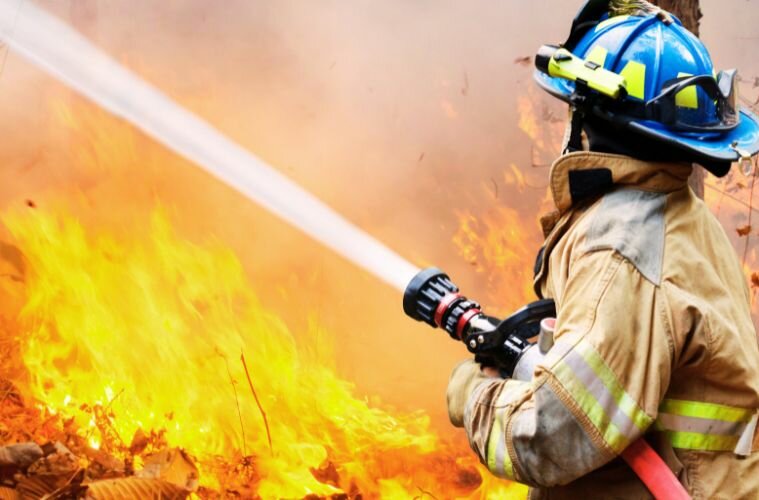
When a wildfire burns near a transmission corridor, physical damage is the obvious risk. The less visible risk is what smoke and ash contamination do to high-voltage infrastructure across a much wider area. In Alberta and British Columbia, that contamination risk now extends the effective disruption window well beyond what fire proximity maps show.
Canada’s 2023 wildfire season burned over 18.5 million hectares, an area larger than the combined landmass of all Atlantic provinces. The infrastructure consequences of that season, and the 2024 and 2025 seasons that followed, have been studied closely at the equipment level. What is getting less attention in operational planning conversations is the mechanism by which wildfire activity degrades grid performance without a single tower being touched.
A March 2026 review published in Frontiers in Energy Research compiled two decades of research on wildfire and smoke impacts on transmission systems. The findings are relevant to any industrial operation in western Canada with a summer operating plan. Ash and smoke particles that settle on high-voltage conductors and insulators reduce the insulation’s electrical performance, increasing the probability of arc faults and flashover events. Thermal stress from heat in fire-adjacent areas causes conductors to sag, which elevates the risk of contact failures and can trigger automatic protective line tripping. Those trips can propagate through neighboring lines operating near capacity. The grid can degrade from a distance.
How Smoke and Ash Contamination Degrade Transmission Infrastructure Beyond Fire Proximity
The mechanism is not complicated but it is frequently underestimated. Smoke particles carry conductive material that coats insulator surfaces. As particle concentration accumulates, the insulator’s ability to withstand the voltage difference across it diminishes. Under certain humidity conditions, that contamination layer becomes conductive enough to allow current to flow along the surface, creating a partial discharge or full flashover. The result is an automatic trip of the affected line.
What makes this operationally significant for industrial facilities is the geography involved. A facility located 200 kilometers from an active fire can be within the smoke plume for weeks. Alberta Electric System Operator (AESO) and BC Hydro both track transmission line performance against regional fire activity. The reliability disruption window associated with wildfire seasons is not bounded by fire perimeter maps. It extends with the plume.
Alberta’s Grid Reserve Margin Heading Into Summer 2026
During Alberta’s 2024 cold snap, AESO’s grid reserves fell to approximately 10 megawatts at peak stress. The entire province’s grid buffer, at that moment, was smaller than what a single large industrial facility draws in normal operation. BC Hydro provided 300 megawatts through the one functioning intertie linking British Columbia (BC) and Alberta near Cranbrook to help stabilize the system. That event was a winter stress scenario, not a fire-season one. It demonstrated how little margin the Alberta system operates with when conditions are difficult.
The BC-Alberta intertie has been operating well below its rated capacity. Eastward electricity transfers dropped to roughly 25% of the line’s capacity in recent years, according to BC Hydro records. In December 2024, Alberta’s Minister of Affordability and Utilities directed AESO to restore the intertie to 950 MW, which is 79% of rated capacity, by the end of 2026. That restoration is underway but not complete. Alberta has also recently joined an interprovincial-territorial agreement to strengthen grid reliability and energy security across Canadian provinces, and has launched a new wildfire mitigation strategy specifically designed to protect critical infrastructure during fire seasons.
Holdover Fires From 2025 and What the 2026 Season Outlook Means for Operations
Holdover fires, which survive winter by smoldering underground in organic matter and peat, were present in both BC and Alberta heading into the 2025-2026 winter. These fires can re-emerge in spring when soil dries and oxygen reaches the burn zone. The BC and Alberta wildfire outlook for spring 2026 is shaped by above-normal snowpack in some areas, which reduces early fire risk but increases flooding potential. The pattern from recent seasons is that the effective fire season is starting earlier and ending later than historical models predicted, and that holdover fires provide an ignition source before seasonal precipitation has dried out.
Alberta is conducting a two-day emergency response exercise in 2026 specifically to test coordination between wildfire and grid disruption scenarios. The fact that this exercise is being conducted is informative: the convergence of those two risk categories is being taken seriously at the provincial government level.
What Industrial Operators in Western Canada Should Review Before Peak Fire Season
Facilities that rely on a single transmission feed, or that use the BC-Alberta intertie as a backup path, should understand that the intertie is operating at constrained capacity and that the winter cold snap event demonstrated how quickly Alberta’s reserve margin can narrow. Substation inspection protocols for operations in fire-adjacent regions should account for smoke and ash contamination as a maintenance trigger, not just proximity to active burns.
The operational planning question is specific: does the Q3 operating plan account for a degraded-grid scenario in Alberta or BC, and has facilities leadership mapped which production processes cannot tolerate an unplanned interruption lasting hours to days rather than minutes? AESO issues grid alerts when emergency reserves are being drawn down. An organization receiving one of those alerts for the first time during peak fire season, without a pre-established load prioritization protocol, is making decisions under time pressure that a relatively brief planning conversation could have resolved months earlier.